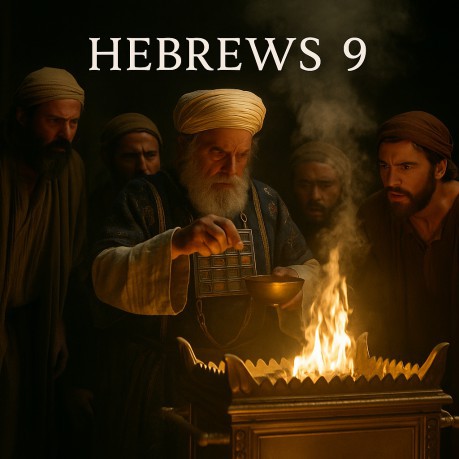
Hebrews 9 Hebrews 9:1 † The old covenant was detailed with laws for
worship and a physical sanctuary. Its focus was outward and
temporary. The contrast with Christ is that His covenant is inward,
spiritual, and eternal. Hebrews 9:2 † The lampstand and bread represented light and
provision. Christ fulfills both as the Light of the world (John 8:12)
and the Bread of Life (John 6:35). Hebrews 9:3-4 † The ark held three great symbols of God's
covenant dealings. Christ fulfills them all: manna as true bread,
Aaron's rod as resurrection power, tablets as the Law completed in
Him. Hebrews 9:5 † The cherubim symbolized God's presence and
the barrier of sin. Hebrews turns our attention to Christ, the true
mercy seat, who removed that barrier. Hebrews 9:6-7 † This restricted access showed that the old
covenant was limited. Even the high priest had to offer blood for his
own sins. Christ, by contrast, entered by His own blood once for
all. Hebrews 9:8-9 † The veil signified closed access. Only Christ
would open the way into God's presence. Hebrews 9:10 † These outward regulations never touched the
heart. They lasted only until Christ, the true reformer, came. Hebrews 9:11-12 † Christ's sacrifice was once for all. The
earthly priests entered yearly, but Christ entered the true heavenly
tabernacle with His own blood and secured eternal redemption. Hebrews 9:13-14 † Animal sacrifices only cleansed outwardly,
but Christ's blood cleanses the conscience. The Spirit was present in
His offering, making it eternal. Hebrews 9:15 † Christ's death redeems sins committed under
the first covenant and secures the eternal inheritance. The Law
pointed to this redemption but could not provide it. Hebrews 9:16-17 † Christ's death inaugurated the new covenant.
Just as a will is enforced by death, so His covenant came into force
by His death. Hebrews 9:18-21 † Moses used blood to inaugurate the covenant.
This foreshadowed Christ's blood inaugurating the new covenant. Hebrews 9:22 † Blood was always required for forgiveness.
Yet animal blood was insufficient. Christ's blood alone removes sin
forever. Hebrews 9:23-24 † The earthly sanctuary was only a copy,
cleansed with animal blood. Christ entered heaven itself with His own
blood. This is the reality the shadow pointed to. Hebrews 9:25-26 † Christ's sacrifice was once for all, not
repeated yearly. It came at the consummation of the ages, which was
the end of the old covenant age. Hebrews 9:27-28 † Christ died once and returned in the first
century to complete salvation, apart from sin, fulfilling His
promise. The judgment He brought was the end of the old covenant
world. Application For Us Today † Christ's sacrifice was once for all. No other
sacrifices are needed. † The old covenant sanctuary, rituals, and
blood offerings were shadows. Christ fulfills them all in the true
heavenly sanctuary. † Forgiveness is final in Christ's blood.
Rituals, sacraments, or temple systems cannot replace or add to it. † His second appearing was fulfilled at the end
of the age in AD 70. For us today, we live in the reality of His
eternal redemption and His unshakable kingdom. † This is the fulfilled perspective we proclaim at
Fulfilled Prophecies † Source Index
By Dan Maines
Now even the first covenant had
regulations for divine worship and the earthly sanctuary.
† Josephus
(Antiquities 3.6.1) described the exact layout of the tabernacle and
its furnishings, emphasizing how important the structure was under
the Law. Hebrews reminds us these things were only shadows.
For a tabernacle was prepared:
the outer sanctuary, in which were the lampstand, the table, and the
sacred bread; this is called the Holy Place.
† Philo
(On the Life of Moses 2.102) allegorized the lampstand as divine
wisdom. Hebrews points us to Christ Himself as that wisdom.
Behind the second veil there
was a tabernacle which is called the Most Holy Place, having a golden
altar of incense and the ark of the covenant covered on all sides
with gold, in which was a golden jar holding the manna, Aaron's staff
which budded, and the tablets of the covenant.
† The Dead Sea Scrolls (4QFlorilegium)
interpreted the ark's presence as God's throne among His people.
Hebrews shows that throne fulfilled in Christ.
And above it were the cherubim
of glory overshadowing the atoning cover; but about these things we
cannot now speak in detail.
†
Origen (Homilies on Leviticus 9) taught that Christ Himself is the
true atonement cover where God and humanity meet.
Now when these things have
been so prepared, the priests continually enter the outer tabernacle,
performing the divine worship, but into the second, only the high
priest enters once a year, not without taking blood which he offers
for himself and for the sins of the people committed in ignorance.
† Mishnah Yoma 5.1 gives the exact
sequence of the high priest's entry on Yom Kippur, proving how
limited the access really was.
† Philo (On
the Special Laws 1.216) emphasized how fearful the high priest was
when entering, aware of his own weakness.
The Holy Spirit is signifying
this, that the way into the holy place has not yet been disclosed
while the first tabernacle is still standing, which is a symbol for
the present time. Accordingly, both gifts and sacrifices are offered
which cannot make the worshiper perfect in conscience.
†
Josephus (Wars 5.212) described the great veil in the temple as a
barrier no man could cross except the high priest once a year.
Hebrews says that veil was a symbol removed by Christ.
†
The Gospel writers record the veil tearing at Christ's death (Matthew
27:51), showing the Spirit's meaning fulfilled.
Since they relate only to food,
drink, and various washings, regulations for the body imposed until a
time of reformation.
†
The Mishnah (Mikvaot 1.1) details endless ritual washings. Hebrews
declares them obsolete.
But when Christ appeared as
a high priest of the good things having come, He entered through the
greater and more perfect tabernacle, not made by hands, that is, not
of this creation, and not through the blood of goats and calves, but
through His own blood, He entered the holy place once for all time,
having obtained eternal redemption.
†
Ignatius (Letter to the Ephesians 1) said Christ's blood brought
eternal redemption for all believers.
†
Tertullian (On the Resurrection of the Flesh 63) emphasized Christ's
one offering as securing eternal salvation, unlike the endless cycles
of Law.
For if the blood of goats
and bulls, and the ashes of a heifer sprinkling those who have been
defiled, sanctify for the cleansing of the flesh, how much more will
the blood of Christ, who through the eternal Spirit offered Himself
without blemish to God, cleanse your conscience from dead works to
serve the living God?
† The
Mishnah (Parah 3.5) explains how the red heifer ashes purified the
flesh. Hebrews says Christ's blood does infinitely more.
†
Augustine (Tractates on John 36) said Christ's blood purges the heart
and conscience, not just the body.
For this reason He is the
mediator of a new covenant, so that, since a death has taken place
for the redemption of the violations that were committed under the
first covenant, those who have been called may receive the promise of
the eternal inheritance.
†
Justin Martyr (Dialogue with Trypho 11) pointed to Christ as the
mediator of the new covenant, fulfilling Jeremiah 31.
For where there is a
covenant, there must of necessity be the death of the one who made
it. For a covenant is valid only when people are dead, for it is
never in force while the one who made it lives.
† Seneca (Letters 47.11)
observed that a will is binding only after the death of the testator,
a parallel cultural point Hebrews builds upon.
Therefore even the first
covenant was not inaugurated without blood. For when every
commandment had been spoken by Moses to all the people according to
the Law, he took the blood of the calves and the goats, with water
and scarlet wool and hyssop, and sprinkled both the book itself and
all the people, saying, "This is the blood of the covenant which
God commanded you." And in the same way he sprinkled both the
tabernacle and all the vessels of the ministry with the blood.
†
Philo (On the Life of Moses 2.91) recorded Moses' sprinkling as the
sealing of the covenant.
And almost all things are
cleansed with blood, according to the Law, and without the shedding
of blood there is no forgiveness.
† Tertullian (Against Marcion 4.40)
used this verse to prove that Christ's blood is the final sacrifice.
Therefore it was necessary
for the copies of the things in heaven to be cleansed with these, but
the heavenly things themselves with better sacrifices than these. For
Christ did not enter a holy place made by hands, a mere copy of the
true one, but into heaven itself, now to appear in the presence of
God for us.
†
Origen (Homilies on Hebrews 9) taught that Christ's entrance into
heaven is the real fulfillment of all temple imagery.
Nor was it that He would
offer Himself often, as the high priest enters the Holy Place year by
year with blood that is not his own. Otherwise, He would have needed
to suffer often since the foundation of the world; but now once at
the consummation of the ages He has been revealed to put away sin by
the sacrifice of Himself.
† Augustine
(City of God 10.20) said Christ's sacrifice ended all others,
fulfilling every type and shadow.
† The Dead
Sea Scrolls (4QFlorilegium) spoke of the last days as a time of
consummation, aligning with Hebrews' claim that Christ's offering was
timely and final.
And just as it is destined
for people to die once, and after this comes judgment, so Christ
also, having been offered once to bear the sins of many, will appear
a second time for salvation without reference to sin, to those who
eagerly await Him.
† Josephus (Wars 6.300) described
heavenly signs and portents before the temple's fall, which
Christians saw as proof of His appearing.
†
Eusebius (Ecclesiastical History 3.5) confirmed that Christians
recognized the destruction of Jerusalem as God's judgment and
Christ's vindication.
† Genesis
14:18 - Melchizedek
† Exodus 24:8 - blood of
the covenant
† Leviticus 16:2-34 - Day of
Atonement
† Jeremiah 31:31-34 - new covenant
prophecy
† Ezekiel 36:26 - new heart and
Spirit
† Matthew 27:51 - veil torn at
Christ's death
† Josephus, Antiquities 3.6.1
- tabernacle details
† Josephus, Wars 5.212 -
temple veil as barrier
† Josephus, Wars 6.93
- sacrifices until temple fell
† Josephus,
Wars 6.300 - destruction and signs
† Philo,
On the Life of Moses 2.91, 2.95, 2.102 - ark, blood, lampstand
†
Philo, On the Special Laws 1.216 - fear of high priest entering
†
Philo, Allegorical Interpretation 3.102 - shadows of heavenly
things
† Mishnah Yoma 5.1 - high priest entry
on Yom Kippur
† Mishnah Mikvaot 1.1 - ritual
washings
† Mishnah Parah 3.5 - red heifer
ashes
† Dead Sea Scrolls, 4QFlorilegium -
last days and consummation
† Dead Sea
Scrolls, 11QTemple - earthly temple shadow
†
Dead Sea Scrolls, 4QFlorilegium - ark as God's throne
†
Ignatius, Letter to the Ephesians 1 - Christ's blood as eternal
redemption
† Justin Martyr, Dialogue with
Trypho 11 - Christ's death fulfills new covenant
†
Origen, Homilies on Leviticus 9 - Christ as true mercy seat
†
Origen, Homilies on Hebrews 9 - Christ entering heaven as reality
†
Augustine, Tractates on John 36 - blood purges the heart
†
Augustine, City of God 10.20 - once-for-all sacrifice ended all
others
† Tertullian, On the Resurrection 63 -
Christ's one offering eternal
† Tertullian,
Against Marcion 4.40 - forgiveness only by blood
†
Eusebius, Ecclesiastical History 3.5 - fall of Jerusalem as
judgment
† Seneca, Letters 47.11 - wills
enforced by death
Links