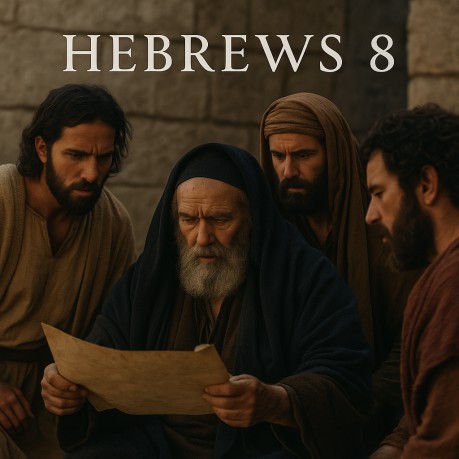
Hebrews 8 Hebrews 8:1 † Christ is not standing like the Levitical
priests who never finished their work, but sitting, His sacrifice was
final. The throne at God's right hand shows majesty, authority, and
completion. Hebrews 8:2 † Christ's ministry is not in the earthly
shadow but in the true heavenly sanctuary. The earthly tabernacle was
only a copy. Hebrews 8:3 † Christ's offering was not the blood of
animals but Himself. This sacrifice was once for all, surpassing all
the offerings of the Law. Hebrews 8:4 † Christ's priesthood was heavenly, not
earthly. Earthly priests were still ministering until the temple's
destruction. Hebrews 8:5 † The tabernacle was a copy, a shadow. Moses
was told to follow the pattern, but it was never the true reality. Hebrews 8:6 † Christ's covenant is superior. It is not a
patch on the old but a new creation altogether. Hebrews 8:7 † The very existence of the promise of a new
covenant proves the first was temporary. It served its purpose but
could not perfect. Hebrews 8:8-9 † Jeremiah 31 foresaw a new covenant, different
from Sinai. The old covenant failed because the people broke it. The
new covenant would be unbreakable in Christ. Hebrews 8:10 † Unlike Sinai, where the Law was written on
stone, the new covenant is written on hearts. This is internal,
spiritual, and eternal. Hebrews 8:11 † In the new covenant, all God's people know
Him directly. There is no class of mediating priests or teachers. Hebrews 8:12 † Forgiveness under the old covenant was
temporary, repeated every year. Under the new covenant, forgiveness
is final. Hebrews 8:13 † At the time Hebrews was written, the old
covenant was obsolete, decaying, and ready to vanish away. This found
visible fulfillment in AD 70 when the temple was destroyed. Application For Us Today † Hebrews 8 proves the old covenant is
obsolete. Any system that tries to revive temple worship, Levitical
priesthood, or sacrifices denies the new covenant in Christ. † The new covenant is written on hearts, not
stone. It is internal and Spirit-led, not external and ritualistic. † Forgiveness is complete and final in Christ.
No repetition, no yearly atonement, no further sacrifice. † Futurism contradicts Hebrews 8 by expecting
another temple, priesthood, or sacrificial system. Hebrews leaves no
room for that, the old has vanished, the new has come. † This is the fulfilled perspective we proclaim at
Fulfilled Prophecies † Source Index
By Dan Maines
Now the main point in what has
been said is this: we have such a high priest, who has taken His seat
at the right hand of the throne of the Majesty in the heavens.
† Psalm 110:1 prophesied this
enthronement, and the apostles applied it to Christ (Acts 2:34-36).
†
Chrysostom (Homilies on Hebrews 14) stressed that "sitting"
means His sacrifice was complete. The old priests never sat down in
the holy place.
A minister in the sanctuary and
in the true tabernacle, which the Lord set up, not man.
† Philo (On the Migration of
Abraham 102) wrote of a heavenly archetype beyond human hands.
Hebrews shows Christ as minister there.
† The
Dead Sea Scrolls (11QTemple) attempted to model a perfect earthly
temple, but Hebrews shows the true temple is only in heaven.
For every high priest is
appointed to offer both gifts and sacrifices; so it is necessary that
this high priest also have something to offer.
† Irenaeus (Against
Heresies 4.18.2) insisted that Christ alone fulfilled all sacrifices
in Himself.
Now if He were on earth, He
would not be a priest at all, since there are those who offer the
gifts according to the Law.
† Josephus (Wars 6.93) records
that sacrifices continued until the Romans destroyed the temple.
Hebrews shows their futility since Christ's offering was already
complete.
Who serve a copy and shadow of
the heavenly things, just as Moses was warned by God when he was
about to erect the tabernacle; for, "See," He says, "that
you make all things by the pattern which was shown to you on the
mountain."
†
Philo (Allegorical Interpretation 3.102) said the earthly things were
shadows of the heavenly. Hebrews applies this to show fulfillment in
Christ.
† Origen (Homilies on Exodus 13)
explained that the earthly tabernacle was a shadow, but Christ
fulfilled the pattern.
But now He has obtained a more
excellent ministry, to the same extent that He is also the mediator
of a better covenant, which has been enacted on better promises.
†
Tertullian (Against Marcion 5.11) argued that if the covenant of
Christ were not superior, there would be no reason to replace the
old.
† Seneca (On Benefits 4.31) said true
promises are those that cannot be broken, a fitting contrast to the
broken promises of the old covenant.
For if that first covenant had
been free of fault, no circumstances would have been sought for a
second.
† Philo (On the Decalogue
2.5) admitted the Law trained outwardly but did not heal inwardly.
For in finding fault with the
people, He says, "Behold, days are coming, says the Lord, when I
will bring about a new covenant with the house of Israel and the
house of Judah, not like the covenant which I made with their fathers
on the day I took them by the hand to bring them out of the land of
Egypt; for they did not continue in My covenant, and I did not care
about them, says the Lord."
†
The Targum on Jeremiah 31 confirms the expectation of a new covenant
in Jewish tradition.
† Justin Martyr
(Dialogue with Trypho 11) argued that this prophecy proved the Law
was temporary and that Christians inherited the new covenant.
"For this is the covenant
which I will make with the house of Israel after those days, says the
Lord: I will put My laws into their minds, and write them on their
hearts. And I will be their God, and they shall be My people."
† Ezekiel 36:26
promised a new heart and spirit, fulfilled in Christ.
†
Origen (Homilies on Jeremiah 18) said that in Christ, the Law is
engraved in the soul by the Spirit.
"And they will not teach,
each one his fellow citizen, and each one his brother, saying, ‘Know
the Lord,' for they will all know Me, from the least to the greatest
of them."
†
Clement of Alexandria (Stromata 2.6) saw this verse fulfilled in the
Spirit's universal teaching within the church.
"For I will be merciful
toward their wrongdoings, and their sins I will no longer remember."
† Mishnah (Yoma 8.9) admitted that
Yom Kippur atoned only year by year. Hebrews declares forgiveness
once for all.
† Augustine (On the Psalms
103.12) said God's forgetfulness of sin is the mark of the gospel
covenant.
When He said, "A new
covenant," He has made the first obsolete. But whatever is
becoming obsolete and growing old is about to disappear.
†
Josephus (Wars 6.300) described the destruction of the temple,
confirming Hebrews' statement.
† Origen
(Against Celsus 2.8) pointed to the temple's destruction as God's
judgment and the establishment of the new covenant.
†
Eusebius (Ecclesiastical History 3.7) explained that the destruction
of Jerusalem marked the end of the old covenant order.
† Psalm
110:1 - Messiah at God's right hand
†
Jeremiah 31:31-34 - promise of a new covenant
†
Ezekiel 36:26 - new heart and spirit promise
†
Philo, Allegorical Interpretation 3.102 - earthly things as shadows
†
Philo, On the Migration of Abraham 102 - heavenly archetype
sanctuary
† Philo, On the Decalogue 2.5 - Law
disciplines but cannot perfect
† Dead Sea
Scrolls, 1QS 8.4-9 - sectarian community as temple
†
Dead Sea Scrolls, 11QTemple - earthly temple as shadow
†
Josephus, Wars 6.93 - sacrifices until temple's fall
†
Josephus, Wars 6.300 - destruction of the temple
†
Chrysostom, Homilies on Hebrews 14 - Christ seated means completed
work
† Tertullian, Against Marcion 5.11 - new
covenant superior to old
† Origen, Homilies
on Exodus 13 - tabernacle as shadow of Christ
†
Origen, Homilies on Jeremiah 18 - Law engraved on the soul
†
Origen, Against Celsus 2.8 - destruction of temple proof of new
covenant
† Justin Martyr, Dialogue with
Trypho 11 - Christians inherit new covenant
†
Clement of Alexandria, Stromata 2.6 - Spirit's universal teaching
†
Augustine, On Psalms 103.12 - forgiveness marks gospel covenant
†
Eusebius, Ecclesiastical History 3.7 - destruction of Jerusalem ended
old covenant
† Mishnah, Yoma 8.9 - Yom Kippur
atones annually
† Targum on Jeremiah 31 - new
covenant promise in Jewish tradition
†
Seneca, On Benefits 4.31 - true promises cannot be broken
Share on Facebook
Links