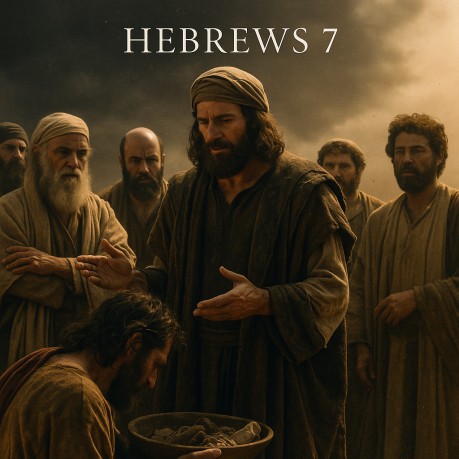
Hebrews 7 Hebrews 7:1-2 † Melchizedek appears briefly in Genesis 14,
but his significance is great. He was both king and priest, unlike
Israel's system where kings and priests were separate. His name means
king of righteousness, and Salem means peace, pointing forward to
Christ. Hebrews 7:3 † The Genesis account gives no genealogy for
Melchizedek. This silence was interpreted to mean his priesthood was
perpetual. He resembled the Son of God in having an eternal
priesthood. Hebrews 7:4-7 † Abraham, the father of Israel, gave a tithe
to Melchizedek. This act placed Melchizedek above Abraham and, by
extension, above Levi. The one who blesses is greater than the one
who receives the blessing. Hebrews 7:8-10 † Levi, and by extension the entire Levitical
priesthood, acknowledged Melchizedek's superiority when Abraham paid
him tithes. This placed Melchizedek's order above Levi's, showing the
temporary nature of the Law. Hebrews 7:11-12 † If the Law and Levitical priesthood had
brought perfection, there would have been no need for another priest.
But the very mention of Melchizedek shows that something greater was
intended. With a change of priesthood comes a change of covenant. Hebrews 7:13-17 † Jesus came from Judah, not Levi. This means
His priesthood was outside the Law and of a higher order. He is
priest not by lineage but by the power of His indestructible life.
His resurrection is the ultimate proof. Hebrews 7:18-22 † The Law could not perfect, but Christ's
covenant does. His priesthood was established with an oath, making
Him the guarantee of a better covenant. Hebrews 7:23-25 † Levitical priests died and had to be
replaced. Christ never dies, so His priesthood continues permanently.
His intercession is constant and complete. Hebrews 7:26-27 † Christ is the perfect high priest. He needed
no sacrifice for Himself, and His offering of Himself was once for
all. The repetition of sacrifices ended in Him. Hebrews 7:28 † The Law appointed weak men, but God appointed
His Son by oath, making Him perfect forever. His priesthood is final
and unchanging. Application For Us Today † Hebrews 7 shows the supremacy of Christ's
priesthood. He is not part of a corrupt, dying order, but of the
eternal order of Melchizedek. † The change of priesthood means the change of
law. The Old Covenant has ended, and Christ's New Covenant reigns
forever. † Christ's one sacrifice was sufficient.
Futurism that looks for another temple or sacrifices denies the
finality of His work. † Our hope rests in His eternal intercession.
Unlike earthly priests, Christ never dies, never leaves, and never
fails. † This is the fulfilled perspective we proclaim at
Fulfilled Prophecies † Source Index
By Dan Maines
For this Melchizedek, king of
Salem, priest of the Most High God, who met Abraham as he was
returning from the slaughter of the kings and blessed him, to whom
also Abraham apportioned a tenth part of all the spoils, was first of
all, by the translation of his name, king of righteousness, and then
also king of Salem, which is king of peace.
† Philo (On Abraham 235) wrote that
Melchizedek symbolized true righteousness and peace. Hebrews applies
this directly to Christ.
† Origen (Homilies
on Genesis 16) noted that Melchizedek was greater than Abraham
because he blessed him, foreshadowing Christ's greater priesthood.
Without father, without mother,
without genealogy, having neither beginning of days nor end of life,
but resembling the Son of God, he remains a priest perpetually.
† The Dead Sea Scrolls
(11QMelchizedek) presented Melchizedek as an eschatological
deliverer, reinforcing his role beyond a mere historical king.
†
Rabbinic tradition (Midrash on Psalm 76:2) identified Salem with
Jerusalem, showing how Jews connected Melchizedek with the holy city.
Now observe how great this man
was to whom Abraham, the patriarch, gave a tenth of the choicest
spoils. And those indeed of the sons of Levi who receive the priest's
office have a commandment in the Law to collect a tenth from the
people, that is, from their brothers and sisters, although these are
descended from Abraham. But the one whose genealogy is not traced
from them collected a tenth from Abraham and blessed the one who had
the promises. But without any dispute the lesser person is blessed by
the greater.
† The Talmud
(Nedarim 32b) affirms that Melchizedek's priesthood was honored by
Abraham's tithe, proving his superiority.
In this case mortal men
receive tithes, but in that case one receives them, of whom it is
testified that he lives on. And so to speak, through Abraham even
Levi, who received tithes, has paid tithes, for he was still in the
loins of his forefather when Melchizedek met him.
† Chrysostom
(Homilies on Hebrews 12) explained that Levi's priesthood was only
potential in Abraham, but Melchizedek's was already real and eternal.
So if perfection was through
the Levitical priesthood (for on the basis of it the people received
the Law), what further need was there for another priest to arise
according to the order of Melchizedek, and not be designated
according to the order of Aaron? For when the priesthood is changed,
of necessity there takes place a change of law also.
†
Josephus (Antiquities 20.10.1) recorded corruption in the Levitical
priesthood under Roman control, highlighting the need for a greater
priesthood.
† Tertullian (Against the Jews 9)
argued that the prophecy of Psalm 110 proved the Law was temporary
and that Christ's priesthood was eternal.
For the one about whom these
things are said belongs to another tribe, from which no one has
officiated at the altar. For it is evident that our Lord was
descended from Judah, a tribe with reference to which Moses said
nothing concerning priests. And this is clearer still, if another
priest arises according to the likeness of Melchizedek, who has
become a priest not on the basis of a law of physical requirement,
but according to the power of an indestructible life. For it is
attested of Him, "You are a priest forever according to the
order of Melchizedek."
†
Origen (Homilies on Hebrews 8) emphasized that Christ's resurrection
was the seal of His eternal priesthood.
For, on the one hand, there
is the nullification of a former commandment because of its weakness
and uselessness (for the Law made nothing perfect); on the other
hand, there is the introduction of a better hope, through which we
come near to God. And to the extent that it was not without an oath
(for they indeed became priests without an oath, but He with an oath
through the One who said to Him, "The Lord has sworn and will
not change His mind, ‘You are a priest forever'"); by the same
extent Jesus also has become the guarantee of a better covenant.
† The
Mishnah (Avot 1.2) said the world stood on the Law, temple, and
sacrifices but Hebrews shows the better covenant now rests only on
Christ.
† Augustine (On the Psalms 110.4)
taught that the Lord's oath was unbreakable, proving Christ's eternal
priesthood.
The former priests, on the
one hand, existed in greater numbers because they were prevented by
death from continuing; Jesus, on the other hand, because He continues
forever, holds His priesthood permanently. Therefore He is also able
to save forever those who come to God through Him, since He always
lives to make intercession for them.
†
Chrysostom (Homilies on Hebrews 13) emphasized that Christ's unending
priesthood guarantees salvation forever.
†
Seneca (Letters 24.22) remarked that death interrupts all human
offices, but Christ's indestructible life proves His eternal
priesthood.
For it was fitting for us to
have such a high priest: holy, innocent, undefiled, separated from
sinners, and exalted above the heavens; who has no daily need, like
those high priests, to offer up sacrifices, first for His own sins
and then for the sins of the people, because He did this once for all
time when He offered up Himself.
†
The Mishnah (Yoma 5.1) described the yearly sacrifices of the high
priest, but Hebrews declares Christ's one sacrifice fulfilled them
all.
† Irenaeus (Against Heresies 4.17.2)
said Christ's once-for-all sacrifice ended the need for repeated
offerings.
For the Law appoints men as
high priests who are weak, but the word of the oath, which came after
the Law, appoints a Son, who has been made perfect forever.
† Tertullian (Against Marcion
5.9) declared that Christ's eternal priesthood fulfilled and ended
the temporary system.
† Genesis
14:18-20 - Melchizedek blesses Abraham
†
Psalm 110:4 - priest forever after Melchizedek
†
Philo, On Abraham 235 - Melchizedek as righteousness and peace
†
Philo, On the Decalogue 2.5 - Law disciplines but does not perfect
†
Origen, Homilies on Genesis 16 - Melchizedek greater than Abraham
†
Origen, Homilies on Hebrews 8 - resurrection seals priesthood
†
Dead Sea Scrolls, 11QMelchizedek - Melchizedek as heavenly
deliverer
† Midrash on Psalm 76:2 - Salem
identified with Jerusalem
† Talmud, Nedarim
32b - Melchizedek honored by Abraham's tithe
†
Mishnah, Yoma 5.1 - yearly sacrifices of the high priest
†
Mishnah, Avot 1.2 - world stands on Law, temple, sacrifices
†
Josephus, Antiquities 20.10.1 - corruption of Levitical priesthood
†
Chrysostom, Homilies on Hebrews 12-13 - Melchizedek greater, Christ's
intercession eternal
† Augustine, On the
Psalms 110.4 - God's oath proves eternal priesthood
†
Irenaeus, Against Heresies 4.17.2 - Christ's one sacrifice ended
repetition
† Tertullian, Against the Jews 9 -
Psalm 110 proves Law was temporary
†
Tertullian, Against Marcion 5.9 - Christ's eternal priesthood
fulfilled Law
† Seneca, Letters 24.22 - death
interrupts all human offices
Links