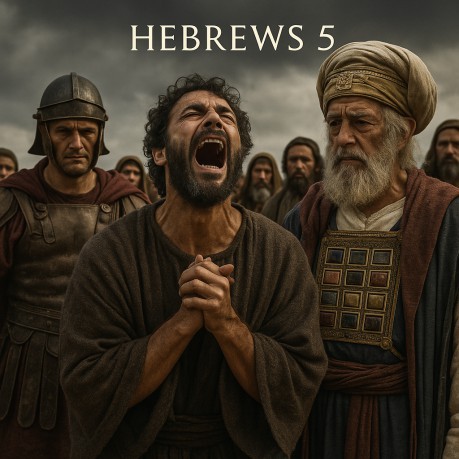
Hebrews 5 Hebrews 5:1 † The role of the high priest was to represent
the people before God. He offered gifts and sacrifices to deal with
sin. The writer begins by describing the earthly priesthood to
prepare for the contrast with Christ. Hebrews 5:2 † The earthly high priest understood human
weakness because he shared in it. His ministry required compassion,
not harshness. Hebrews 5:3 † Unlike Christ, earthly priests needed to
offer sacrifices for their own sins. This showed their imperfection
and limitation. Hebrews 5:4 † The high priesthood was not a self-appointed
role but a divine calling. Aaron was chosen by God as the first high
priest. Hebrews 5:5 † Christ did not take the office Himself. God
appointed Him, fulfilling Psalm 2:7. His sonship was the foundation
of His priesthood. Hebrews 5:6 † Christ's priesthood was not according to
Aaron but Melchizedek. This was a higher, eternal order, predating
the Law itself. Hebrews 5:7 † Jesus, in His humanity, prayed with deep
emotion. His suffering was real, and He relied completely on the
Father. This points to Gethsemane and His submission to God's will. Hebrews 5:8 † Christ's sonship did not exempt Him from
suffering. Through His suffering, He fully demonstrated obedience.
This made Him the perfect example and mediator. Hebrews 5:9 † Christ's suffering perfected His mission,
completing the work of redemption. As the obedient Son, He became the
source of eternal salvation. Hebrews 5:10 † Christ was officially appointed as high
priest in the Melchizedek order, eternal and unchangeable. His
priesthood did not end like Aaron's line but remains forever. Hebrews 5:11 † The writer pauses, noting that his audience
had become spiritually dull. The deeper truths of Christ's
Melchizedek priesthood were hard to teach to an unresponsive
audience. Hebrews 5:12 † Instead of maturing, the audience had
regressed. They needed basics again instead of advancing to maturity.
This was a rebuke, urging them to grow. Hebrews 5:13 † Immaturity in faith leaves one unskilled in
righteousness. The audience was being challenged to grow beyond
infancy. Hebrews 5:14 † The mature are trained by constant practice
to discern right from wrong. Growth in faith requires discipline and
application, not just knowledge. Application For Us Today † Hebrews 5 shows the superiority of Christ's
priesthood. Unlike Aaronic priests, He was sinless, eternal, and
directly appointed by God. † The example of Melchizedek reminds us that
Christ's priesthood is universal and everlasting, not tied to the
temple system that perished in AD 70. † Christ's suffering teaches us obedience. He
did not avoid suffering but embraced it, showing that true faith is
proven in trials. † The rebuke about immaturity applies strongly
today. Many believers remain on "milk," clinging to basics,
while neglecting to grow in the depth of fulfilled truth. † Just as the original audience risked
dullness, modern futurism reflects the same immaturity, refusing to
move on from shadows to the reality of Christ's finished work. † This is the fulfilled perspective we proclaim at
Fulfilled Prophecies † Source Index
By Dan Maines
For every high priest taken from
among men is appointed on behalf of people in things pertaining to
God, in order to offer both gifts and sacrifices for sins.
†
Josephus (Antiquities 3.9.7) described the high priest as chosen to
intercede for the nation, showing how this office was understood in
first-century Judaism.
† The Mishnah (Yoma
1.3) details how the high priest was carefully appointed and prepared
for the Day of Atonement, highlighting the weight of his role.
He can deal gently with the
ignorant and misguided, since he himself also is clothed in weakness.
† Philo (On Dreams 1.215) said
the high priest must sympathize with those under him because he
himself is subject to passions and weakness.
And because of it he is
obligated to offer sacrifices for sins for himself, as well as for
the people.
† Philo (On the Special Laws
1.97) emphasized that the high priest, being human, needed to atone
for his own sins before interceding for others.
†
The Talmud (Yoma 7b) records that the high priest confessed his own
sins first on the Day of Atonement before he could intercede for
Israel.
And no one takes the honor for
himself, but receives it when he is called by God, just as Aaron also
was.
† Josephus (Antiquities 20.10.1)
notes that later political appointments of high priests by Rome
corrupted this calling, contrasting it with the true divine
appointment of Christ.
So too Christ did not glorify
Himself in becoming a high priest, but it was He who said to Him,
"You are My Son, today I have fathered You."
† Justin Martyr (Dialogue
with Trypho 33) explained that Psalm 2 applied to Christ as God's
appointed Son, not to earthly rulers.
Just as He also says in another
passage, "You are a priest forever according to the order of
Melchizedek."
† The Qumran community
(11QMelchizedek) described Melchizedek as a heavenly deliverer who
would proclaim liberty, showing how Jews expected a greater priestly
figure.
† Origen (Homilies on Genesis 16)
wrote that Melchizedek prefigured Christ's eternal priesthood,
greater than the Levitical priesthood.
In the days of His humanity, He
offered up both prayers and pleas with loud crying and tears to the
One able to save Him from death, and He was heard because of His
devout behavior.
†
Ignatius (Letter to the Ephesians 18) spoke of Christ's prayers and
tears as proof of His real humanity, against those who denied it.
†
The Gospel accounts (Matthew 26:36-44; Luke 22:44) record His agony
in Gethsemane, confirming Hebrews' description.
Although He was a Son, He
learned obedience from the things which He suffered.
†
Seneca (On Providence 2.6) argued that suffering perfects character,
a truth mirrored perfectly in Christ.
And having been perfected, He
became the source of eternal salvation for all those who obey Him.
† Irenaeus
(Against Heresies 3.18.7) taught that Christ's obedience even unto
death was the foundation of salvation for all believers.
†
Tertullian (On the Flesh of Christ 17) stressed that salvation
depends on Christ's real suffering and death, not an illusion.
Being designated by God as High
Priest according to the order of Melchizedek.
†
The Babylonian Talmud (Nedarim 32b) linked Melchizedek with
priesthood and blessing, an expectation Hebrews applies directly to
Christ.
Concerning him we have much to
say, and it is difficult to explain, since you have become poor
listeners.
† Clement of Alexandria (Paedagogus
1.6) criticized believers who refused to advance in knowledge,
echoing this warning.
For though by this time you
ought to be teachers, you have need again for someone to teach you
the elementary principles of the actual words of God, and you have
come to need milk and not solid food.
†
Clement of Alexandria (Stromata 1.1) wrote that many Christians
remained on "milk" and did not progress to deeper
knowledge, echoing Hebrews' concern.
† Origen
(Homilies on Hebrews 7) saw "milk" as the literal teaching,
and "solid food" as the spiritual depth in Christ.
For everyone who partakes only
of milk is unacquainted with the word of righteousness, for he is an
infant.
† Seneca (Letters 94.7) warned that
those who never advance in philosophy remain children in
understanding, a parallel to Hebrews' rebuke.
But solid food is for the
mature, who because of practice have their senses trained to
distinguish between good and evil.
† Origen
(Homilies on Hebrews 6) noted that solid food represents the deeper
mysteries of Christ, which only the mature can grasp.
†
The Wisdom of Solomon 8:7 described wisdom training the senses to
discern justice, courage, and righteousness, echoing Hebrews' view of
maturity.
† Psalm 2:7
- You are My Son
† Psalm 110:4 - You are a
priest forever after Melchizedek
† Genesis
14:18 - Melchizedek blessing Abraham
†
Josephus, Antiquities 3.9.7 - high priest interceding for the
nation
† Josephus, Antiquities 20.10.1 -
corruption of high priest appointments under Rome
†
Philo, On the Special Laws 1.97 - high priest atoning for his own
sins
† Philo, On Dreams 1.215 - high priest
as sympathetic to the weak
† Dead Sea
Scrolls, 11QMelchizedek - Melchizedek as heavenly deliverer
†
Mishnah, Yoma 1.3 - appointment and preparation of high priest
†
Talmud, Yoma 7b - high priest confessing his sins first
†
Talmud, Nedarim 32b - Melchizedek linked with priesthood and
blessing
† Ignatius, Letter to the Ephesians
18 - Christ's prayers and tears prove His humanity
†
Irenaeus, Against Heresies 3.18.7 - salvation grounded in Christ's
obedience
† Tertullian, On the Flesh of
Christ 17 - salvation depends on Christ's real suffering
†
Clement of Alexandria, Stromata 1.1 - believers stuck on milk
†
Clement of Alexandria, Paedagogus 1.6 - refusal to advance in
knowledge
† Origen, Homilies on Hebrews 6-7 -
milk vs. solid food as spiritual maturity
†
Origen, Homilies on Genesis 16 - Melchizedek prefiguring Christ
†
Chrysostom, Homilies on Hebrews 7 - confidence through Christ's
priesthood
† Seneca, On Providence 2.6 -
suffering perfects character
† Seneca,
Letters 94.7 - immaturity in knowledge keeps one as a child
†
Wisdom of Solomon 8:7 - wisdom training the senses
Links