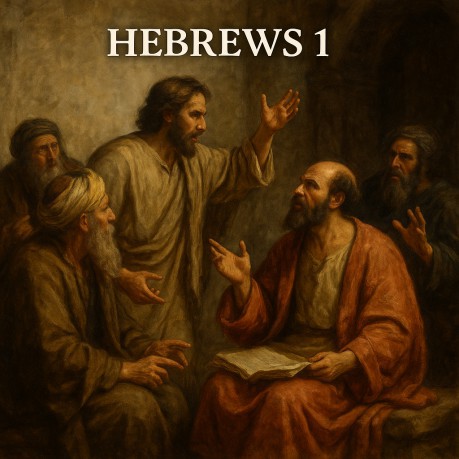
Hebrews 1 Hebrews 1:1 † The letter opens by reminding readers of
God's past revelation through the prophets. He spoke in many ways,
through visions, dreams, symbols, and direct words. This points back
to the Old Covenant as the foundation. Hebrews 1:2 † The writer contrasts the past with the
present. God's final word came through His Son in the last days of
the Old Covenant age. Christ was the heir of all things, the one
through whom God made the ages. The focus is on covenantal
fulfillment, not the end of the physical universe. Hebrews 1:3 † Jesus is the perfect revelation of God, His
very image. He accomplished purification for sins through His
sacrifice and now reigns at the Father's right hand. His exaltation
shows the completed work of redemption. Hebrews 1:4 † Christ is superior to angels, bearing a
greater name and authority. The Son is not a servant but the heir,
fulfilling what angels only foreshadowed. Hebrews 1:5 † The writer quotes Psalm 2:7 and 2 Samuel 7:14
to show Christ's unique sonship. Angels were messengers, but Jesus
was the promised Son of David and Son of God. Hebrews 1:6 † The firstborn, Christ, receives worship from
angels. This highlights His supremacy over all spiritual beings. The
quotation recalls Deuteronomy 32:43 in the Septuagint. Hebrews 1:7 † Angels are described as servants, instruments
of God's power. They are not sons or heirs but created beings used
for ministry. Hebrews 1:8-9 † The Son's kingdom is eternal. Unlike angels
or earthly rulers, Christ reigns with perfect righteousness. This
quotation from Psalm 45 points to His exalted kingship. Hebrews 1:10-12 † The creation language points to the stability
of Christ in contrast to the perishable old order. The heavens and
earth here symbolically represent the Old Covenant world that was
passing away. Christ remains unchanged, reigning forever. Hebrews 1:13 † Psalm 110 is quoted, showing the unique
authority given to Christ. No angel was ever invited to sit at God's
right hand. This authority belonged only to the Son. Hebrews 1:14 † Angels are ministering spirits, serving those
who are heirs of salvation. Christ reigns as King, while angels serve
His people. This contrast concludes the argument of His superiority. Application For Us Today † Hebrews 1 reminds us that Christ is the final
and complete revelation of God. We don't look for new prophets or
additional revelations, we look to the Son. † The contrast between angels and Christ warns
us not to elevate servants above the King. Whether it's angels,
traditions, or church leaders, nothing compares to Christ's
supremacy. † The covenantal language of the old creation
passing away shows that Christ's kingdom is eternal and unshakable.
We live in the reality of His reign, not waiting for another age to
come. † Futurists misuse "last days" as if
it's our time, but history proves it was the last days of the Old
Covenant. Josephus himself recorded the end of the Jewish nation,
confirming Hebrews was speaking of that transition. † Just as angels ministered to those inheriting
salvation, God still works all things for the good of His people. Our
assurance rests in the risen, reigning Christ who never changes. † This is the fulfilled perspective we proclaim at
Fulfilled Prophecies † Source Index
By Dan Maines
God, after He spoke long ago to
the fathers in the prophets in many portions and in many ways.
In these last days has spoken to
us in His Son, whom He appointed heir of all things, through whom He
also made the world.
†
Josephus (Against Apion 2.190) spoke of the prophets as God's voice
to Israel, but the Son surpasses them all.
†
Josephus (Wars 6.109) also described the destruction of Jerusalem as
"the end of the Jewish nation," confirming that the "last
days" referred to that covenantal transition.
And He is the radiance of His
glory and the exact representation of His nature, and upholds all
things by the word of His power. When He had made purification of
sins, He sat down at the right hand of the Majesty on high.
†
Philo of Alexandria (On the Confusion of Tongues 146) described the
Logos as the "image of God," language similar to Hebrews,
showing that Jewish thought connected divine radiance with God's
Word.
† The Wisdom of Solomon 7:26 describes
wisdom as "a reflection of eternal light, a spotless mirror of
the working of God." This Jewish background makes the
description of Christ unmistakable as God's perfect image.
Having become so much better
than the angels, to the extent that He has inherited a more excellent
name than they.
For to which of the angels did
He ever say, "You are My Son, today I have fathered You"?
And again, "I will be a Father to Him and He will be a Son to
Me"?
And when He again brings the
firstborn into the world, He says, "And let all the angels of
God worship Him."
†
The Dead Sea Scrolls (Songs of the Sabbath Sacrifice, 4Q400) exalted
angelic worship in Jewish imagination, but Hebrews shows that Christ
alone is worthy of that worship.
And regarding the angels He
says, "He makes His angels winds, and His ministers a flame of
fire."
But regarding the Son He says,
"Your throne, God, is forever and ever, and the scepter of
righteousness is the scepter of His kingdom. You have loved
righteousness and hated lawlessness; therefore God, Your God, has
anointed You with the oil of joy above Your companions."
"You, Lord, in the
beginning laid the foundation of the earth, and the heavens are the
works of Your hands; they will perish, but You remain; and they all
will wear out like a garment, and like a cloak You will roll them up;
like a garment they also will be changed. But You are the same, and
Your years will not come to an end."
†
Isaiah 51:16 uses "heavens and earth" as covenant language,
showing God's creation of Israel as His people. Hebrews applies the
same imagery.
† Josephus (Wars 5.19) called
the temple and Jerusalem "the very heaven and earth" for
the Jews, making it clear the writer of Hebrews was speaking
covenantally.
† The Dead Sea Scrolls (1QS
4.25) also spoke of the perishing of the present order and the coming
renewal, echoing this covenantal contrast.
But to which of the angels has
He ever said, "Sit at My right hand, until I make Your enemies a
footstool for Your feet"?
†
Rabbinic tradition (Midrash Tehillim on Psalm 110) also recognized
this as a messianic psalm, proving the Jewish expectation that it
pointed to the Messiah.
Are they not all ministering
spirits, sent out to provide service for the sake of those who will
inherit salvation?
† Hebrews
1:2 - last days through the Son
† Psalm 2:7 -
You are My Son, today I have fathered You
†
Psalm 45:6-7 - throne of righteousness
†
Psalm 110:1 - Sit at My right hand
† Isaiah
51:16 - heavens and earth as covenant language
†
Josephus, Against Apion 2.190 - prophets as God's voice to Israel
†
Josephus, Wars 6.109 - end of the Jewish nation
†
Josephus, Wars 5.19 - temple and Jerusalem called heaven and earth
†
Philo, On the Confusion of Tongues 146 - Logos as image of God
†
Wisdom of Solomon 7:26 - wisdom as reflection of God's glory
†
Dead Sea Scrolls, 1QS 4.25 - present order perishing and renewal
coming
† Dead Sea Scrolls, Songs of the
Sabbath Sacrifice (4Q400) - angelic worship
†
Midrash Tehillim on Psalm 110 - Jewish recognition of a messianic
psalm
† Eusebius, Church History 1.2 - Christ
exalted above angels
Links