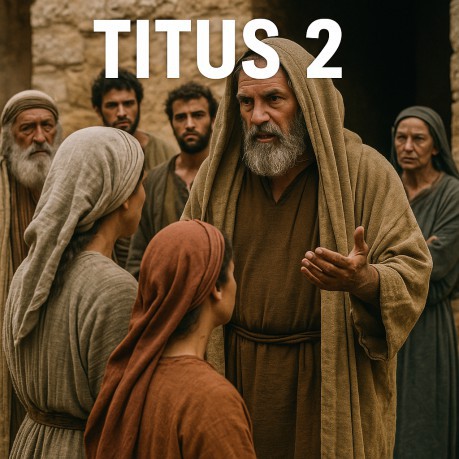
Titus
2 Titus 2:1 † Titus was
charged to speak only what was sound, in contrast to the false
teachers of chapter 1. Sound doctrine produces godly living, while
myths and lies corrupt. Titus 2:2 † Godly
leadership begins with older men. Their role was to be examples of
sobriety, faith, love, and endurance. Their lives were to guide the
younger. Titus 2:3 † Older women
were to live reverently, avoiding gossip and indulgence. Their role
was to teach what is good, becoming mentors for the younger women. Titus 2:4-5 † The faith of
young women was to be shown in love, purity, and devotion to their
families. Their obedience brought honor to God's Word in a culture
that watched closely. Titus 2:6 † Young men
were called to self-control, the virtue needed most in youth. A
disciplined mind and life brought strength to the community. Titus 2:7-8 † Titus
himself was to lead by example, showing integrity in doctrine and
behavior. When leaders lived above reproach, opponents of the faith
were silenced. Titus 2:9-10 † Even slaves
were called to faithfulness, showing obedience and honesty so the
gospel would be honored. The focus was not on overthrowing the system
but on living faithfully within it. Titus 2:11 † God's grace
had been revealed in Christ, bringing salvation for Jew and Gentile
alike. The scope of His work was universal, fulfilling the promises
of the prophets. Titus 2:12 † Grace is not
freedom to sin but instruction to live righteously. The present age
was the Old Covenant world that was passing away. In that context,
believers were to live godly lives in the midst of corruption. Titus 2:13 † The blessed
hope was the appearing of Christ in judgment and vindication, not in
some far-off future, but in their generation (Matthew 16:27-28).
Believers were awaiting His appearing, which would bring relief and
fulfillment. Titus 2:14 † Christ's
death redeemed His people and purified them. The goal was a holy
people, eager to live in good works. Redemption was both deliverance
from sin and transformation into godliness. Titus 2:15 † Titus was to
teach and exhort with full authority, not timidly. God's truth
carried divine authority, and no one was to dismiss the message. Application For Us Today † Titus 2
reminds us that sound doctrine is not just about belief, but about
living. The gospel shapes men, women, young and old, in every stage
of life. Each group has a role to play in showing the reality of
Christ's kingdom. † Just as in
the first century, the world watches our conduct. When we live
faithfully, the Word of God is honored. When we compromise, the
gospel is dishonored. † Paul's words
about the "present age" remind us that we live in the age
to come, the kingdom of Christ. The Old Covenant has passed, and we
live under the New Covenant, redeemed and purified. † The blessed
hope, the appearing of Christ, has already come in judgment on the
Old Covenant system. For us today, the hope is realized, and we live
in the reality of Christ's eternal reign. † The
instructions for households also apply now: when families live in
order and love, the church is strengthened and the gospel is adorned.
False teaching still upsets households today, but godly conduct
guards against it. † This chapter
calls us to holiness, self-control, and integrity in every part of
life. Sound doctrine must always be matched by sound living. † This is the fulfilled
perspective we proclaim at Fulfilled Prophecies † Source Index
By Dan Maines
But
as for you, proclaim the things which are fitting for sound doctrine.
†
Clement of Rome (1
Clement 21) likewise
exhorted the church to keep to "the rule of sound instruction"
so that no division would grow among them.
Older
men are to be temperate, dignified, self-controlled, sound in faith,
in love, in perseverance.
†
Philo of Alexandria (On
the Special Laws 2.41)
emphasized the dignity and moderation required of elders, showing how
this was recognized as a cultural virtue even outside the church.
Older
women likewise are to be reverent in their behavior, not malicious
gossips nor enslaved to much wine, teaching what is good.
†
Plutarch (Advice to Bride
and Groom) highlighted
the importance of older women training the younger in household
virtue, confirming the cultural setting of Paul's instructions.
So
that they may encourage the young women to love their husbands, to
love their children, to be sensible, pure, workers at home, kind,
being subject to their own husbands, so that the word of God will not
be dishonored.
†
Xenophon (Oeconomicus)
described how a wife's orderliness in the home reflected honor upon
her husband in Greek culture. Paul elevates this principle by linking
it to the honor of God's Word.
Likewise
urge the young men to be sensible.
†
Aristotle (Nicomachean
Ethics 3.12) warned of
rashness and lack of self-control among youth, showing how Paul's
charge lined up with well-known moral instruction.
In
all things show yourself to be an example of good deeds, with purity
in doctrine, dignified, sound in speech which is beyond reproach, so
that the opponent will be put to shame, having nothing bad to say
about us.
†
Josephus (Against Apion
2.190) recorded how
critics mocked the Jews for hypocrisy when their lives didn't match
their teaching. Paul wanted Titus to prevent such slander against the
faith.
Slaves
are to be subject to their own masters in everything, to be pleasing,
not argumentative, not stealing, but showing all good faith, so that
they will adorn the doctrine of God our Savior in every respect.
†
Pliny the Younger (Letters
8.16) commended slaves
who showed loyalty and honesty, noting how rare and valuable such
faithfulness was. Paul applies this as a testimony to the gospel.
For
the grace of God has appeared, bringing salvation to all people.
†
Justin Martyr (Dialogue
with Trypho 119) later
echoed this, saying that God's salvation extended to all nations
through Christ, not to Israel alone.
Instructing
us to deny ungodliness and worldly desires and to live sensibly,
righteously, and in a godly manner in the present age.
†
The Dead Sea Scrolls (Community
Rule 1QS 3.7-9) also
instructed the faithful to separate from ungodliness and walk in
holiness during "this age," showing how Jews of the time
viewed the tension between two ages.
Looking
for the blessed hope and the appearing of the glory of our great God
and Savior, Christ Jesus.
†
Eusebius (Church History
3.5) affirms that the
destruction of Jerusalem vindicated the words of Christ and brought
peace to the churches, showing this blessed hope was fulfilled.
Who
gave Himself for us to redeem us from every lawless deed, and to
purify for Himself a people for His own possession, eager for good
deeds.
†
Irenaeus (Against
Heresies 3.18.7)
highlighted that Christ came to redeem His people and make them His
own possession, echoing Paul's exact language here.
These
things speak and exhort, and rebuke with all authority. No one is to
disregard you.
†
Chrysostom (Homilies on
Titus 2) commented that
Paul gave Titus this charge so that the message would stand firm
against cultural ridicule and opposition.
†
Matthew 16:27-28 - Christ's appearing in that generation
†
1 Corinthians 15:54-57 - Christ's victory over death
†
Acts 20:28-30 - warning about false teachers entering the church
†
Josephus, Antiquities 20.2.4 - Jewish leaders misleading households
†
Josephus, Wars of the Jews 6.5.2 - false prophets during the siege
†
Suetonius, Lives of the Caesars, Claudius 25 - disputes among Jews in
Rome
†
Epimenides (quoted by Paul) - Cretans as liars and gluttons
†
Polybius, Histories 6.46 - Cretans' greed and dishonesty
†
Philo, On the Special Laws 2.41 - dignity and moderation of elders
†
Plutarch, Advice to Bride and Groom - older women mentoring the
younger
†
Xenophon, Oeconomicus - household honor and family order
†
Aristotle, Nicomachean Ethics 3.12 - youth lacking self-control
†
Josephus, Against Apion 2.190 - critics mocking hypocrisy
†
Pliny the Younger, Letters 8.16 - faithful slaves commended
†
Justin Martyr, Dialogue with Trypho 119 - salvation for all nations
†
Dead Sea Scrolls, Community Rule 1QS 3.7-9 - living faithfully in
this age
†
Eusebius, Church History 3.5 - vindication of Christ's words in
Jerusalem's fall
†
Irenaeus, Against Heresies 3.18.7 - Christ purifying a people for
Himself
†
Clement of Rome, 1 Clement 21 - rule of sound instruction
†
Chrysostom, Homilies on Titus 2 - exhorting with authority
Links