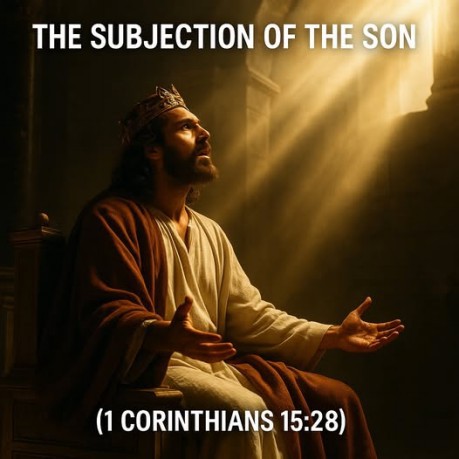
The
Subjection of the Son (1 Corinthians 15:28) 1
Corinthians 15:28 † Paul is not
teaching that Christ ceases to be God. The Son is eternally divine,
one with the Father and Spirit (John 10:30). His subjection here is
the act of presenting the completed kingdom to the Father in perfect
unity. John 17:4-5 † Jesus declared
that He had eternal glory with the Father before creation. His
subjection at the end means returning the finished kingdom to the
Father, not losing His place as God. Philippians 2:6-8 † Christ always
existed in the form of God. His humility did not remove His deity,
it revealed it. The subjection in 1 Corinthians 15:28 is the same
humility: freely obeying the Father's will and completing
redemption. 1 Corinthians 15:56 † This explains how
death was destroyed. Death's power came through the Law of the Old
Covenant. When that Law was removed in AD 70, the sting of death was
broken, and life in Christ was revealed. Isaiah 25:7-8 † Paul's teaching
that death would be abolished is rooted in Isaiah's prophecy. In
Christ's finished work, this was fulfilled. The veil of separation
was removed, and covenantal death was swallowed up. Daniel 12:2, 7 † Daniel connects
the resurrection with the shattering of the power of the holy
people, the destruction of Jerusalem and the temple. Hebrews 10:19-22 † This is what
Christ's work as Mediator accomplished. He removed the barriers and
opened the way to the Father. His subjection means that He has
completed this work perfectly. Revelation 5:6 † Christ is forever
the Lamb who was slain and forever God the Son who reigns in power.
His sacrifice never loses its effect, and His deity never changes. John 5:23 † This rules out
any idea of eternal inferiority. The Son is to be honored equally
with the Father, showing His full deity even in His subjection. Colossians 2:9 † Christ does not
lose His deity when He subjects Himself to the Father. The fullness
of God continues to dwell in Him eternally. His subjection is the
final display of His unity with the Father, not a surrender of
divinity. Historical Witness –
Josephus How it applies to us today † This is the fulfilled
perspective we proclaim at Fulfilled Prophecies † Source Index
By Dan Maines
When all things are subjected to
Him, then the Son Himself also will be subjected to the One who
subjected all things to Him, so that God may be all in all.
† This is the language of order
within the Godhead, not of inferiority. The Son's obedience shows
His finished mission, not a loss of divinity.
†
Irenaeus (Against Heresies 5.36) wrote that Christ "sums up all
things" and hands them to God, showing the plan fulfilled.
I
glorified You on the earth, having accomplished the work which You
have given Me to do. And now You, Father, glorify Me together with
Yourself, with the glory which I had with You before the world
existed.
Who,
as He already existed in the form of God, did not consider equality
with God something to be grasped, but emptied Himself by taking the
form of a bond-servant and being born in the likeness of men. And
being found in appearance as a man, He humbled Himself by becoming
obedient to the point of death, death on a cross.
† Athanasius explained that the
Son's subjection is the restoration of all things to God, not a
lowering of the Son Himself.
The
sting of death is sin, and the power of sin is the law.
And
on this mountain He will swallow up the covering which is over all
peoples, even the veil which is stretched over all nations. He will
swallow up death for all time, and the Lord God will wipe tears away
from all faces.
†
Revelation 21:4 echoes the same promise, showing its fulfillment in
the new covenant kingdom.
Many
of those who sleep in the dust of the ground will awake, these to
everlasting life, but the others to disgrace and everlasting
contempt… And I heard the man clothed in linen, who was above the
waters of the river, as he raised his right hand and his left toward
heaven, and swore by Him who lives forever that it would be for a
time, times, and half a time; and as soon as they finish shattering
the power of the holy people, all these events will be completed.
†
This happened in AD 70, matching Paul's teaching in 1 Corinthians
15. The "resurrection" Daniel foresaw was covenantal: the
raising of God's people into everlasting life in Christ, while the
covenant-breakers were cast into judgment.
†
Eusebius (Ecclesiastical History 3.5) confirms that the church fled
Jerusalem before its destruction, understanding these prophecies
were coming to pass in their own generation.
Therefore,
brothers and sisters, since we have confidence to enter the holy
place by the blood of Jesus, by a new and living way which He
inaugurated for us through the veil, that is, His flesh, and since
we have a great priest over the house of God, let's approach God
with a sincere heart in full assurance of faith.
† Augustine
wrote that God being "all in all" means His glory fills
His people directly, because of the Son's finished work.
And
I saw between the throne and the elders a Lamb standing, as if
slain, having seven horns and seven eyes, which are the seven
spirits of God sent out into all the earth.
†
His subjection is triumph, God the Son presenting the kingdom to His
Father, so that God is revealed as all in all.
So
that all will honor the Son just as they honor the Father. The one
who does not honor the Son does not honor the Father who sent Him.
For
in Him all the fullness of Deity dwells in bodily form.
† Josephus, a Jewish
historian and eyewitness to the destruction of Jerusalem in AD 70,
records that the temple was burned, sacrifices ceased, and the
priesthood was cut off (Wars 6.4.5). This event was the visible
marker of the end of the Old Covenant system.
†
Without the temple, there was no altar, no sacrifices, and no
priesthood, proving that Christ's new and living way had fully
replaced the old.
† This confirms Paul's
words in 1 Corinthians 15 and Daniel 12: the kingdom had been handed
over, the Law that gave death its power was removed, and life in
Christ was revealed.
†
This verse proves we live in a finished work. We are not waiting for
Christ to become victorious. He already reigns and has delivered the
kingdom to the Father. That means we are not a people of delay, but
a people of fulfillment.
† This changes how
we read Scripture. We don't look for future temples, sacrifices, or
mediators. We already have direct access to the Father through
Christ, the eternal Son of God. Anything that adds to His work
denies what He has already accomplished.
†
This changes how we see the world. Christ has destroyed every enemy,
including death, and given us eternal life. That is why Paul says
God is all in all, because through Christ, His presence fills His
people, His kingdom, and His creation.
†
This changes how we face trials. We don't fight as though victory
depends on us. We live in the finished victory of Christ. Even in
suffering, we know nothing can undo what He has secured. The Son has
not lost His glory, He reigns with the Father and Spirit forever.
†
This changes how we live every day. We are citizens of a kingdom
that cannot be shaken. Our lives are to reflect the reality that God
is all in all. That means we pray with confidence, we walk with
hope, and we serve with boldness. We don't live in fear of what is
to come. We live in the confidence of what has already been
fulfilled.
†
John 10:30 – Christ and the Father are one
†
John 17:4-5 – Christ's eternal glory with the Father
†
Philippians 2:6-8 – Christ equal with God, humbled in obedience
†
1 Corinthians 15:56 – Death's sting is sin, power of sin is the
Law
† Isaiah 25:7-8 – Death swallowed up
forever, veil removed
† Daniel 12:2, 7 –
Resurrection tied to the shattering of Israel's power
†
Revelation 21:4 – God wipes away every tear
†
John 5:23 – The Son honored equally with the Father
†
Colossians 2:9 – Fullness of Deity dwells in Christ bodily
†
Irenaeus, Against Heresies 5.36 – Christ summing up and handing
over the kingdom
† Athanasius, Orations
Against the Arians 1.43 – Subjection as restoration, not
inferiority
† Augustine, City of God 22.30 –
God all in all in His people
† Ignatius of
Antioch, Ephesians 7 – Christ called "our God"
†
Tertullian, Against Praxeas 2 – The Father and the Son are both
God, one God
† Nicene Creed (AD 325, 381) –
Christ "true God from true God"
†
Josephus, Wars 6.4.5 – Destruction of the temple in AD 70
†
Hebrews 10:19-22 – Access to God through Christ
†
Revelation 5:6 – Christ eternally the Lamb who was slain
†
2 Timothy 1:10 – Christ abolished death and brought immortality
Links