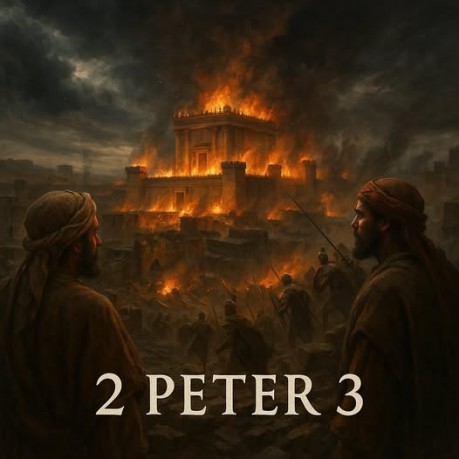
2
Peter 3 2
Peter 3:1-2 † Peter reminds
them that the prophets, Jesus, and the apostles were all in
agreement. The prophets warned of judgment on Israel, Jesus repeated
the warning in His ministry, and the apostles kept telling the
church it was about to happen. 2 Peter 3:3-4 † The last days
aren't the end of the planet but the last days of the Old Covenant
system. Scoffers in Peter's day denied that judgment was coming. 2 Peter 3:5-6 † Peter recalls the
judgment of the ancient world by flood and uses it as a warning that
another judgment was approaching, this time upon Israel's covenant
world. 2 Peter 3:7 † The present
heavens and earth was the Mosaic covenant. Isaiah 51:16 and
Deuteronomy 32:1 use heaven and earth language for Israel itself.
This covenantal world was set apart for fiery destruction, which
came in AD 70 when Rome burned the city and temple. 2 Peter 3:8-9 † This isn't saying
the promise could be thousands of years away. It's saying God's
timing is perfect. His patience gave Israel more time to repent. 2 Peter 3:10 † The day of the
Lord was covenant judgment, not the end of creation. The elements
were the principles of the Old Covenant law, not atoms of the
universe. In AD 70 the temple, priesthood, and sacrificial system
were burned. 2 Peter 3:11-12 † Because the end
of that covenant world was so close, Peter urged them to live holy
lives. Their prayers and obedience were part of hastening the day,
just as Jesus said the gospel would be preached to all nations
before the end came. 2 Peter 3:13 † This is Isaiah
65-66 fulfilled. The new heavens and earth is the New Covenant
order. When the Old Covenant passed away in AD 70, the church
entered fully into this new creation where righteousness dwells. 2 Peter 3:14-16 † Paul also wrote
about this transition, especially in 2 Corinthians 5 and Galatians
4. Resurrection and covenant transformation were deep subjects, and
they were often twisted then just like they're twisted now. 2 Peter 3:17-18 † The day of
eternity is the New Covenant age, eternal and unshakable. Peter
calls them to stay faithful as that age was breaking in through
judgment. † This is the fulfilled
perspective we proclaim at Fulfilled Prophecies † Source Index
By Dan Maines
This is now, beloved, the second letter
I'm writing to you in which I'm stirring up your sincere mind by way
of a reminder, that you should remember the words spoken beforehand
by the holy prophets and the commandment of the Lord and Savior
spoken by your apostles.
† The
consistency between prophets, Christ, and apostles shows there was
one covenantal message from start to finish. This destroys the
futurist idea of a "delay." The early church wasn't
waiting for something 2,000 years away, but for what was already
unfolding in their generation.
Know
this first of all, that in the last days mockers will come with
their mocking, following after their own lusts, and saying, Where is
the promise of His coming? For ever since the fathers fell asleep,
all continues just as it was from the beginning of creation.
†
Josephus wrote that people mocked and ignored warnings right before
Jerusalem's destruction, exactly like Peter said they would.
†
This mocking spirit was also foretold by Jesus in Matthew 24:48 when
the evil slave said, "My master is not coming for a long time."
The unbelieving Jews thought their city and temple would stand
forever, and even some Christians wavered under persecution.
For
when they maintain this, it escapes their notice that by the word of
God the heavens existed long ago and the earth was formed out of
water and by water, through which the world at that time was
destroyed, being flooded with water.
† Writers like Philo used world and
cosmos to describe Israel's covenant order.
†
The prophets also used flood imagery to describe judgment on
nations, such as Isaiah 8:7-8 where the Assyrian invasion is called
an "overflowing flood." Peter is not teaching cosmic
annihilation but covenantal transition.
But
by His word the present heavens and earth are being reserved for
fire, kept for the day of judgment and destruction of ungodly men.
†
Josephus described the flames devouring the temple until nothing was
left. He said it looked like the whole city was one massive fire.
†
Isaiah 34:9-10 spoke of judgment as fire and burning pitch that
would not be quenched, imagery Peter echoes here.
But
do not let this one fact escape your notice, beloved, that with the
Lord one day is like a thousand years, and a thousand years like one
day. The Lord is not slow about His promise, as some count slowness,
but is patient toward you, not wishing for any to perish but for all
to come to repentance.
†
Jesus gave the same picture in the parable of the fig tree when the
vinedresser asked for one more year before the tree was cut down.
†
Paul said the same in Romans 2:4, that God's kindness and patience
were meant to lead to repentance. Peter is applying this directly to
his generation, not ours.
But
the day of the Lord will come like a thief, in which the heavens
will pass away with a roar and the elements will be destroyed with
intense heat, and the earth and its works will be burned up.
† Tacitus said Jerusalem's
destruction was so complete it was as if the city had been erased
from existence.
† Paul also used the word
"elements" (stoicheia) in Galatians 4:3 and Colossians
2:20 to mean the principles of the law. This proves Peter was
speaking of covenantal foundations, not the cosmos.
Since
all these things are to be destroyed in this way, what sort of
people ought you to be in holy conduct and godliness, looking for
and hastening the coming of the day of God, because of which the
heavens will be destroyed by burning, and the elements will melt
with intense heat.
† Hebrews 12:27-28 says
the things that could be shaken (the Old Covenant) were removed so
that the unshakable kingdom would remain. Peter's exhortation ties
perfectly with that.
But
according to His promise we are looking for new heavens and a new
earth, in which righteousness dwells.
†
The promise of the prophets was never about the planet but about a
covenantal reality where God's righteousness rules among His people.
Therefore,
beloved, since you look for these things, be diligent to be found by
Him in peace, spotless and blameless, and regard the patience of our
Lord as salvation, just as also our beloved brother Paul, according
to the wisdom given him, wrote to you, as also in all his letters,
speaking in them of these things, in which are some things hard to
understand, which the untaught and unstable distort, as they do also
the rest of the Scriptures, to their own destruction.
†
Even in the first century, false teachers were corrupting Paul's
words, just as many do today by stretching them thousands of years
into the future instead of seeing them fulfilled in Christ's
generation.
You
therefore, beloved, knowing this beforehand, be on your guard so
that you are not carried away by the error of unprincipled men and
fall from your own steadfastness, but grow in the grace and
knowledge of our Lord and Savior Jesus Christ. To Him be the glory,
both now and to the day of eternity. Amen.
† Notice Peter doesn't say "to
the end of the world" but "to the day of eternity."
Eternity had dawned through Christ's kingdom, replacing the
temporary covenantal system that was passing away.
†
Josephus, Wars of the Jews 6.5.3, 6.8.5 –
https://penelope.uchicago.edu/josephus/
†
Tacitus, Histories 5.13 –
https://penelope.uchicago.edu/Thayer/E/Roman/Texts/Tacitus/
†
Philo of Alexandria – https://earlyjewishwritings.com/philo.html
Links