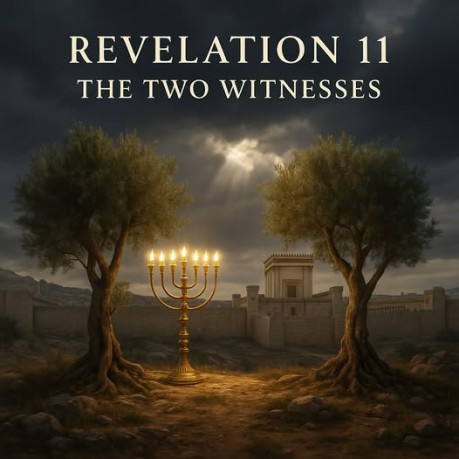
Revelation
11 - The Two Witnesses Revelation
11:3-4 † They are the
first century covenant church, the royal priesthood in Christ, Jew
and Gentile together, bearing witness against Jerusalem in its last
days. † Explanation in
plain terms † Put together,
that means they are the first-century church, Jew and Gentile
believers together in Christ, a royal priesthood (1 Peter 2:9). † Olive trees in
Zechariah 4:3, 11-14 stand for the priest and the king, Joshua and
Zerubbabel, who were empowered by the Spirit to lead God's people.
In Christ, those roles are combined and extended to the church,
which is made a kingdom and priests, Revelation 1:6, 5:10. Revelation 11:2-3 † Forty-two months
equals 1260 days, three and a half years, the tribulation span of
the Jewish War leading to AD 70. Luke 21:20-22 † Jesus fixed the
timing, the fulfillment would occur when Jerusalem was surrounded by
armies in that generation. Revelation 11:5-6 † Moses and Elijah
motifs, drought and blood, show the church speaking with prophetic
authority, Jeremiah 5:14, 1 Kings 17, Exodus 7, not that Moses and
Elijah literally return. Revelation 11:7-9 † The great city is
Jerusalem, where the Lord was crucified. Revelation 11:11 † God vindicated
His people, the testimony revived, the gospel could not be
crushed. 1 Peter 2:9 † Royal priesthood
language ties the church to Zechariah's priest king pattern,
matching the two olive trees identity. † The two witnesses
are not the Old and New Testament. The text identifies them as olive
trees and lampstands, not books. Scripture is living and active
(Hebrews 4:12), but Revelation 11 speaks of a people prophesying in
sackcloth, being killed, and vindicated. That cannot apply to
scrolls. † The two witnesses
are not Jesus Himself. Revelation distinguishes the witnesses from
the Lord of the earth whom they stand before, Revelation 11:4. Jesus
is the Judge and King, not one of the two witnesses. † The two witnesses
are not the Father. The Father never takes the role of a prophetic
witness clothed in sackcloth, nor does He suffer persecution or
death at the hands of Jerusalem and Rome. † The two witnesses
are not Jesus ben Ananias, the prophet Josephus records who warned
Jerusalem before its fall (Wars 6.5.3). He was one man, not two, and
he is not called an olive tree or lampstand. His warnings confirm
the church's testimony, but he does not fulfill Revelation 11. † Revelation itself
defines the two witnesses: they are the covenant community of the
church in the first century, Jew and Gentile together, a royal
priesthood testifying against Jerusalem before its destruction. † This is the fulfilled
perspective we proclaim at Fulfilled Prophecies † Source Index † Josephus, Wars of
the Jews - https://www.perseus.tufts.edu/hopper/text?doc=J.+BJ † Eusebius,
Ecclesiastical History - https://www.newadvent.org/fathers/2501.htm † Tacitus,
Histories -
https://penelope.uchicago.edu/Thayer/E/Roman/Texts/Tacitus/home.html † Suetonius, The
Twelve Caesars -
https://penelope.uchicago.edu/Thayer/E/Roman/Texts/Suetonius/home.html † Victorinus,
Commentary on the Apocalypse -
https://www.newadvent.org/fathers/0712.htm † Augustine, City
of God - https://www.newadvent.org/fathers/120120.htm † Revelation 11,
Luke 21, Zechariah 4 - https://biblehub.com/nasb
By Dan Maines
And I will grant authority to my two witnesses,
and they will prophesy for twelve hundred and sixty days, clothed in
sackcloth. These are the two olive trees and the two lampstands that
stand before the Lord of the earth.
† Two lampstands points to churches,
Revelation 1:20, so this is corporate, not two future individuals.
†
Two olive trees recalls Zechariah 4, priest and king, now fulfilled
in the church as a kingdom of priests, Revelation 1:6, 5:10, 1 Peter
2:9.
† The number two answers the law of
witness, Deuteronomy 19:15, confirmed by Jesus, Matthew 18:16.
† In fulfilled theology, the two
witnesses are not two future prophets (like Enoch and Elijah or
Moses and Elijah, as futurists often claim). Revelation itself tells
us who they are.
† Olive trees = priest and
king roles from Zechariah 4.
† Lampstands =
churches, Revelation 1:20.
† Two witnesses =
covenantal requirement for testimony, Deuteronomy 19:15.
†
They wore sackcloth because they were warning Jerusalem like
prophets. Their ministry looked like Moses and Elijah, plagues,
drought, fire, but that is symbolic, not literal. Their "death"
represents persecution and the attempt to silence the church's
testimony. Their "resurrection" is their vindication when
Jerusalem was destroyed in AD 70, proving their message was true and
that Christ had come in judgment just as He promised.
†
So the two witnesses = the covenant community of the church in the
first century, bearing faithful testimony against Jerusalem before
its destruction.
†
Lampstands in Revelation 1:20 are not individuals but churches. John
already explained this at the beginning of the book. When Revelation
11 calls the witnesses lampstands, it is showing they are a
corporate body of believers, not just two men.
†
Two witnesses in Deuteronomy 19:15 and Matthew 18:16 reflect the
covenant law that nothing is established without the testimony of
two or three witnesses. The number is not random, it is covenantal
language that says the church's witness was legally valid before
God.
† When you put these together, it
becomes clear that the witnesses are not two special end-time
prophets. They are the first-century church itself, Jew and Gentile
joined into one body in Christ, called a royal priesthood, 1 Peter
2:9. Their role was to testify against Jerusalem before its
destruction in AD 70.
They
will tread underfoot the holy city for forty-two months. And I will
grant authority to my two witnesses, and they will prophesy for
twelve hundred and sixty days, clothed in sackcloth.
† Their
sackcloth shows covenant warning and mourning to Israel before the
end of the Old Covenant order.
But
when you see Jerusalem surrounded by armies, then recognize that her
desolation is near. Then those who are in Judea must flee to the
mountains, and those who are inside the city must leave, and those
who are in the country must not enter the city, because these are
days of vengeance, so that all things which have been written will
be fulfilled.
And
if anyone wants to harm them, fire flows out of their mouth and
devours their enemies, so if anyone wants to harm them, he must be
killed in this way. These have the power to shut up the sky, so that
rain will not fall during the days of their prophesying, and they
have power over the waters to turn them into blood, and to strike
the earth with every plague, as often as they desire.
† The church bears
the Law and the Prophets fulfilled in Christ, Luke 24:44, testifying
to Israel before the judgment.
When
they have finished their testimony, the beast that comes up out of
the abyss will make war with them, and overcome them and kill them.
And their dead bodies will lie in the street of the great city which
is spiritually called Sodom and Egypt, where also their Lord was
crucified.
†
The beast's assault pictures the attempt to silence the church's
witness by Jewish and Roman power before AD 70.
†
Jerusalem is spiritually called Sodom and Egypt for its covenant
corruption.
But
after the three and a half days, the breath of life from God came
into them, and they stood on their feet, and great fear fell upon
those who were watching them.
† AD 70 confirmed Christ's coming
in judgment and His witnesses' victory.
But
you are a chosen race, a royal priesthood, a holy nation, a people
for God's own possession, so that you may proclaim the excellencies
of Him who has called you out of darkness into His marvelous light.
†
Conclusion, the two witnesses are the corporate, royal priestly
church of the first century, testifying in the spirit and power of
Moses and Elijah, establishing covenant lawsuit against Jerusalem,
and vindicated in AD 70.
Links