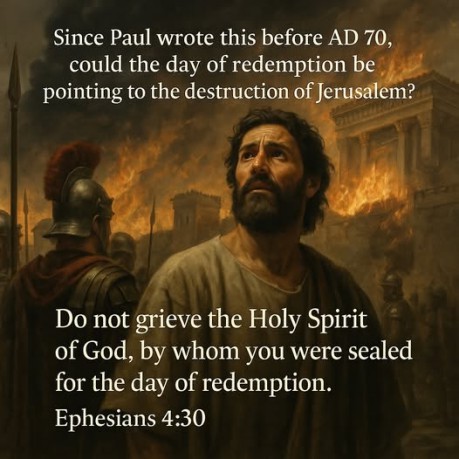
SINCE
PAUL WROTE THIS BEFORE AD 70, COULD THE DAY OF REDEMPTION BE POINTING
TO THE DESTRUCTION OF JERUSALEM? (EPHESIANS 4:30) Yes,
exactly. Paul ties the Spirit's sealing to a future "day of
redemption" (Ephesians 4:30), and Jesus used that same language
when speaking of the fall of Jerusalem: "But when these things
begin to take place, straighten up and lift up your heads, because
your redemption is drawing near" (Luke 21:28). When the temple
fell in AD 70, the old order of sacrifices and priesthood was
finally removed, and the New Covenant stood in full. That was the
day of redemption Paul's audience was sealed for. SEALED FOR THE DAY OF
REDEMPTION
Ephesians 4:30 says, "Do not grieve
the Holy Spirit of God, by whom you were sealed for the day of
redemption." Paul wrote these words to a
first-century audience living in the overlap of two covenants. The
Spirit was given as a seal, not for an endless waiting period, but
for a specific day when redemption would be fully realized. THE SPIRIT AS A GUARANTEE
Paul
explained earlier, "In Him, you also, after listening to the
message of truth, the gospel of your salvation, having also
believed, you were sealed in Him with the Holy Spirit of the
promise, who is a first installment of our inheritance, in regard to
the redemption of God's own possession, to the praise of His glory"
(Ephesians 1:13-14). The Spirit was the down payment of
what was about to be received in full. Jesus tied this day of
redemption to the destruction of Jerusalem, saying, "But when
these things begin to take place, straighten up and lift up your
heads, because your redemption is drawing near" (Luke 21:28). THE CONNECTION TO AD 70
Paul
wrote before AD 70, so the day of redemption was still future to his
audience, but near. Jesus Himself had declared, "Truly I say to
you, this generation will not pass away until all things take place"
(Luke 21:32). Hebrews 8:13 confirms the same reality, "When He
said, 'A new covenant,' He has made the first obsolete. But whatever
is becoming obsolete and growing old is about to disappear." That disappearance of the Old Covenant
happened in the judgment on Jerusalem. The temple was destroyed, the
sacrifices ended, and the old priesthood was swept away. What
remained was the New Covenant standing in full. That was the day of
redemption for which the saints had been sealed. THE REDEMPTION OF THE
BODY
Paul also calls this event "the revealing of
the sons of God" and "the redemption of our body" in
Romans 8:19, 23. The "body" here was not individual
fleshly corpses but the corporate body of God's people. Israel after
the flesh was passing away, and the true body of Christ was being
raised into glory. This is why Paul urged them not to
grieve the Spirit. The Spirit was guiding them through the
transition from the Old Covenant to the New. To resist that work was
to cling to the system that was about to be destroyed. HISTORICAL CONFIRMATION
Josephus, a
first-century eyewitness, confirms the very events Jesus and Paul
spoke of. He describes the Roman siege and destruction of Jerusalem
in vivid detail: The temple, the very center of
Old Covenant life, was consumed by fire (Wars 6.4.5). The sacrifices ceased, ending the
priestly system forever (Wars 6.2.1). Josephus even remarked that Jerusalem's destruction was so
complete it looked as though it had never been inhabited (Wars
6.9.1). These events match the language of
redemption and judgment in scripture. God removed the obsolete
covenant system and brought His people fully into the New Covenant
kingdom. CONCLUSION
Ephesians
4:30 is not pointing to something 2000 years later. The saints were
sealed by the Spirit until the "day of redemption," which
came with the destruction of Jerusalem in AD 70. That day was the
fulfillment of Jesus' prophecy, the completion of the covenant
transition, and the liberation of God's people into the New
Creation. The scriptures and history agree: the
day of redemption Paul spoke of has been fulfilled.
By Dan Maines
Links