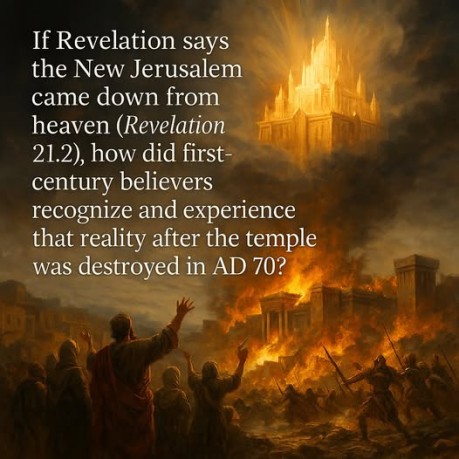
If
Revelation says the New Jerusalem came down from heaven (Revelation
21:2), how did first-century believers recognize and experience that
reality after the temple was destroyed in AD 70? Revelation
21:2 says, "And I saw the holy city, New Jerusalem,
coming down out of heaven from God, prepared as a bride adorned for
her husband." This was not a literal city dropping from the sky, but the
arrival of the New Covenant reality. The city is called "the
bride, the wife of the Lamb" (Revelation 21:9-10), and Paul had
already identified the church as that bride (2 Corinthians 11:2;
Ephesians 5:25-27). When the Old Covenant system fell in AD 70, the way was cleared
for the New Jerusalem to be revealed. First-century believers
recognized this because the very things Jesus had foretold came to
pass, "not one stone here will be left upon another"
(Matthew 24:2). The temple, once the symbol of God's dwelling, was
removed. In its place stood the reality of God's promise: "Behold,
the tabernacle of God is among the people, and He will dwell among
them, and they shall be His people, and God Himself will be among
them" (Revelation 21:3). The New Jerusalem was not about geography but about covenant
presence. The writer of Hebrews said, "You have come to Mount
Zion and to the city of the living God, the heavenly Jerusalem"
(Hebrews 12:22). Notice the tense, not "you will come,"
but "you have come." Believers were already experiencing
this reality in Christ, though it was overshadowed as long as the
temple still stood (Hebrews 9:8-10). When the temple was destroyed,
what had been true spiritually was now confirmed historically. They experienced the reality of the New Jerusalem in several
ways: Freedom to worship without the
temple (John 4:21-23; Hebrews 10:19-22) Unity of Jew and Gentile fully
revealed (Ephesians 2:14-16; Galatians 3:28) Assurance that Christ's kingdom was vindicated (Daniel
7:13-14 fulfilled in Matthew 24:30) These were not distant promises but lived realities once the old
order was removed. Josephus confirms the decisive break that took place. In Wars of
the Jews 6.4.5, he records the burning of the temple and how even
Roman generals were astonished at its complete destruction. This was
exactly what Jesus had prophesied, and it gave undeniable proof that
God had judged the old system. Without the temple, worship was no
longer tied to a building but to Christ, who had made His people the
temple (1 Corinthians 3:16; 1 Peter 2:5). The unity of the body,
once hidden by the shadow of the Old Covenant, now stood out clearly
as the New Jerusalem. The city had come down from heaven
because it was not of man's making. It was "prepared as a bride
adorned for her husband" God's own work through Christ. By AD
70, the bride was revealed in her fullness, the church joined to her
Lord, and the dwelling of God among His people forever established. That is how the first-century saints
recognized the New Jerusalem: not by looking for stones and walls,
but by seeing the living temple of God built upon Christ Himself
(Ephesians 2:19-22; 1 Peter 2:4-5).
By Dan MainesThe End of the Old
Covenant
The Reality of the
New Jerusalem
How They
Experienced It
Historical
Confirmation
The Fulfillment
Links