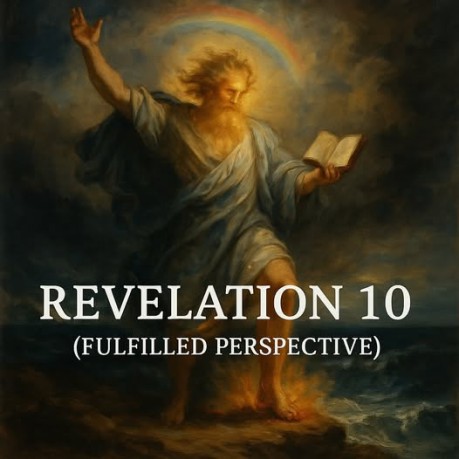
Revelation 10:1
"I
saw another strong angel coming down from heaven, clothed with a
cloud, and the rainbow was on his head, and his face was like the
sun, and his feet like pillars of fire." This angel reflects Christ
Himself, or at minimum represents His authority. Clothed with a
cloud recalls Daniel 7:13 where the Son of Man comes on the clouds
of heaven, a symbol of judgment and authority. The rainbow on His head recalls
God's covenant mercy in Genesis 9:13, showing that even in judgment
there is covenant faithfulness. His face like the sun and His feet like pillars of fire echo
Revelation 1:15-16, tying Him directly to the description of Christ
in chapter 1. Revelation 10:2
"And he had in his
hand a little scroll, which was open. He placed his right foot on
the sea and his left on the land." The little scroll contrasts with
the larger scroll of chapter 5. This one is opened, symbolizing
that the mystery is revealed and ready to be declared. His stance over sea and land shows universal dominion. Both
Israel (land) and the nations (sea) fall under His authority. Revelation 10:3
"And he cried out with
a loud voice, as when a lion roars; and when he had cried out, the
seven peals of thunder uttered their voices." His voice like a lion's roar
reflects Amos 1:2 where the Lord roars from Zion in judgment. The seven thunders symbolize complete testimony and the
fullness of God's voice in judgment. Revelation 10:4
"When the seven peals
of thunder had spoken, I was about to write; and I heard a voice
from heaven saying, Seal up the things which the seven peals of
thunder have spoken, and do not write them." John is told not to reveal what
was spoken. This shows there are aspects of judgment that remain
hidden. It echoes Daniel 12:4, where some things were sealed until
the time of the end. The difference is crucial. Daniel was told to seal until the
end, but John is later told, "Do not seal up the words of the
prophecy of this book, for the time is near" (Revelation
22:10). Daniel pointed forward, John announces arrival. Revelation 10:5-6
"Then the angel whom
I saw standing on the sea and on the land raised his right hand to
heaven, and swore by Him who lives forever and ever, who created
heaven and the things in it, and the earth and the things in it, and
the sea and the things in it, that there will no longer be a delay." This is a solemn oath, affirming
that the time of fulfillment has arrived. God, as Creator, is the witness
to this oath. The statement that there will be no more delay confirms the
nearness of the events in the first century. The Greek phrase
chronos ouketi estai means no more delay, not the end of time. Revelation 10:7
"but in the days of
the voice of the seventh angel, when he is about to sound, then the
mystery of God is finished, as He announced to His servants, the
prophets." The mystery of God refers to the
gospel and the covenant transition. Paul speaks of this mystery in
Ephesians 3:4-6, that Gentiles are fellow heirs. By the sounding of the seventh
trumpet, the Old Covenant order would be finished and the New
Covenant fully established. This was fulfilled in AD 70 with the
destruction of Jerusalem. Revelation 11:15 confirms this, "The kingdom of the
world has become the kingdom of our Lord and of His Christ." Revelation 10:8-9
"Then the voice
which I heard from heaven, I heard again speaking with me, and
saying, Go, take the scroll which is open in the hand of the angel
who stands on the sea and on the land. And I went to the angel,
telling him to give me the little scroll. And he said to me, Take it
and eat it; it will make your stomach bitter, but in your mouth it
will be sweet as honey." Eating the scroll recalls Ezekiel
3:1-3, where the prophet ate the scroll of lamentations and woes. Sweet to the mouth because God's word is true and glorious.
Bitter to the stomach because the message involves judgment and
destruction. Revelation 10:10
"I took the little
scroll from the angel's hand and ate it, and in my mouth it was
sweet as honey; and when I had eaten it, my stomach was made
bitter." The sweetness reflects the joy of
revelation and the fulfillment of God's promises. The bitterness reflects the sorrow of seeing Jerusalem
judged and covenant curses fall on those who rejected Christ. Revelation 10:11
"And they said to me,
You must prophesy again concerning many peoples, nations, languages,
and kings." John is commissioned to continue
prophesying about the nations. The judgment of Jerusalem is not the end of God's work. The
gospel would spread to all nations and the kings of the earth would
be confronted with the authority of Christ. Revelation itself anchors the
timing Revelation 1:1, 3 says "things
which must soon take place" and "the time is near." Revelation 22:6, 10 repeats
"things which must soon take place" and "do not
seal up the words of the prophecy, for the time is near." Revelation 10:6 seals it, "there
will be delay no longer." The countdown ended in that
generation. The seventh trumpet aligns with
covenant transition Revelation 10:7 declares, "the
mystery of God is finished." Revelation 11:15 shows the
result at the seventh trumpet, "The kingdom of the world has
become the kingdom of our Lord and of His Christ." Paul confirms in 1 Corinthians
15:52 that resurrection is at the last trumpet, which ties
directly into the covenantal shift. The immediate context targets
Jerusalem's temple Revelation 11:1-2 describes the
temple and "the holy city" being trampled for forty-two
months, just as Jesus said in Luke 21:24, "Jerusalem will be
trampled under foot by the Gentiles." History confirms the temple and
Jerusalem were destroyed in AD 70, exactly within the framework
John describes. The imagery fits Christ and
covenant judgment Cloud-coming matches Daniel 7:13
and Matthew 24:30. The rainbow shows covenant mercy
amid judgment. The little scroll, sweet and
bitter, recalls Ezekiel's commission and mirrors the joy of
fulfillment mixed with the grief of covenant wrath. The sealed thunders confirm that some details remain hidden,
but the revealed words are unsealed and fulfilled in John's time,
not centuries later. CONCLUSION
Revelation
10 is not a vague prophecy about the distant future. It is a clear
declaration that the mystery of God would be finished soon, with no
more delay. The context leads straight into the trampling of
Jerusalem and the fall of the temple in AD 70. The sweetness and
bitterness of the scroll reflect the joy of the gospel and the
sorrow of judgment. The seventh trumpet marked the end of the Old
Covenant and the establishment of the kingdom of Christ. Scripture,
history, and covenant context together prove first century
fulfillment.
By Dan Maines
REVELATION 10 (FULFILLED PERSPECTIVE)
SCRIPTURAL AND
HISTORICAL SUPPORT
Links