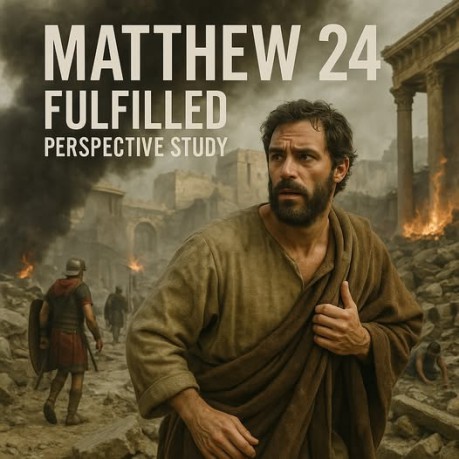
MATTHEW
24 – FULFILLED PERSPECTIVE STUDY (NASB) 1
Jesus came out from the temple and was going away when His disciples
came up to point out the temple buildings to Him.
2
And He said to them, "Do you see all
these things? Truly I say to you, not one stone here will be left
upon another, which will not be torn down." Commentary: This
prophecy was fulfilled in AD 70 when the Romans destroyed Jerusalem
and the Temple. Josephus records that the entire structure was
dismantled so completely that not one stone remained on another
(Wars 7.1.1, p. 467). --- 3 As He was sitting
on the Mount of Olives, the disciples came to Him privately, saying,
"Tell us, when will these things happen, and what will
be the sign of Your coming, and of the end of the age?" Commentary: The
disciples asked three specific questions: WHEN
would the Temple's destruction occur, what would be the sign of His
COMING, and what would mark the END OF THE
AGE. They viewed all three as connected, referring to the
close of the Old Covenant age, not the end of the physical world
(cf. Matthew 13:39-40; Hebrews 9:26). --- 4 And Jesus
answered and said to them, "See to it that no
one misleads you.
5 For many
will come in My name, saying, 'I am the Christ,' and they will
mislead many." Commentary: Before AD
70, many false messiahs arose claiming divine authority (Acts
5:36-37; 1 John 2:18). Josephus records several such figures who
deceived the people (Wars 2.13.4, p. 124; Antiquities
20.8.6, p. 382). --- 6 "You
will be hearing of wars and rumors of wars. See that you are not
alarmed, for those things must take place, but that is not yet the
end.
7 For nation will rise
against nation, and kingdom against kingdom, and in various places
there will be famines and earthquakes.
8
But all these things are merely the beginning of birth
pains." Commentary: The
decades before AD 70 were marked by political unrest, uprisings, and
civil wars within the Roman Empire (Tacitus, Histories 1.2,
p. 180). Famines occurred (Acts 11:28), and major earthquakes struck
places such as Laodicea (AD 60) and Pompeii (AD 62). Jesus calls
these the "beginning of birth pains," the early signs
before Jerusalem's judgment. --- 9 "Then
they will hand you over to tribulation and kill you, and you will be
hated by all nations because of My name.
10
And at that time many will fall away, and they will betray
one another and hate one another.
11
And many false prophets will rise up and mislead many
people.
12 And because
lawlessness is increased, most people's love will become cold.
13
But the one who endures to the end is the one who will be
saved." Commentary: The book
of Acts records numerous persecutions, imprisonments, and executions
of believers (Acts 7:59; Acts 12:2). "Enduring to the end"
refers to remaining faithful until the end of the Jewish-Roman War,
when Jerusalem was destroyed. False prophets also arose, misleading
the people to stay in the city during the siege (Wars
6.5.2, p. 435). --- 14 "This
gospel of the kingdom shall be preached in the whole world as a
testimony to all the nations, and then the end will come." Commentary: By the
early 60s AD, Paul wrote that the gospel had been proclaimed "in
all creation under heaven" (Colossians 1:23; Romans 10:18). The
term "whole world" (Greek: oikoumene) refers to
the Roman Empire, the inhabited land of their time, not the entire
globe. --- 15 "Therefore
when you see the abomination of desolation, which was spoken of
through Daniel the prophet, standing in the holy place (let the
reader understand),
16 then
those who are in Judea must flee to the mountains.
17
Whoever is on the housetop must not go down to get things
out of his house.
18 And
whoever is in the field must not turn back to get his cloak. Commentary: The
"abomination of desolation" refers to the Roman armies
surrounding Jerusalem (Luke 21:20), which was the signal for
believers to flee. Early church historian Eusebius records that the
Christians obeyed and escaped to Pella before the final siege
(Eusebius, Ecclesiastical History 3.5.3, p. 75). --- 19 "But
woe to those women who are pregnant, and to those who are nursing
babies in those days!
20 Moreover,
pray that when you flee, it will not be in the winter, or on a
Sabbath." Commentary: Winter
would make travel difficult, and Sabbath travel restrictions among
Jews could hinder escape. Josephus notes that the Roman assault was
timed near Passover, when travel in and out of the city was
restricted (Wars 5.3.1, p. 400). --- 21 "For
then there will be a great tribulation, such as has not occurred
since the beginning of the world until now, nor ever will again.
22
And if those days had not been cut short, no life would have
been saved; but for the sake of the elect those days will be cut
short." Commentary: This
describes the horrific events of AD 70. Josephus calls the
destruction of Jerusalem the most tragic of all wars, with
unparalleled suffering (Wars 6.9.4, p. 442). God "cut
short" the siege to spare the elect, the believers who had fled
beforehand. --- 23 "Then
if anyone says to you, 'Behold, here is the Christ,' or 'He is over
here,' do not believe him.
24 For
false christs and false prophets will arise and will provide great
signs and wonders, so as to mislead, if possible, even the elect.
25
Behold, I have told you in advance. Commentary: During
the siege, false prophets inside Jerusalem promised deliverance,
urging people to stay. Josephus says these impostors performed signs
to keep people from surrendering to the Romans (Wars 6.5.2,
p. 435). --- 26 "So
if they say to you, 'Behold, He is in the wilderness,' do not go out
there; behold, He is in the inner rooms, do not believe them.
27
For just as the lightning comes from the east and flashes as
far as the west, so will the coming of the Son of Man be.
28
Wherever the corpse is, there the vultures will gather." Commentary: The
"coming" here is a coming in judgment upon Jerusalem, not
a bodily return to earth. Lightning imagery speaks of suddenness and
visibility. The vultures (or eagles) are symbolic of Roman armies
(their military standard was the eagle), gathering over the carcass
of the city (cf. Luke 17:37). --- 29 "But
immediately after the tribulation of those days the sun will be
darkened, and the moon will not give its light, and the stars will
fall from the sky, and the powers of the heavens will be shaken.
30
And then the sign of the Son of Man will appear in the sky,
and then all the tribes of the earth will mourn, and they will see
the 'Son of Man coming on the clouds of the sky' with power and
great glory.
31 And He will
send forth His angels with a great trumpet blast, and they will
gather together His elect from the four winds, from one end of the
sky to the other." Commentary: This
apocalyptic language is drawn from Isaiah 13:10 and Daniel 7:13-14,
describing divine judgment using cosmic signs. "Coming on the
clouds" is covenant judgment language, fulfilled when Christ
judged Jerusalem through the Romans. The "angels"
(messengers) gathering the elect refers to the gospel call and the
preservation of believers throughout the empire. --- 32 "Now
learn the parable from the fig tree: as soon as its branch has
become tender and sprouts its leaves, you know that summer is
near;
33 so you too, when you
see all these things, recognize that He is near, right at the
door.
34 Truly I say to you,
this generation will not pass away until all these things take
place.
35 Heaven and earth
will pass away, but My words will not pass away." Commentary: The
"generation" of Jesus' hearers lived to see the
destruction of Jerusalem in AD 70 (about 40 years later). "Heaven
and earth" here can refer symbolically to the Old Covenant
order (Isaiah 51:16). --- 36 "But
about that day and hour no one knows, not even the angels of heaven,
nor the Son, but the Father alone.
37
For the coming of the Son of Man will be just like the days
of Noah.
38 For as in those
days before the flood they were eating and drinking, marrying and
giving in marriage, until the day that Noah entered the ark,
39
and they did not understand until the flood came and took
them all away; so will the coming of the Son of Man be." Commentary: The
comparison to Noah shows that judgment came suddenly while life
seemed normal. Likewise, Jerusalem's destruction came swiftly upon
those ignoring Jesus' warning (Luke 21:20-24). --- 40 "At
that time there will be two men in the field; one will be taken and
one will be left.
41 Two
women will be grinding at the mill; one will be taken and one will
be left." Commentary: Those
"taken" are taken in judgment (cf. Luke 17:34-37), while
those "left" are the spared who escaped before the siege. --- 42 "Therefore
be on the alert, for you do not know which day your Lord is
coming.
43 But be sure of
this, that if the head of the house had known at what time of the
night the thief was coming, he would have been on the alert and
would not have allowed his house to be broken into.
44
For this reason you must be ready as well; for the Son of
Man is coming at an hour when you do not think He will." Commentary: Readiness
here meant heeding the signs and fleeing when the Roman armies
appeared. The believers who remembered Jesus' words escaped. --- 45 "Who
then is the faithful and sensible slave whom his master put in
charge of his household slaves, to give them their food at the
proper time?
46 Blessed is
that slave whom his master finds so doing when he comes.
47
Truly I say to you that he will put him in charge of all his
possessions.
48 But if that
evil slave says in his heart, 'My master is not coming for a long
time,'
49 and he begins to
beat his fellow slaves, and to eat and drink with those who are
habitually drunk;
50 then the
master of that slave will come on a day that he does not expect and
at an hour that he does not know,
51
and he will cut him in two and assign him a place with the
hypocrites; in that place there will be weeping and gnashing of
teeth." Commentary: The
"faithful servant" represents the believers who stayed
watchful and obedient. The "evil servant" represents the
unbelieving leaders of Israel who ignored the warnings and abused
God's people. Judgment fell on them in AD 70.
By Dan Maines
Links