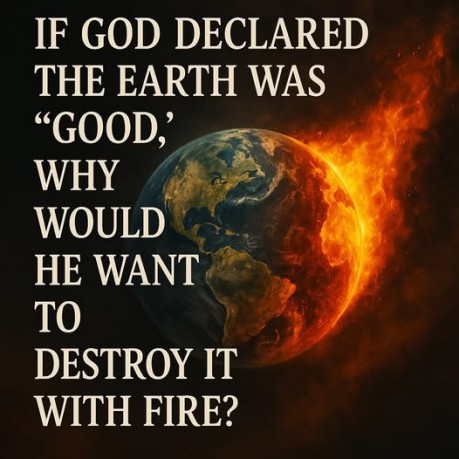
If
God Declared the Earth Was Good, Why Would He Want to Destroy It with
Fire?
Introduction: Many Christians today believe that God
will one day destroy the physical earth with fire. But is that what
scripture really teaches? If God declared His creation "very
good," why would He want to obliterate it? As a Preterist, I
believe the Bible teaches a different story, one rooted in covenant,
not cosmic destruction. Genesis Declares the Earth Was Good Genesis 1:31: God saw all that He
had made, and behold, it was very good. And there was evening and
there was morning, the sixth day. God's creation was not flawed or evil. It was very good.
There was no reason for Him to later decide it must be
annihilated. The Fire Judgment Was Not Cosmic, But Covenantal 2 Peter 3:7: But by His word the
present heavens and earth are being reserved for fire, kept for the
day of judgment and destruction of ungodly people. The “heavens and earth” here
refers to the Old Covenant system. Peter was not speaking of
literal planets and stars, but the world of the Mosaic order. Hebrews 12:26-27: And His voice
shook the earth then, but now He has promised, saying, "Yet
once more I will shake not only the earth, but also the heaven."
This expression, "Yet once more," denotes the removal of
those things which can be shaken, as of created things, so that
those things which cannot be shaken may remain. The shaking was the removal of the Old Covenant system, not
the physical globe. The Earth Abides Forever Ecclesiastes 1:4: A generation
goes and a generation comes, but the earth remains forever. The physical earth is not
destined for destruction. Scripture plainly states it will remain. Psalm 104:5: He established the
earth upon its foundations, so it will not totter forever and ever. God's intention is for His physical creation to endure. What Was Burned? Malachi 4:1: For behold, the day
is coming, burning like a furnace, and all the arrogant and every
evildoer will be chaff; and the day that is coming will set them
ablaze, says the Lord of armies, so that it will leave them neither
root nor branches. The fire was a judgment on people, not nature. This was
fulfilled in the judgment of AD 70. The Elements That Melted 2 Peter 3:10: But the day of the
Lord will come like a thief, in which the heavens will pass away
with a roar and the elements will be destroyed with intense heat,
and the earth and its works will be discovered. The word “elements” (Greek: stoicheia) refers to the
basic principles of the Law (Galatians 4:3, Colossians 2:20).
These were the elements that were destroyed, not the periodic
table. New Heavens and New Earth = New Covenant Isaiah 65:17: For behold, I
create new heavens and a new earth; and the former things will not
be remembered or come to mind. This is covenantal language. God
was promising a new order, not a new planet. Revelation 21:1: Then I saw a new
heaven and a new earth; for the first heaven and the first earth
passed away, and there is no longer any sea. This is the full establishment of the New Covenant, where
God dwells with His people. Conclusion: God did not create the world only to
later destroy it. He declared it good, and it remains good. The fire
judgment in scripture refers to the end of the Old Covenant world,
not to the annihilation of the physical planet. The Preterist view
restores harmony to scripture and exalts the enduring purpose of
God's good creation. Final Thought: Psalm 119:89: Forever, Lord, Your word
stands in heaven. If God's word stands forever, and His
creation was called good, then what was truly destroyed in fire was
not creation, but corruption. The earth remains, and God's
redemptive plan continues, not through destruction, but through
restoration.
By Dan Maines
Links