If
Babylon will 'never be found again,' what does that mean from a
historical or covenantal standpoint? (Revelation 18:21) From the historical standpoint,
Revelation 18:21 points to the complete destruction and removal of
what "Babylon" symbolized. While some see Babylon as Rome,
from the fulfilled view, Babylon refers to Jerusalem under the Old
Covenant system. Jesus called Jerusalem the city that kills the
prophets (Matthew 23:37), and Revelation 18:24 says, "And in her
was found the blood of prophets and of saints, and of all who have
been slaughtered on the earth." This could only apply to
Jerusalem (see also Luke 13:33-34). When Revelation says Babylon "will
never be found again," it is using finality language, like what
we see in Jeremiah 51:63-64, where physical Babylon is thrown into
the Euphrates to show its total end. Likewise, in Revelation 18:21,
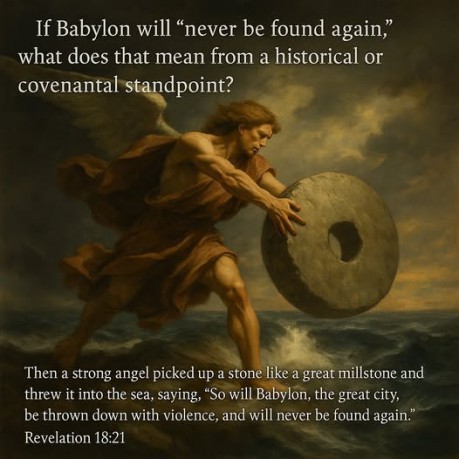
the imagery of the millstone shows a judgment from which there is no
recovery. From the covenantal standpoint, this
means the Old Covenant system tied to the earthly Jerusalem, the
temple, the priesthood, and the sacrificial law was completely and
permanently ended. Hebrews 8:13 says, "When He said, 'A new
covenant,' He has made the first obsolete. But whatever is becoming
obsolete and growing old is about to disappear." That
disappearance was completed in the destruction of Jerusalem in AD 70. So the phrase "never be found
again" does not refer to a literal city vanishing from the map,
but to the permanent covenantal removal of apostate Jerusalem as the
center of God's redemptive plan. It was replaced with the heavenly
Jerusalem, the body of Christ, the New Covenant people (Hebrews
12:22-24).
By Dan Maines
Links