The
Original Audience – The Key to Understanding Scripture
Brothers and sisters in Christ, as a Preterist and student of
fulfilled prophecy, I want to take a moment to highlight a
foundational principle that must guide our interpretation of the
Word of God: Audience Relevance. Without this lens,
we risk distorting the truth and applying promises or judgments
where they were never intended. Let me walk you through this critical
truth using Scripture and reason, step by step: The Original Audience Matters Always ask yourself: "What
did it mean to the first century disciples?"
This is not
just a helpful question, it is essential. It does not matter what
you think a verse means today unless you first understand what it
meant then. Consider Jesus' words in Matthew
24:34:
"Truly I say to you, this generation will
not pass away until all these things take place."
Jesus
was not speaking ambiguously. He addressed that generation, not
ours. Audience relevance tells us Jesus was speaking directly to
His listeners. Hebrews 1:1-2 says:
"God, after
He spoke long ago to the fathers in the prophets in many portions
and in many ways, in these last days has spoken to us in His
Son..."
Notice who us is. The author of Hebrews is saying
they were in the last days. Not us. The original recipients were
experiencing the climax of the ages. Scripture Was Not Written To Us One of the biggest missteps in
modern Christianity is treating the Bible like a direct letter to
the 21st century.
Let us be clear: the Bible is for us, but it
was not written to us. Romans 15:4
reminds us:
"For whatever was written in earlier times
was written for our instruction, so that through perseverance and
the encouragement of the Scriptures we might have hope."
Paul
confirms it was written for our benefit, but not to us. When John wrote Revelation, he was writing
to seven literal churches in Asia Minor (Revelation 1:4).
They
were real churches dealing with real persecution. He was not
cryptically writing to a distant generation 2,000 years later. We Are Reading Someone Else's Mail When you open the New Testament,
you are reading correspondence between apostles and early Christian
communities.
The issues, questions, and warnings were specific
to their circumstances. 1 Corinthians 1:2:
"To
the church of God which is in Corinth..."
Paul is not
writing to a church in modern America. He is writing to Corinth,
and everything he says must first be understood in that historical
context. Philippians 1:1:
"To all the
saints in Christ Jesus who are in Philippi..."
Again, an
audience in a specific city, at a specific time, under specific
pressures. "Here's What This Scripture Means To Me" – A
Dangerous Statement In modern Christianity, people
often say, "Here's what this Scripture means to me."
But
the only biblical truth at that point is: It does not matter what
it means to you, unless you understand what it meant to them. 2 Peter 1:20-21 warns us:
"But
know this first of all, that no prophecy of Scripture becomes a
matter of someone's own interpretation, for no prophecy was ever
made by an act of human will..."
Meaning is not personal.
It is rooted in what God meant, and what it meant to the people to
whom it was written. Time Statements Were Not Elastic Scripture is full of time
indicators: "the time is near", "this generation",
"about to", "at hand".
These phrases were
meant for the original audience. Revelation 1:1:
"The
Revelation of Jesus Christ... to show His bond-servants the things
which must soon take place."
If that didn't mean soon for
them, then the text is meaningless. James 5:8-9:
"You too be patient,
strengthen your hearts, for the coming of the Lord is near. Do not
complain... behold, the Judge is standing right at the door."
That
urgency was for them, not for us 2,000 years later. Conclusion We must rightly divide the Word
of truth, and that begins by respecting who it was written to and
why.
The truth is, there is not one book in the Bible that was
written to someone living today. That may be a shocking statement,
but it is honest. The Bible was written to others, but for us.
It
reveals God's character, redemptive plan, and the fulfillment of
His promises. So next time you hear, "Here's what this verse means to
me", remember:
What matters is what it meant to them.
That's where Bible truth is found.
Only after understanding
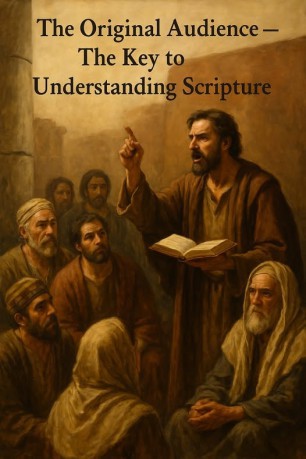
that, can we apply it faithfully to our own lives today. Amen. The image represents a generic
first-century preacher or apostle delivering a message to the
original audience, symbolizing how scripture was addressed to real
people in a real time. The goal was to visually reinforce the theme
of "The Original Audience – The Key to Understanding
Scripture,"
By Dan Maines
Links