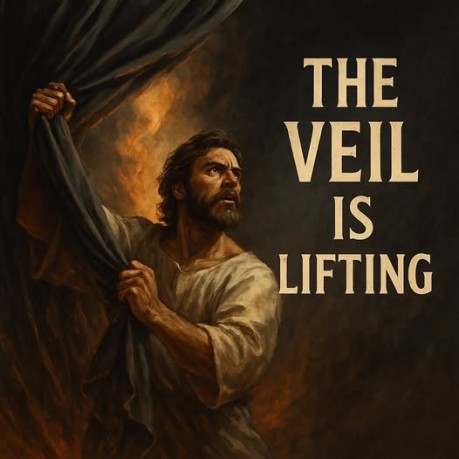
The
Veil Is Lifting That's the painful
truth many of us have had to face. We were brought up in a religious
system that mixed the Old and New Covenants, taught us to idolize
Israel, and left us stuck in the shadow of the Old Testament, even
after Jesus fulfilled it all. Hebrews 8:13 says, The author of Hebrews wrote those words in the first century. The
Old Covenant was not only obsolete, it was about to disappear
entirely. And it did, when the temple fell in 70 AD. That system was
judged and removed. Yet here we are, 2,000 years
later, and most of Christianity is still clinging to what God
already ended. They still preach the Ten
Commandments as if we're under Sinai, instead of the law of Christ,
which is love, grace, and walking in the Spirit. They still elevate ethnic Israel,
even though Galatians 3:28 says, They still condemn others based on Mosaic Law, when Jesus
came bringing grace and truth. Why? Because church tradition took precedence over scripture. And
Jesus warned us about it: Matthew 15:6 – "You invalidated the word of God for
the sake of your tradition." This is why it's hard to sit in a church today and hear messages
that: Mix Law and Grace like oil and
water Preach a future return of Christ
when He clearly said He would come in their generation Matthew 24:34 – "Truly I
say to you, this generation will not pass away until all these
things take place." Quote Moses more than they quote Jesus Many of us have walked this lonely
road. We felt isolated. We were called heretics, outcasts, or even
dangerous for questioning tradition. But now we know the truth. We are free from the bondage of
man-made systems. We are part of the true body of Christ. 2 Corinthians 3:14-15 says, What Does It Mean That the
Veil Is Gone? When scripture says the veil is gone, it is not just poetic
language. It is a powerful truth about access, identity, and
transformation. The veil represented separation.
It kept man out of the presence of God. When Jesus died, that separation was ended once and for all. Now: We no longer need a physical
priest We no longer need an earthly
temple The Old Covenant access system is
abolished We walk in the Spirit with
boldness and freedom Hebrews 6:19-20 – To say the veil is gone is to say: The Old Covenant system is
fulfilled and finished We are no longer separated from
God's presence We walk in the Spirit, not by the
letter of the Law We see clearly what generations
before could not We are free So when you hear that the veil is
gone, know this: Christ has opened the way fully and forever. No
more shadows. No more confusion. No more waiting. The veil is gone. The kingdom has
come. And you are living in the reality they only hoped for. Praise God, we are no longer
behind the veil. We are in His presence. What Veil Was Torn? Matthew 27:51 says, This moment is often quoted, but not always understood. So which
veil was torn? The Second Temple (Herod's Temple) had two key veils: Inner veil
(parokhet): Only the High Priest could pass
through this veil, once a year on the Day of Atonement (Leviticus
16:2). Outer veil (masak): Most scholars and early church sources
(like Josephus and the Talmud) agree that Matthew 27:51
refers to the inner veil that separated the Holy
Place from the Most Holy Place. Reasons for this view: The tearing of the veil
symbolized the end of separation between God and man,
since the Holy of Holies represented God's
presence (Hebrews 9:7). Hebrews 10:19–20
links Jesus' death to access into the Holy of Holies: The dramatic tearing from
top to bottom implies divine action, not man's. Early rabbinic sources mention strange
temple events around 30 AD, implying disruption in the inner
sanctuary. Some suggest it could have been the
outer veil (at the entrance to the Holy Place),
pointing to the symbolism of mankind gaining access to the priestly
ministry of Jesus. While that symbolism fits in a limited
way, there's no biblical evidence that this veil
had the same theological weight as the inner veil. The inner veil is always associated with direct
access to God's presence (Exodus 26:33, Leviticus 16:2),
which aligns better with the message of the cross. Two more divisions: Court of the Gentiles
barrier: Court of Women barrier: It was the inner veil,
the one separating the Holy Place from the Holy
of Holies. It symbolized access into
God's presence, which was restricted under the Old
Covenant but opened through Christ. This fits perfectly with Hebrews
6:19-20: The types and shadows show that Jesus, our
High Priest, didn't just minister in the outer area. He entered the
true Holy of Holies in heaven (Hebrews 9:24), and
the torn veil proves that access is now open through Him.
By Dan Maines
Per request from a comment and
which veil was torn (at bottom).
"When He said, 'A new
covenant,' He has made the first obsolete. But whatever is becoming
obsolete and growing old is about to disappear."
"There is neither Jew
nor Greek, there is neither slave nor free, there is neither male
and female, for you are all one in Christ Jesus."
"But their minds were
hardened, for until this very day at the reading of the old
covenant the same veil remains unlifted, because it is removed in
Christ. But to this day whenever Moses is read, a veil lies over
their heart."
"This hope we have as an
anchor of the soul, a hope both sure and reliable and one which
enters within the veil, where Jesus has entered as a forerunner for
us..."
"And behold, the veil of the
temple was torn in two from top to bottom, and the earth shook and
the rocks were split."1. The Temple
Layout: Two Main Veils
This separated the Holy Place
from the Most Holy Place (Holy of Holies).
This was at the
entrance to the Holy Place, separating it from the
outer court (Exodus 26:36–37).2. The Veil in
Matthew 27:51 – Which One?
The traditional
view: the inner veil
"Therefore,
brothers and sisters, since we have confidence to enter the holy
place by the blood of Jesus... through the veil, that is, through
His flesh."Alternative view:
the outer veil
3. Other
'Barriers' in the Temple
A literal stone wall separated the Court of
the Gentiles from the inner courts. Paul refers to this in
Ephesians 2:14:
"For He Himself is our
peace... and broke down the barrier of the dividing wall."
This
was not a veil but a literal wall with warnings in
Greek and Latin that Gentiles could not pass.
Women were
restricted from entering certain inner courts, but again, this was
not a veil, it was a physical division
in the Temple architecture.4. Conclusion: The
Veil Torn Was the Inner Veil
"This hope we have as an anchor of the
soul... which enters within the veil, where Jesus has entered as a
forerunner for us..."
Links