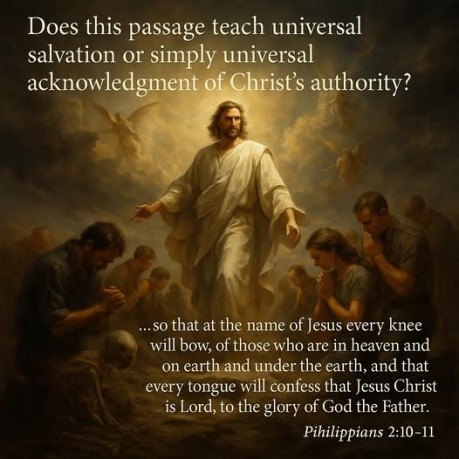
Does this
passage teach universal salvation or simply universal acknowledgment
of Christ's authority? (Philippians 2:10–11) Philippians 2:10–11 teaches universal
acknowledgment of Christ's authority, not universal salvation. Here's why, with scripture (NASB): Philippians 2:10–11: "...so that at the name of Jesus
every knee will bow, of those who are in heaven and on earth and
under the earth, and that every tongue will confess that Jesus Christ
is Lord, to the glory of God the Father." This is a clear reference to Isaiah
45:23, where God says: "To Me every knee will bow, every
tongue will swear allegiance." But in Isaiah 45:24, it continues: "They will say of Me, 'Only in the
Lord are righteousness and strength.' People will come to Him, and
all who were angry at Him will be put to shame." So the acknowledgment is universal, but
the response is not. Some rejoice in salvation, others bow in defeat
and judgment. Compare with Romans 14:11–12: "As I live, says the Lord, to Me
every knee will bow, and every tongue will give praise to God. So
then each one of us will give an account of himself to God." That's judgment language, not salvation
for all. And finally, Revelation 20:11–15
shows the dead standing before the throne. They too confess and bow
but some are thrown into the lake of fire. Their confession does not
result in salvation. Philippians 2:10–11 describes
Christ's universal authority being recognized. It does not mean all
are saved. Some bow in joy, others in judgment.
By Dan Maines
Links