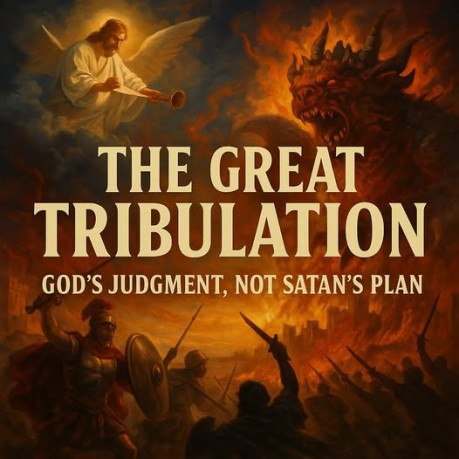
The
Great Tribulation: God's Judgment, Not Satan's Plan
Many people teach that the Great Tribulation is Satan's doing, often
pointing to Revelation 13:5-8. But when we look at the full context
of Revelation, we see that this is not Satan's master plan. It is
God's covenantal judgment, carried out through events that He
ordains and controls. The entire structure of Revelation, the seals,
trumpets, and bowls, is initiated by God, not by Satan. The Lamb Initiates the Judgments Revelation 6:1 says, "Then I
saw when the Lamb broke one of the seven seals." Every seal is
opened by Jesus, the Lamb of God. Revelation 8:6 says, "And
the seven angels who had the seven trumpets prepared themselves to
sound them." These judgments come from heaven, by the command
of God. Revelation 16:1 says, "Go
and pour out on the earth the seven bowls of the wrath of God."
The bowls are explicitly called God's wrath, not Satan's. This structure mirrors Old Testament covenant judgments,
where God used nations (like Babylon or Assyria) to bring wrath on
His people. In Revelation, God is doing the same through Rome. The Devil's Wrath Is Reactionary Revelation 12:12 says, "Woe
to the earth and the sea, because the devil has come down to you,
having great wrath, knowing that he has only a short time." Satan is furious because his time
is short, but he is reacting to God's judgments, not directing
them. His actions are limited and permitted only for a brief
period. Revelation 12:9-10 shows that Satan had been defeated and
cast down before his wrath is mentioned. This proves his role is
subordinate. The Beast's Power Is Given, Not Taken Revelation 13:5 says, "A
mouth was given to him speaking arrogant words and blasphemies, and
authority to act for forty-two months was given to him." Revelation 13:7 continues, "It
was also given to him to make war with the saints and to overcome
them, and authority was given to him over every tribe, people,
language, and nation." The text does not say the Beast
seized this authority on his own. It says it was given. This
implies divine permission, showing that God is still sovereign,
even over the Beast's limited reign. Revelation 17:17 confirms this: "God has put it in
their hearts to execute His purpose... until the words of God will
be fulfilled." Even the Beast fulfills God's plan. The Antichrist Is Not in Revelation Many people assume that "the
Antichrist" is the Beast of Revelation, but the term
"Antichrist" is never used in Revelation. John explains the concept of
Antichrist in his letters: 1 John 2:18, "Children, it
is the last hour, and just as you heard that antichrist is coming,
even now many antichrists have appeared, from this we know that it
is the last hour." 1 John 2:22 says, "Who is
the liar except the one who denies that Jesus is the Christ? This
is the antichrist..." 1 John 4:3 and 2 John 7 also
refer to antichrists already present in the first century. John links the Antichrist idea to apostates from
within the faith community, not a future global dictator. The 42 Months and the Siege of Jerusalem The Beast's authority lasts 42
months (Revelation 13:5), which aligns perfectly with the
historical siege of Jerusalem by the Romans from 66 to 70 AD. This time frame corresponds to
three and a half years, matching other prophetic time statements
such as: "time, times, and half a
time" (Daniel 7:25) "1,260 days"
(Revelation 12:6) Revelation 11:2 says, "They
will trample the holy city for forty-two months." The "holy
city" is Jerusalem, just as in Matthew 4:5 and Nehemiah 11:1. History confirms that the Jewish-Roman war lasted from late
66 AD to the destruction of the temple in August 70 AD a span of
about 3.5 years. The Great Tribulation in the Words of Jesus Matthew 24:15-16 says,
"Therefore, when you see the abomination of desolation which
was spoken of through Daniel the prophet, standing in the holy
place, then those who are in Judea must flee to the mountains." Jesus places the Great
Tribulation in Judea, not the entire world. Luke 21:20-22 gives the same
prophecy more plainly: "But when you see Jerusalem surrounded
by armies, then recognize that her desolation is near... because
these are days of vengeance, so that all things which have been
written will be fulfilled." Matthew 24:21-22 adds, "For
then there will be a great tribulation, such as has not occurred
since the beginning of the world until now, nor ever will again." This was a one-time
covenantal judgment, not a future global apocalypse. Matthew 24:34 concludes it
plainly: "Truly I say to you, this generation will not pass
away until all these things take place." A biblical generation is around 40 years (Psalm 95:10,
Hebrews 3:9-10). Jesus said this around 30 AD, and the temple was
destroyed in 70 AD. Revelation Confirms the Timeframe and Scope Revelation 11:2 mentions 42
months of trampling the holy city — the same timeframe and city
Jesus warned about. Revelation 17:16-17 confirms that
the Beast and ten kings destroy the harlot city (Jerusalem), not
Rome, and that God is the one who put it
in their hearts to do it. This mirrors Old Testament patterns, like when God used
Babylon to destroy Jerusalem in 586 BC (Jeremiah 25:9). Conclusion
The
Great Tribulation was not Satan's plan but God's covenantal judgment
on Jerusalem, fulfilling what Jesus foretold in Matthew 24:34:
"Truly I say to you, this generation will not pass away until
all these things take place." Satan's wrath was real, but it
was short-lived and under God's control. The Beast's power was
permitted, not autonomous. And the concept of "the Antichrist"
is separate from Revelation altogether, rooted in John's own time,
not in some distant future apocalypse.
By Dan Maines
Links