The
Transition Period
Jewish theology maintains that time was divided into two great
periods, the Mosaic Age (olam hazeh) and the Messianic Age (olam
haba). The Messiah was viewed as one who would bring in a new world.
The period of the Messiah was, therefore, correctly characterized by
the Synagogue as "olam haba," which means: "the world
to come."
By Dan Maines
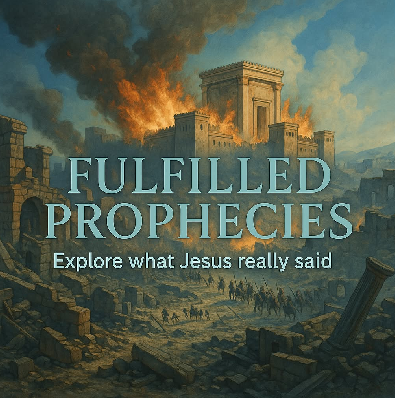
The Transition Period began on
Pentecost in A.D. 30, with the birth of the Church, and it ended at
the destruction of the Jewish Temple in A.D. 70, which ended the Old
Covenant Age. During the Transition Period the Church was growing
from infancy to maturity. God worked in the growing Church through
miraculous gifts and spoke to His prophets to bring His Church to
maturity. A spiritual house was being built in which God would dwell.
This was a time of change and growth, it was a time of transformation
from the Old to the New. The old things of Judaism, the Old Covenant,
faded out very slowly, and the New Covenant gradually phased in. It
was a changing of the ages.
All through the New Testament
we see these two ages in contrast: "this age" and the "age
to come":
"Whoever speaks a word against the Son
of Man, it shall be forgiven him; but whoever speaks against the Holy
Spirit, it shall not be forgiven him, either in this age or in the
age to come. Matthew 12:32 NASB
The word "come" at the end of
the verse is the Greek word mello, which means: "about to be."
We could translate this: "the age about to come" (in the
first century) So the writers of the New Testament saw the "olam
haba" as very near:
far above all rule and authority
and power and dominion, and every name that is named, not only in
this age but also in the one to come. Ephesians 1:21 NASB
So,
the New Testament speaks of two ages, "this age" and "the
age to come." The understanding of these two ages and when they
changed is fundamental to interpreting the Bible. The ages didn't
change over night, there was a Transition Period of forty years.
During this forty years the "this age" was fading away and
"the age to come" was developing.
The New
Testament writers lived in the age that they called "this age."
To the New Testament writers the "age to come" was future,
but it was very near, because "this age" was about to
end:
Now these things happened to them as an example, and
they were written for our instruction, upon whom the ends of the
ages have come. 1 Corinthians 10:11 NASB
Paul said very plainly
that the end of the ages was coming upon "them" (the first
century saints). "This age" was about to end.
We
now live in what was to the first century saints the "age to
come." When most Christians read in the New Testament and see
the words "the age to come," they think of a yet future
(to us) age. But the New Testament writers were referring to the
Christian Age. We live in what was to them the "age to come"
(the New Covenant Age).
Since the "this age" of
the Bible ended in A.D. 70 with the destruction of the Temple and
the parousia, we now live in the "age to come." And since
the "this age" ended in A.D. 70, there are things in the
Bible that applied to the saints who lived in the Transition Period,
but do not apply to us. Paul was writing to saints during the
Transition Period.
Links