Already,
Now, and Soon: A Forgotten Key in Revelation
Let's look a verse in Revelation that many overlook. A verse that
unlocks the timeline of the entire book. It is Revelation 1:19,
where the Lord Jesus commands John: "Therefore write the
things which you have seen, and the things which are, and the things
which will take place after these things." (Revelation 1:19
NASB) There are three time frames here, past, present, and shortly
coming future. The things you have seen
- that's the past. John is told to write what he has already seen,
likely referring to the vision of the glorified Christ in verses
12-18. The things which are
- that's the present. John is writing to real churches dealing with
real situations at that very time. The things which will take place after these things
- that's the future from John's perspective, but not a distant
future. These are things soon to come after the present moment in
his day. This tells us something critical: not
everything in Revelation was future when John wrote it. Much
had already happened. Much was happening. And much was just about to
happen. So when someone comes along and says the bulk of Revelation
is about events 2,000 or 3,000 years removed from John's day, we
must ask: where are they getting that? Because it's not from the
text. It's not from Revelation 1:19. Jesus even repeats this idea of imminence throughout the book: "The time is near."
(Revelation 1:3 NASB) "Behold, I am coming
quickly." (Revelation 3:11 NASB) "Do not seal up the words of the prophecy of
this book, for the time is near." (Revelation 22:10 NASB) If we take Jesus seriously, we must
also take His timeline seriously. If He said it was near, it was
near. Let's now consider one of the
judgments often misunderstood, the sixth bowl judgment in Revelation
16: "The sixth angel poured
out his bowl on the great river, the Euphrates; and its water was
dried up, so that the way would be prepared for the kings from the
east." (Revelation 16:12 NASB) Some interpret this symbolically, and
others historically. But either way, the imagery has roots in real
world events. When Cyrus the Persian conquered Babylon in 539 B.C.,
he diverted the Euphrates River, marched under the city wall, and
took Babylon without a fight. That same imagery is used here, the
drying up of a river to allow an invasion. But now, Babylon isn't literal
Babylon. In Revelation, Babylon is a symbol and I believe, as do
many others, that it represents Jerusalem. Not Rome. Not the
Vatican. Jerusalem. Why Jerusalem? Because this was the
city that had rejected her Messiah. The city Jesus lamented over,
saying: "Jerusalem, Jerusalem,
who kills the prophets and stones those who have been sent to her!"
(Matthew 23:37 NASB) Revelation is a tale of two cities,
the harlot and the bride, Babylon and the New Jerusalem. The harlot
rides the beast, persecutes the saints, and sheds the blood of the
prophets. Only one city fits that description according to Jesus:
Jerusalem. And just like historical Babylon fell
by way of the Euphrates being dried up, John envisions the same fate
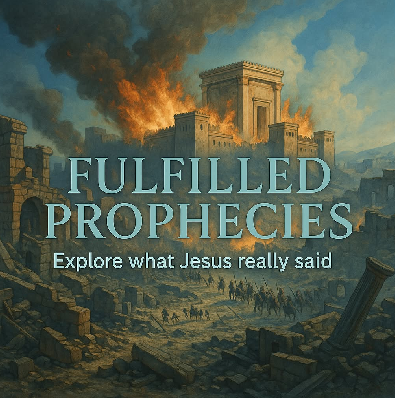
for Jerusalem. Josephus tells us that reinforcements for Titus came
from the Euphrates region. Two men, Sohaemus and Antiochus ruled
territories along the eastern edges of the empire and aided Titus
during the siege of Jerusalem in 70 AD. That's the historical anchor for this
prophecy. It's not random. It's not far off in some unknowable
future. It happened. God had once dried up waters to save
His people, the Red Sea in Exodus 14, and the Jordan in Joshua 3.
Now He uses that same image to bring judgment but this time, on the
apostate city. And while judgment came to Jerusalem,
the faithful were spared. The church, the new covenant people, were
preserved. That's the theme of Revelation. It's not a horror story.
It's a victory scroll. So when we read Revelation, let's read
it as the first century church would have, as something unfolding in
their generation. As something soon. As something they were living
through. Because when we do that, it opens up the true message:
Christ reigns. His kingdom has come. And though judgment fell on
Jerusalem, salvation came to His people. "Because these are days
of punishment, so that all things which have been written will be
fulfilled." (Luke 21:22 NASB) All things written. Not some.
Not partial. All.
By Dan Maines
Links