Satan's
Little Season (SLS) Satan is cast out of heaven Part 3 of 4 Let's aim for that "ah
ha" moment by walking step-by-step through the
timeline Scripture gives. The key is to connect Revelation
12 and 20, since they are describing the same
sequence from different angles. Most miss this because they
separate them by thousands of years, but Revelation doesn't. Revelation 12:9-10
"And the great
dragon was thrown down... the one who accuses them before our God
day and night has been thrown down."
→ This is a clear
moment in history: Satan lost his place in heaven.
He could no longer accuse the brethren. That happened at the
cross, where Jesus disarmed spiritual powers (Colossians
2:15). At that point, the Kingdom began (Rev
12:10), not later. Revelation 12:12
"Woe to the earth...
the devil has come down to you, having great wrath, because he knows
that he has a short time."
→ Here's the key: Satan isn't
bound yet, he's furious. This is the same
"little season" mentioned later in Revelation 20.
People expect Satan's release to happen after a millennium
of peace, but Revelation shows he was already active
in a short, violent burst right after being cast down.
There's no gap. Revelation 12:13-17
He goes after the woman
(Israel), then her offspring (the Church).
→ This is exactly
what happened in Acts and the epistles. He stirred up Jewish leaders
and Roman authorities to kill Jesus and then persecute believers.
Jesus warned of this in Matthew 24:9, saying,
"Then
they will hand you over to tribulation and kill you, and you will be
hated by all nations because of My name."
→ That is
Satan's little season. The persecution, deception,
and attempted destruction of the early Church, not
some distant future rebellion. Revelation 20:1-3
"...so that he would
not deceive the nations any longer..."
→ This is
symbolic of the gospel age, starting in the first
century. The nations were no longer locked in darkness. Paul says in
Colossians 1:6,
"...the gospel... is
bearing fruit and increasing in all the world..."
→
Satan was bound from stopping the gospel mission. That didn't mean
he wasn't doing anything, but his power to blind and
control the nations was broken. Revelation 20:3
"...after these things
he must be released for a short time."
→ That "short
time" is not future. It's the same "short
time" as Revelation 12:12. That's the "ah ha"
moment:
Revelation 12's short wrath = Revelation 20's
little season.
They are the same event,
just told twice, once from heaven's viewpoint, once from the
symbolic "millennium" timeline. Revelation 20:9-10
"And fire came down
from heaven and devoured them. And the devil... was thrown into the
lake of fire..."
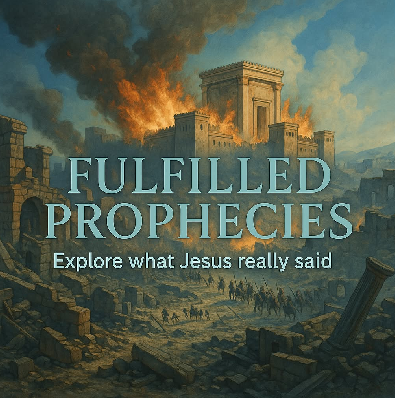
→ This happened when Jerusalem, his
symbolic throne (Revelation 11:8), was judged in AD 70.
Jesus described this judgment as coming in fire in
Matthew 22:7:
"But the king was enraged,
and he sent his armies and destroyed those murderers and set their
city on fire."
→ That's the end of
Satan's influence in covenant history. He's never mentioned again
after that. Revelation doesn't have
two different "short times" for Satan. Revelation 12's "short
time" is the same as Revelation 20's
"little season." That period already happened, in
the first century, between the cross and the fall of Jerusalem. After that, Satan is gone. No more accusation, no more
deception, no more role. This ties the whole picture together
and completely removes the need for a future satanic rebellion. Recap: Revelation 20:1-3 (Satan
bound):
This is not something that happens after
the fall of Jerusalem, but rather before it, beginning with
Christ's first coming. Jesus said in Matthew 12:28-29: "But if I cast out the
demons by the Spirit of God, then the kingdom of God has come upon
you. Or how can anyone enter the strong man's house and carry off
his property, unless he first ties up the strong man? And then he
will plunder his house." Christ already bound Satan to
launch the kingdom. That is the beginning of the symbolic 1000
years, a complete period of gospel expansion before judgment fell in
AD 70. Revelation 20:7-9 (Satan
released):
The "little season" is the same
as Revelation 12:12 where Satan, cast out of heaven, has "a
short time." It's the final push of persecution just before the
judgment falls on Jerusalem. That short season leads directly to: Revelation 20:9:
"And
they came up on the broad plain of the earth and surrounded the camp
of the saints and the beloved city, and fire came down from heaven
and devoured them." This is not a second, future war. It's the same war described all
throughout Revelation: Revelation 11:2 – the holy city
is trampled. Revelation 13:7 – the beast
makes war with the saints. Revelation 17:14 – they wage
war against the Lamb. Luke 21:20 – Jerusalem surrounded by armies. It's all the same. Revelation 20:9 is
AD 70. The "beloved city" is not physical
Jerusalem, it is the Bride, the people of God. Satan rallied Rome
and apostate Israel to crush the saints, but instead, fire came
down, God judged the persecutors. The aha moment is
this:
Satan's little season already happened. It was
the tribulation period leading up to the destruction of Jerusalem.
Revelation 20 recaps what we already saw in Revelation 11,
13, and 17. It's not a future release or final global rebellion.
That false assumption is what leads people into futurism.
Part
1 of 4 https://www.facebook.com/share/p/1JKccJU1nF/ Part 2 of 4
https://www.facebook.com/share/p/1Y3reopyWZ/ Part 3 of 4
https://www.facebook.com/share/p/18w85ttNVL/ Part 4 of 4
https://www.facebook.com/share/p/1AZCvKysJR/
By Dan MainesStep 1: Satan is
cast out of heaven
Step 2: Satan is
angry, active, and dangerous on earth
Step 3: Satan
persecutes the saints and the Church
Step 4: Satan is
bound during the spread of the Gospel
Step 5: Satan is
released for a short time
Step 6: Satan's
final defeat
The Ah Ha Moment:
Links