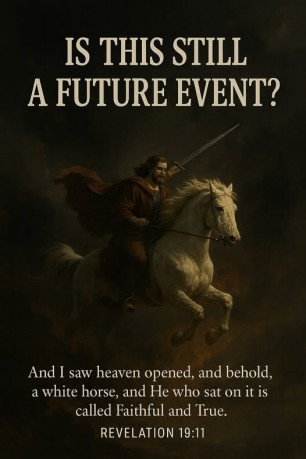
No,
Revelation 19:11 is not a future event if you're coming from a
Preterist (fulfilled prophecy) perspective. Here is the verse: Revelation 19:11 (NASB): "And I saw heaven opened, and
behold, a white horse, and He who sat on it is called Faithful and
True, and in righteousness He judges and wages war." Why it is not a future event: Audience relevance: The book of
Revelation was written to first-century believers (Revelation 1:1-3),
and they were told the events were "soon to take place" and
"the time is near." Revelation 19 is about the destruction
of Jerusalem (70 AD): The rider on the white horse (Christ)
is symbolically coming in judgment against the apostate harlot
(Jerusalem, Rev 17–18). His waging war in righteousness matches
Matthew 22:7 – "But the king was enraged, and he
sent his armies and destroyed those murderers and set their city on
fire." Compare Revelation 19 with Matthew 24: In Matthew 24:30, Jesus says they would
see the Son of Man coming on the clouds of heaven with power and
great glory in that generation (Matthew 24:34). Revelation 19 is a
symbolic depiction of that same event. He already rules with a rod of iron: Revelation 19:15 says "He will
rule them with a rod of iron" – but Psalm 2 and Revelation
2:27 show this is already fulfilled in Christ's judgment on
rebellious Israel and the nations. It's part of the same timeline as
Revelation 18: Revelation 18 describes the fall of
Babylon, symbolic for Jerusalem. Revelation 19 follows immediately as
the aftermath, celebrating God's vindication. Revelation 19:11 is a vivid symbolic
vision of Christ's coming in judgment on apostate Israel, fulfilled
in the destruction of Jerusalem in 70 AD. It is not a future,
physical, sky-splitting return, but a covenantal judgment using
symbolic apocalyptic language, just as the Old Testament prophets
used when God judged nations (Isaiah 13, Ezekiel 32, etc.).
By Dan Maines
Links