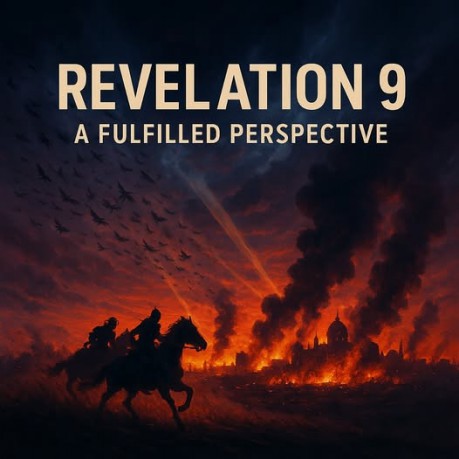
REVELATION
9, A FULFILLED PERSPECTIVE
Revelation 9 continues the trumpet judgments, which in the fulfilled
perspective are symbols of historical events leading up to the
destruction of Jerusalem in AD 70. The visions describe God's
covenantal judgments, using symbolic imagery that draws from Old
Testament language. Revelation 9:1 Scripture: Then the fifth angel
sounded, and I saw a star from heaven which had fallen to the
earth, and the key to the shaft of the abyss was given to him. Commentary: In prophetic language, a "star"
represents a ruler or leader (Isaiah 14:12, Daniel 8:10). This star
is not falling at that moment, but had already fallen. The one
given the key represents an authority permitted by God to unleash
judgment. The "abyss" is the realm of demonic forces.
This is similar to Luke 8:31, where demons begged Jesus not to send
them into the abyss. Here, the judgment is about to be unleashed
upon apostate Israel. Revelation 9:2 Scripture: He opened the shaft of
the abyss, and smoke ascended out of the shaft like the smoke of a
great furnace, and the sun and the air were darkened from the smoke
of the shaft. Commentary: Smoke darkening the
sun and air is Old Testament judgment imagery (Joel 2:10, Isaiah
13:10). The darkness represents confusion, chaos, and the removal
of God's light from the nation. The abyss is opened, showing that
this is a divine judgment allowing spiritual forces of destruction
to operate. Josephus describes Jerusalem at this time as plunged
into chaos, filled with infighting, murder, and famine that
darkened the city's spirit long before the final destruction (Wars
5.1.5). Notes and sources: Josephus: "The sedition at Jerusalem was revived, and
parted into three factions, and that one faction fought against
the other." Wars 5.1. Revelation 9:3 Scripture: Then out of the smoke
came locusts upon the earth, and power was given them, as the
scorpions of the earth have power. Commentary: The locusts here are symbolic, not literal
insects. In the Old Testament, locusts often represent invading
armies (Joel 1:4-6, Nahum 3:15-17). These locusts are empowered to
sting like scorpions, meaning they bring torment and misery rather
than immediate destruction. Revelation 9:4 Scripture: They were told not to
hurt the grass of the earth, nor any green thing, nor any tree, but
only the people who do not have the seal of God on their foreheads. Commentary: This is not a
physical plague on vegetation but a targeted judgment on the
unsealed, those who rejected Christ. The sealed are the faithful
remnant, protected spiritually from God's wrath (Revelation 7:3).
This judgment is focused on apostate Israel, not on the Gentile
nations. Early church history, recorded by Eusebius, notes that
believers fled the city before the final siege, leaving the
unrepentant to face Rome's wrath. Eusebius: "The people of the
church in Jerusalem had been commanded by a revelation… to dwell
in a certain town of Perea called Pella." (Church History
3.5.3) Notes and sources: Eusebius, Church History 3.5.3, early Christian flight to
Pella. Revelation 9:5 Scripture: And they were not
permitted to kill anyone, but to torment for five months, and their
torment was like the torment of a scorpion when it stings a person. Commentary: Five months is the
typical lifespan of a locust swarm, symbolizing the completeness of
this judgment. This represents a period of intense but limited
torment, the sufferings leading up to the siege of Jerusalem.
Historical accounts match this image. Josephus wrote, "There
was no part of the city which did not partake of the miseries of
the siege… the factions fought it out continually, and their rage
was equal on both sides… they slew one another without fear of
the Romans, and no regard was had to the sanctuary itself"
(Wars 5.1.5). Notes and sources: Josephus: "There was no part of the city which did not
partake of the miseries of the siege… they slew one another
without fear of the Romans." Wars 5.1.5. Revelation 9:6 Scripture: And in those days
people will seek death and will not find it, they will long to die,
and death will flee from them. Commentary: This matches the
horrors of the Jewish War. Josephus records, "Now the
multitude of carcasses that lay in heaps one upon another was a
horrible sight, and produced a pestilential stench… such as would
infect those that were near them… so that many were ready to die
with the stench, but the misery itself would not suffer them to
die" (Wars 6.1.1). Notes and sources: Josephus: "The multitude of carcasses… produced a
pestilential stench… an horrible sight." Wars 6.1.1. Revelation 9:7-10 Scripture: The appearance of the
locusts was like horses prepared for battle, and on their heads
appeared to be crowns like gold, and their faces were like human
faces. They had hair like the hair of women, and their teeth were
like the teeth of lions. They had breastplates like breastplates of
iron, and the sound of their wings was like the sound of chariots,
of many horses rushing to battle. They have tails like scorpions,
and stings, and in their tails is their power to hurt people for
five months. Commentary: This is highly
symbolic, describing a terrifying and unnatural force. "Horses
prepared for battle" ties to cavalry imagery. Crowns "like"
gold indicate authority given for judgment. Faces like men and hair
like women may describe fierceness combined with deceptive beauty.
Teeth like lions show their destructive nature. Their sound like
chariots recalls the army of Joel 2. The scorpion tails indicate
that their harm is in the aftermath of their passing, the lingering
torment after attack. Josephus describes this Roman army: "The
appearance of the Roman army was terrible, both to the eye and to
the ear… the armor of the horsemen was remarkable, and the noise
of their armor was very great… so that the whole place round
about seemed, as it were, to quake" (Wars 3.5.2). Notes and sources: Josephus: "The trumpeters…
sounded together, and the army made a terrible shout… the darts…
intercepted the light." Wars 3.265–267. Josephus: "Nor was there
anything… so terrible to the enemy… the fineness of their
arms, and the good order of their men." Wars 5.351–353. Josephus: "Nor can one imagine anything either greater
or more terrible than this noise…" Wars 6.271–273. Revelation 9:11 Scripture: They have as king over
them, the angel of the abyss, his name in Hebrew is Abaddon, and in
the Greek he has the name Apollyon. Commentary: "Abaddon"
and "Apollyon" both mean "Destroyer." This is
not Satan himself but a destroying power appointed by God to bring
judgment. In the fulfilled perspective, this fits the leadership of
Rome's military, which God used as an instrument to judge Jerusalem
(cf. Isaiah 10:5-6). Josephus writes of Titus, "Titus…
resolved to entirely demolish the city and temple… so that no one
who came there afterward would believe it had ever been inhabited"
(Wars 7.1.1). Notes and sources: Josephus: "The holy house…
was burnt down, even against his consent." Wars 6.4. Josephus: "Caesar gave orders that they should now
demolish the entire city and temple… leaving the great towers."
Wars 7.1.1. Revelation 9:12 Scripture: The first woe has
passed, behold, two woes are still coming after these things. Commentary: The fifth trumpet judgment is the first "woe."
The scene will shift to even more severe judgments. The sequence is
progressive, leading up to the total destruction in AD 70. Revelation 9:13-14 Scripture: Then the sixth angel
sounded, and I heard a voice from the four horns of the golden
altar which is before God, one saying to the sixth angel who had
the trumpet, Release the four angels who are bound at the great
river Euphrates. Commentary: The golden altar represents the prayers of the
saints (Revelation 8:3-4). The answer to those prayers for justice
is coming. The "four angels" at the Euphrates symbolize
forces held back until God's appointed time. The Euphrates was the
eastern boundary of the Roman Empire, beyond which were fierce
armies ready to move when God allowed. Revelation 9:15 Scripture: And the four angels,
who had been prepared for the hour and day and month and year, were
released, so that they would kill a third of mankind. Commentary: This timing shows
God's precision, the judgment is not random. A "third" is
symbolic of a large but partial destruction (Zechariah 13:8-9).
This was not worldwide but targeted toward the covenant people in
the land. Josephus records, "The number of those that perished
during the whole siege… was one million one hundred thousand…
the rest were carried into captivity" (Wars 6.9.3). Notes and sources: Josephus: "Those that perished… eleven hundred
thousand… and ninety-seven thousand captives." Wars 6.9.3. Revelation 9:16-17 Scripture: The number of the
armies of the horsemen was two hundred million; I heard the number
of them. And this is how I saw in the vision the horses and those
who sat on them: the riders had breastplates the color of fire, of
hyacinth, and of brimstone; and the heads of the horses are like
the heads of lions; and out of their mouths came fire, smoke, and
brimstone. Commentary: The massive number is
symbolic of an overwhelming force. The colors, fire, hyacinth, and
brimstone, represent judgment and destruction. The lion like heads
and the fire from their mouths echo Old Testament imagery of divine
wrath (Psalm 18:8). Josephus says, "The entire Roman army
encompassed the city… their numbers were so great and their armor
so bright that the sun's rays reflected off it… the spectacle was
magnificent yet terrible" (Wars 5.1.6). Notes and sources: See also the sound and spectacle lines already cited for
3.265–267, 5.351–353, 6.271–273. Revelation 9:18-19 Scripture: A third of mankind was
killed by these three plagues, by the fire, the smoke, and the
brimstone which came out of their mouths. For the power of the
horses is in their mouths and in their tails; for their tails are
like serpents, and have heads, and with them they do harm. Commentary: Again, this destruction is covenantal. The
"mouths" show that the destruction comes through commands
and decrees of authority, while the serpent like tails indicate
ongoing deception and harm. Revelation 9:20-21 Scripture: The rest of mankind,
who were not killed by these plagues, did not repent of the works
of their hands, so as not to worship demons and the idols of gold,
silver, brass, stone, and wood, which can neither see, nor hear,
nor walk, and they did not repent of their murders, nor of their
witchcraft, nor of their sexual immorality, nor of their thefts. Commentary: Despite the warnings
and partial judgments, the survivors among apostate Israel did not
repent. This stubbornness echoes Jeremiah 5:3 and mirrors what
Jesus lamented in Matthew 23:37, they refused to turn from their
sins. This is why the final destruction in AD 70 came without
delay. Josephus confirms, "The seditious, although they saw
themselves encompassed on all sides, and were in want of
provisions, yet were they not disposed to yield… but did the same
things they did before, as if the city had been in full peace"
(Wars 6.2.1). Notes and sources: Josephus: "The seditious
still shewed no inclinations of yielding." Wars 5.1. Josephus: stubborn refusal even under famine and siege.
Wars 6.2.1. CONCLUSION Revelation 9 is not about some future global apocalypse. It
is a covenantal judgment on first century Israel, using symbolic
prophetic language drawn from the Old Testament. The locusts, the
armies, the plagues, all point to the horrors of the Jewish War and
the siege of Jerusalem, culminating in the complete end of the Old
Covenant age. God was faithful to His Word, fulfilling what He
promised through the prophets and through His Son. Sources • Penelope, UChicago,
Josephus
https://penelope.uchicago.edu/josephus/war-3.html
https://penelope.uchicago.edu/josephus/war-6.html
https://penelope.uchicago.edu/josephus/war-7.html • Lexundria, Josephus, exact
sections
3.265, trumpeters and darts:
https://lexundria.com/j_bj/3.265/wst
5.1–5.46, factions in
Jerusalem: https://lexundria.com/j_bj/5.1-5.46/wst
7.1–7.20,
demolition order: https://lexundria.com/j_bj/7.1-7.20/wst • Early Jewish Writings, Josephus
index
https://www.earlyjewishwritings.com/josephus.html • New Advent, Eusebius, Church
History
Book III, chapter 5, Pella:
https://www.newadvent.org/fathers/250103.htm
Book IV, index:
https://www.newadvent.org/fathers/250104.htm • Wikisource, Eusebius, alternate
text for Book III, chapter
5
https://en.wikisource.org/wiki/Nicene_and_Post-Nicene_Fathers:_Series_II/Volume_I/Church_History_of_Eusebius/Book_III/Chapter_5 • ToposText, Eusebius full work
(reference index)
https://topostext.org/work/732 • DigitalCommons Luther Seminary,
scholarly paper on the Pella
tradition
https://digitalcommons.luthersem.edu/cgi/viewcontent.cgi?article=1017&context=faculty_articles • BAS Library, article on the
Christian flight to
Pella
https://library.biblicalarchaeology.org/article/the-christian-flight-to-pella-true-or-tale/
Older
mirror:
https://old.biblicalarchaeology.org/biblical-archaeology-review/39/3/1 • Loyola Chicago site with Josephus
excerpts, Wars 6
overview
https://www.avande1.sites.luc.edu/jerusalem/sources/wars6.htm • Project Gutenberg, Josephus,
complete Whiston
translation
https://www.gutenberg.org/files/2850/2850-h/2850-h.htm • Fordham Internet History
Sourcebooks, Josephus hub pages
Main Jewish sourcebook:
https://origin.web.fordham.edu/Halsall/jewish/jewishsbook.asp
Project
home: https://sourcebooks.web.fordham.edu/
By Dan Maines
Links