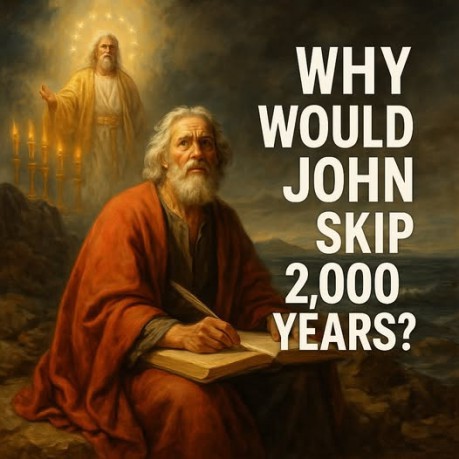
WHY
WOULD JOHN SKIP 2,000 YEARS?
Revelation 1:19 (NASB):
"Therefore write
the things which you have seen, and the things which are, and the
things which will take place after these things." Why would John be told to write about
his past and present, only to suddenly skip 2,000 years and describe
events for a future generation completely unrelated to his own? That
would make no sense. John’s instruction is clear and orderly. He is told to write: "The things which
you have seen" – his past "The things which
are" – his present "The things which will take place after these
things" – his near future This verse gives us a divinely
inspired outline of the book of Revelation. It is consistent with
the urgent time statements surrounding it and keeps the message
grounded in John’s immediate context. 1. THE THINGS WHICH YOU HAVE
SEEN This refers primarily to the vision John just experienced in
Revelation 1, especially the majestic appearance of Christ among the
seven lampstands. This vision includes: The seven golden lampstands
(Revelation 1:12) One like the Son of Man, clothed
in glory (Revelation 1:13-16) Christ's declaration of His identity and authority
(Revelation 1:17-18) But there is more. "The things which you have seen"
also includes everything John had just witnessed in this initial
encounter: Christ's appearance in heavenly
majesty The seven stars in His hand and
the lampstands representing the churches The thunderous voice like a
trumpet (Revelation 1:10) John's setting on the island of
Patmos, where he was "in the Spirit" Possibly even the broader backdrop of his personal testimony
as a witness of Jesus' earthly ministry, resurrection, and
ascension All of this formed the prophetic
backdrop John had already experienced when he was told to write. 2. THE THINGS WHICH ARE These are the realities present at the time of John’s writing.
Revelation chapters 2 and 3 contain direct messages from Jesus to
seven actual churches in Asia: Ephesus Smyrna Pergamum Thyatira Sardis Philadelphia Laodicea These letters address real historical
congregations and deal with their spiritual condition, warnings, and
promises. This part of Revelation is not symbolic or distant. It is
immediate and practical. These were first-century churches facing
real issues and impending covenantal judgment. So, "the things which are"
reflect the current state of the church in John’s day. They serve
as a snapshot of the covenant community shortly before the end of
the Old Covenant age, fulfilled in the judgment on Jerusalem. 3. THE THINGS WHICH WILL TAKE
PLACE AFTER THESE THINGS This third category refers to future events from John's
perspective, beginning in Revelation 4. These chapters unfold a
series of escalating judgments and divine actions: The throne room of heaven
(Revelation 4–5) The opening of the seven seals
(Revelation 6–8) The sounding of seven trumpets
(Revelation 8–11) The pouring out of the seven
bowls (Revelation 15–16) The judgment of Babylon
(Revelation 17–18) The vindication of the saints and the arrival of the New
Jerusalem (Revelation 19–22) But when were these things expected to
occur? The book opens with clear time statements: Revelation 1:1 –
"The Revelation of Jesus Christ, which God gave Him to show to
His bond-servants, the things which must soon take place." Revelation 1:3 – "Blessed is the one
who reads, and those who hear the words of the prophecy, and keep
the things which are written in it, for the time is near." John is not speaking about events
thousands of years removed. He is announcing things that were
imminent to his own generation. The urgency is repeated throughout
the book (see Revelation 22:6, 10). So, in the Preterist view, "the
things which will take place after these things" began shortly
after the writing of the book, in the mid to late 60s AD. These
culminated in the destruction of Jerusalem in AD 70 — the end of
the Old Covenant age and the full establishment of the New Covenant
kingdom. A CONSISTENT TIMELINE All of this forms a cohesive and logical timeline: Past: the vision John had just
seen Present: the condition of the
churches Near future: the judgments and events soon to come There is no justification to break
this progression and leap 2,000 years into the future. If "the
things which are" referred to John's own time, why would "the
things after" suddenly skip to ours? That would completely disrupt the flow and the relevance of the
message. The opening verses make this impossible: "The things which must soon
take place" "For the time is near" Revelation was a message of hope,
judgment, and fulfillment for John's generation. It is not a cryptic
blueprint for the distant future. When read in its historical and
covenantal context, it becomes a powerful testimony to the
faithfulness of God and the completion of all He promised. Let us read Revelation not as
a puzzle for our future, but as a proclamation of fulfilled promises
to the early church.
By Dan Maines
Links