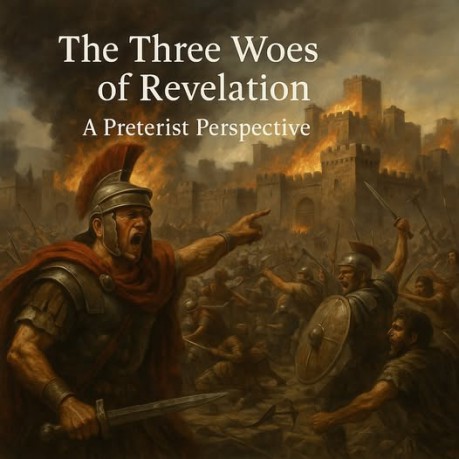
The
Three Woes of Revelation: A Preterist Perspective
As a Preterist, I understand the book of Revelation as a prophecy
fulfilled in the first century, centered around the judgment on
apostate Israel and the destruction of Jerusalem in AD 70. The three
woes mentioned in Revelation are not about our future, but their
past. They are tied directly to the fifth, sixth, and seventh
trumpets and represent increasing intensity of judgment during that
climactic period. First Woe – Revelation 9:1-12 (Fifth Trumpet) Revelation 9:1-2 says,
"Then
the fifth angel sounded, and I saw a star from heaven which had
fallen to the earth, and the key to the shaft of the abyss was
given to him. He opened the shaft of the abyss, and smoke ascended
out of the shaft like the smoke of a great furnace, and the sun and
the air were darkened from the smoke of the shaft." The star fallen from heaven
symbolizes fallen authority, possibly the fall of a Jewish or
spiritual leader. The abyss imagery is symbolic of chaos and
demonic torment, not literal smoke and locusts. Verse 5 says,
"And they
were not permitted to kill anyone, but to torment for five
months..."
This time frame aligns with the Roman siege of
Jerusalem, which lasted about five months in AD 70. The torment from these "locusts"
was not physical death but psychological and spiritual agony for
those rejecting the Messiah. The people were already marked for
destruction and experienced great distress. Symbolism of the Abyss and
Locusts: Joel 1 and 2 use locusts to represent invading armies and
judgment. Here, they point to demonic influence and internal
collapse. Historical Evidence: Josephus describes bizarre, maddening
behavior in Jerusalem before its fall—internal infighting, false
prophets, famine, and spiritual darkness. It was a city under siege
both physically and spiritually. Second Woe – Revelation 9:13-21 and 11:1-14 (Sixth
Trumpet) Revelation 9:14 says,
"Release
the four angels who are bound at the great river Euphrates."
The
Euphrates is a prophetic symbol of invading forces from beyond
Israel's border. Verse 16 says,
"The
number of the armies of the horsemen was two hundred
million..."
The number is symbolic, not literal. It shows
overwhelming force. These "four angels" from the
Euphrates (verse 14) allude to judgment coming from the
east—Babylon once came that way, and now Rome repeats the
pattern. Revelation 11:8
"Where
also their Lord was crucified."
This clearly identifies
the target of the second woe as Jerusalem. Revelation 11:11-13
The
witnesses rise and the city quakes. This represents vindication of
the saints and divine judgment. Verse 13 says a tenth of the city
fell and 7,000 were killed—again symbolic numbers pointing to
partial yet devastating destruction. Historical Evidence: The Roman armies surrounded and
devastated Jerusalem. Josephus writes that over a million Jews died
and the temple was utterly destroyed. The faithful remnant (the
sealed) had fled to Pella beforehand. Third Woe – Revelation 11:15 and Following (Seventh
Trumpet) Revelation 11:15 says,
"Then
the seventh angel sounded; and there were loud voices in heaven,
saying, The kingdom of the world has become the kingdom of our Lord
and of His Christ, and He will reign forever and ever." This is not describing a future
end of time, but the transition from the Old Covenant to the New.
Christ's reign was established through judgment on the old system. Revelation 11:18 declares,
"And
the nations were enraged, and Your wrath came, and the time came
for the dead to be judged, and the time to reward Your
bond-servants the prophets and the saints... and to destroy those
who destroy the earth." The judgment of the dead here
ties to Daniel 12 and the resurrection of the righteous. This
judgment is covenantal, not global, and it happened when God
fulfilled all that had been written. Matthew 23:35-36 and 24:34
Jesus
said, "So that upon you may fall the guilt of all the
righteous blood... Truly I say to you, all these things will come
upon this generation." Historical Fulfillment: In AD 70, the temple was destroyed,
the priesthood ended, the Old Covenant age was closed, and Christ's
kingdom stood alone, unshaken and established. Conclusion The three woes are: First woe – Revelation 9:1-12
(fifth trumpet) Second woe – Revelation
9:13-21 and 11:1-14 (sixth trumpet) Third woe – Revelation 11:15
and following (seventh trumpet) These woes represent God's
measured but increasing judgments on Jerusalem. They were fulfilled
in the events leading to AD 70. As Jesus said in Luke 21:22,
"These are the days
of punishment, so that all things which have been written will be
fulfilled." The woes are not for us to fear in the
future. They are fulfilled history. Christ reigns. The kingdom has
come.
By Dan Maines
Links