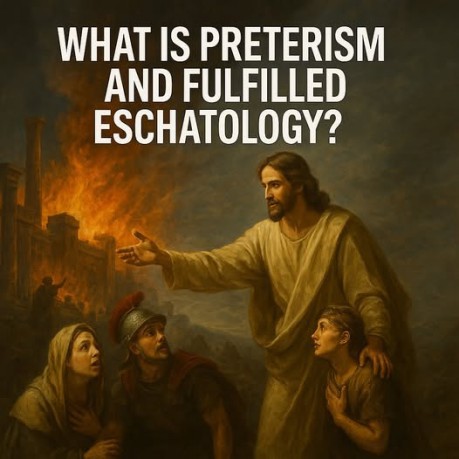
What
Is Preterism and Fulfilled Eschatology?
By a Believer
in the Fulfilled View
Let me take some time today to explain something that many people
have either misunderstood or never even heard of. It is not a
religion. It is not a denomination. It is simply a biblical
understanding of something called eschatology. What Is Eschatology? Eschatology is a theological word that
simply means "the study of last things" or "the study
of end times." It comes from the Greek word eschatos, which
means "last." When we study passages like Matthew 24, the
book of Revelation, Daniel, or 1 Thessalonians 4 and 5, we are
engaging in eschatology. But the key question is this: When did
these things take place, and who were they meant for? What Is Preterism? Preterism is one way of interpreting
eschatology. The word "preterism" comes from the Latin
word praeter, which means "past." In other words, a
preterist believes that most or all of the prophetic scriptures
related to the "end times" have already been fulfilled.
These weren't predictions for thousands of years in the future. They
were about things that happened in the first century. Jesus Himself said in Matthew
24:34,
"Truly I say to you, this
generation will not pass away until all these things take
place."
That was His audience. He was talking to
them, not to us. And everything He spoke of in Matthew 24, Mark 13,
and Luke 21 came true in the judgment against Jerusalem in 70 AD. The Different Forms of
Preterism There are a few different understandings under the preterist
umbrella: Partial Preterism:
This view says many of the prophecies were fulfilled in 70 AD, such
as the destruction of Jerusalem and the Great Tribulation, but they
believe Jesus' physical return and the final resurrection are still
in the future. Full Preterism:
Also called "consistent" or "fulfilled eschatology."
This is the view I hold. It teaches that all prophecy was fulfilled
by 70 AD, including the return of Christ, the resurrection of the
dead, the judgment, and the arrival of the New Heavens and New
Earth. Hyper Preterism:
This is a term usually used by critics to attack full preterists. I
do not use it for myself. I believe full preterism is not extreme,
it is just consistent with what the scriptures actually teach. Israel Only (I.O.):
This is a more extreme fringe view that claims the Bible was only
written to and for Israel, and that salvation, resurrection, and
the New Covenant were exclusively for them. According to I.O., no
one outside the bloodline of Israel has any part in the gospel. I
strongly reject this view. Scripture teaches that the nations were
always part of God's plan and were included in the promises through
faith. Paul clearly wrote in Galatians 3:28 that,
"There is neither Jew nor Greek... for you are all one
in Christ Jesus." The gospel was for all nations. Satan's Little Season (SLS): Some who claim
to be preterists teach that we are now living in what they call
"Satan's Little Season," a supposed time of rebellion and
deception after 70 AD. But Revelation 20:7-10 already places that
short season immediately after the millennium, not 2,000 years
later. If the millennium ended in the first century, then so did
Satan's role. The text says clearly in Revelation 20:10,
"the devil who deceived them was thrown into the lake
of fire." That is not a delayed event, it was
fulfilled. SLS is a man-made invention trying to explain the
presence of evil today, but it undermines the finality of Christ's
victory and ignores the spiritual nature of the kingdom. The
judgment is over. The devil has been cast out. We are not in a
delay period, we are in the everlasting reign of Christ. What Is Fulfilled Eschatology? Fulfilled eschatology is the belief that all biblical prophecies
regarding the end times have already been fulfilled. That includes: The coming of the Lord (Matthew
16:27-28) The Great Tribulation (Matthew
24:21) The resurrection of the dead (1
Corinthians 15:51-52) The judgment (Revelation 20:12) The arrival of the New Heavens and New Earth (Revelation
21:1) These things were not future to us,
they were future to them. And they were fulfilled when and how Jesus
said they would be. Preterism Is Not a Religion Let me be clear. Preterism is not a
religion. It is not a denomination. I don't attend a "preterist
church." I am just a believer in Jesus Christ who takes
seriously what He said and who He said it to. This view is simply a
lens by which we read the scriptures faithfully and in context. Paul wrote in 2 Timothy 2:18
about some who said the resurrection had already happened. That does
not condemn fulfilled eschatology. It simply shows that timing
matters. If Paul could correct those who were saying the
resurrection was past in the wrong generation, then surely we should
pay close attention to when the Bible actually says it would happen. Preterism Is More Common Than
People Think Many people are surprised to learn
that even well-known and respected theologians have held some form
of preterist view. The late R.C. Sproul, one of the most influential
Reformed theologians of our time, was a partial preterist. He
believed that much of Matthew 24 and the book of Revelation referred
to events in the first century. He is not alone. Throughout history,
various pastors, teachers, and scholars have acknowledged the past
fulfillment of key biblical prophecies. In fact, nearly every major
denomination today has members who believe at least some
eschatological prophecies have already been fulfilled. So this is
not some fringe movement. It is a growing realization among
believers who are re-examining scripture in context. Jesus Fulfilled It All Jesus said in Luke
21:22,
"These are days of vengeance, so
that all things which have been written will be fulfilled." He didn't say some things. He said all
things. That's what fulfilled eschatology is all about. I do not base this view on tradition.
I base it on scripture, in context, and on the words of Jesus
Himself. Conclusion So if you're wondering why so many of
us are no longer waiting for the end but are instead living in the
fullness of the kingdom now, it's because we believe Jesus kept His
word. He returned just as He said He would, when He said He would.
The New Covenant has no more waiting for judgment. No more fear of
doom. Just life, peace, and righteousness in His eternal kingdom. Hebrews 12:28
says,
"Therefore, since we receive a kingdom which
cannot be shaken, let's show gratitude." We're not waiting for the kingdom.
We've received it. And that's the heart of what it means
to believe in fulfilled eschatology. Amen.
By Dan Maines
Links