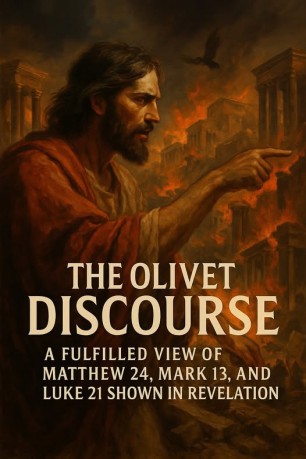
The
Olivet Discourse
A Fulfilled View of Matthew
24, Mark 13, and Luke 21 Shown in Revelation
Introduction
The Olivet Discourse is one of
the most critical sections of Scripture in understanding fulfilled
prophecy. Found in Matthew 24–25, Mark 13, and Luke 21, this
private conversation between Jesus and His disciples reveals the
timing, nature, and audience
of His coming in judgment. As a preterist, I affirm that this
discourse is not about a far future end of the world, but the end of
the Old Covenant age, fulfilled in the destruction of Jerusalem in
70 AD. The Context Matters
Matthew
24:3 is crystal clear about the nature of their question:
"And
as He was sitting on the Mount of Olives, the disciples came to Him
privately, saying, 'Tell us, WHEN will these things
happen, and what will be the sign of Your COMING,
and of the end of the AGE?'" Those three words, WHEN,
COMING, and AGE, are the entire
focus of the Olivet Discourse.
• WHEN , The
disciples wanted to know the timing. Jesus had just
told them the temple would be destroyed, so they asked when
it would happen.
• COMING , They asked about
His coming, not multiple comings. They saw it as
the event that would bring about the temple's fall
and covenantal change.
• AGE , They did not
ask about the end of the world, but the end of the Mosaic
Age, the Old Covenant system with its temple, sacrifices,
and priesthood. This was a direct question about their
time, their temple, and the end of
their covenant world. It had nothing to do with the
physical planet or a global end thousands of years later. The Olivet Discourse Was for
Them
Jesus was not speaking to a generation 2,000
years in the future. He was speaking to them there
then.
Matthew 24:34 seals the argument:
"Truly
I say to you, this generation will not pass away until all these
things take place."
Not some things, but all
these things. You cannot chop this discourse in half and assign part
of it to the destruction of Jerusalem and part of it to some future
end of the world. That forces modern assumptions into a
first-century conversation. A Model for Judgment, Not a
Future Global Event
The coming described in the Olivet
Discourse was the Second Coming, but not in the way
futurists imagine it. It was not about a physical return to destroy
the planet or rapture the church. It was a covenantal coming
in judgment, just like God had come many times before in
the Old Testament.
He came in judgment on Egypt through the
plagues, on Sodom through fire, on Korah's rebellion when the ground
opened up, and on Jerusalem in 586 BC. In the same way, Jesus came
in judgment on apostate Israel in 70 AD, just as He promised.
The
language of Matthew 24:29, sun darkened, moon not giving its light,
stars falling, is symbolic judgment language (Isaiah 13:10, Ezekiel
32:7). It does not describe a literal cosmic collapse. It signifies
the fall of a nation under divine wrath. The Mount of Olives and Its
Setting
The Mount of Olives, also known as Olivet, is
mentioned in 2 Samuel 15:30 and Acts 1:12. In Acts, it is described
as being within a Sabbath day’s journey from
Jerusalem, meaning it was less than 3/4 of a mile—the maximum
distance Jews were permitted to travel on the Sabbath. It was once
covered in olive groves and served as a meaningful place where Jesus
taught His disciples privately.
The Olivet Discourse is the
longest recorded teaching of Jesus during His final week. Its length
and content prove its importance. It is tied directly to the coming
judgment on Jerusalem, not a second coming at the end of time. The
Bible does not speak of the end of time, it speaks of the time of
the end. The Unified Voice of Matthew,
Mark, and Luke
The Olivet Discourse is not found only
in Matthew 24. It is also recorded in Mark 13 and Luke 21, and each
writer gives key details that confirm a first-century fulfillment. Mark 13:2
"Do
you see these great buildings? Not one stone will be left upon
another, which will not be torn down."
This echoes Matthew
24:2, confirming the focus is on the temple in Jerusalem. Mark 13:30
"Truly
I say to you, this generation will not pass away until all these
things take place."
Just like Matthew 24:34, Mark makes it
crystal clear that the timing was within that generation. Luke 21:20-22
"But
when you see Jerusalem surrounded by armies, then recognize that her
desolation is near... because these are days of vengeance, so that
all things which have been written will be fulfilled."
Luke
ties the events directly to Jerusalem, fulfilled
prophecy, and the vengeance of God upon
that generation. Together, Matthew, Mark, and Luke
record the same message from different angles:
• The coming
judgment was near
• It concerned Jerusalem and the temple
•
It would happen in their generation
• It would fulfill
everything written This harmony across all three synoptic
Gospels sets the foundation for Revelation, where John expands on
these same prophetic themes using symbolic and apocalyptic imagery. Revelation Is John's Version
of the Olivet Discourse
Futurists often miss this.
John does not include the Olivet Discourse in his Gospel, but
instead writes the book of Revelation. Revelation is John's
expanded Olivet Discourse, filled with symbols and visions
directly tied to the destruction of Jerusalem.
Compare Matthew
24 with Revelation and you will find parallel themes:
•
Earthquakes
• Tribulation
• The gospel being preached
to all nations
• The abomination of desolation
• The
coming on the clouds
• The judgment on the harlot city
These
are not random parallels. They are deliberate. End of the Age, Not the
World
Matthew 24:3 uses the Greek word aion (age), not
kosmos (world). Jesus was speaking about the end of the Mosaic
Age, not the end of the physical earth. The entire focus is
the temple, the city of Jerusalem, and the covenantal world of
Israel.
Futurists twist this by importing a Western, modern
idea of "end times" into a first-century Jewish framework. Paradigm Shift Needed
Many
who resist fulfilled eschatology simply will not allow the text to
correct their assumptions. They say, "Matthew 24 speaks of a
coming, but the final coming is still future." Yet the
disciples never spoke of multiple comings. They preached the
coming, and they understood it would happen in their
generation.
Peter, James, John, and Paul were not confused.
Jesus did not deceive them. The coming He spoke of happened when He
said it would happen. Conclusion
The
Olivet Discourse is not about the rapture, not about the end of the
planet, and not about a distant future.
It is about the
destruction of Jerusalem, the end of the temple system, and the
fulfillment of all that Jesus promised would happen in that
generation.
The Mount of Olives was the place, the Mosaic age
was the context, and 70 AD was the fulfillment. Matthew 24 is Revelation. The
Olivet Discourse is fulfilled.
It was for
them, not us.
Believe what Jesus actually
said. Let that change your paradigm.
By Dan Maines
Links