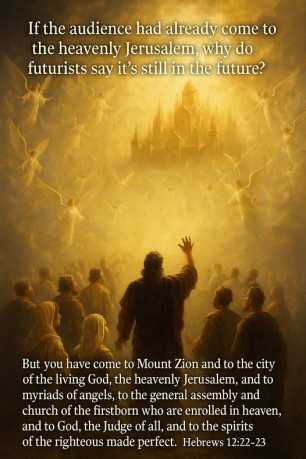
If
the audience had already come to the heavenly Jerusalem (Hebrews
12:22), then it was a present reality, not a distant future hope. The
text does not say you will come, it says you have come. That means
the New Covenant kingdom had already been inaugurated. Futurists claim it's still ahead
because they misunderstand the nature of the kingdom. They expect a
physical city descending from the sky, when scripture describes a
spiritual, covenantal reality already present among first-century
believers (cf. Luke 17:20-21). The contrast in Hebrews 12 is between
Mount Sinai (Old Covenant) and Mount Zion (New Covenant). The writer
was showing that believers had moved from the old to the new. That
transition culminated in the destruction of the earthly Jerusalem in
70 AD, confirming the heavenly, spiritual one had fully taken its
place. To say the heavenly Jerusalem is still
future is to ignore the inspired writer's words, deny the
first-century context, and delay what God already fulfilled.
By Dan Maines
Links