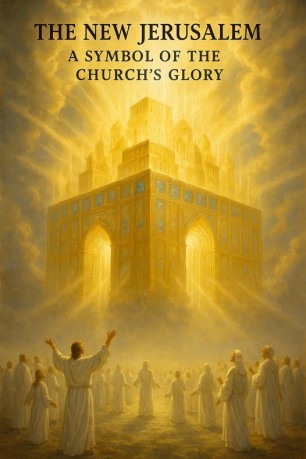
The
New Jerusalem - A Symbol of the Church's Glory Introduction: Seeing the Bride
Through the Symbolism
Many today read Revelation 21 and
imagine a futuristic, physical city descending from the sky. Streets
of gold, gates of pearl, and walls studded with jewels are taken
literally. But we must let scripture interpret scripture. The New
Jerusalem is not about city infrastructure. It is a picture of the
church, the bride of Christ, now fully restored and dwelling with
God. Revelation 21:9-10
makes this crystal clear:
"Come here, I will show you the
bride, the wife of the Lamb. And he carried me away in the Spirit...
and showed me the holy city, Jerusalem, coming down out of heaven
from God."
The angel promised to show John the bride. What
he saw was the New Jerusalem. That means the New Jerusalem is
the bride. This is not a literal city. This is the church, completed,
glorified, and dwelling in covenantal union with Christ. The Size and Shape: Why a Cube?
Revelation
21:16 says the city is 12,000 stadia in length,
width, and height. That's roughly 1,380 miles in each
direction. It is a perfect cube. But why? In 1 Kings 6:20,
the Holy of Holies was a cube:
"And the
inner sanctuary was twenty cubits in length, width, and height; and
he overlaid it with pure gold."
The Holy of Holies
represented the direct presence of God. Now, the entire city - the
entire church - is the Holy of Holies. This shows that God no longer
dwells in one spot behind a veil, but now with all His people. The 12,000 stadia number is symbolic. Twelve
is the number of governmental fullness - 12 tribes, 12 apostles.
Multiply it to the third power (12 x 10 x 10 x 10 = 12,000) and we
have a number symbolizing complete covenantal fullness.
The bride is whole. The kingdom is complete. The church is
perfected. The Foundation Stones and the Apostolic
Connection
Revelation 21:14 says, "And the wall of
the city had twelve foundation stones, and on them were the twelve
names of the twelve apostles of the Lamb." Ephesians 2:19-20 confirms this:
"You
are... of God's household, having been built on the foundation of
the apostles and prophets, Christ Jesus Himself being the
cornerstone."
The foundation stones of the city represent
the apostolic teachings and the early church. This is not a literal
wall. It is the doctrinal and covenantal structure upon which the
New Covenant people stand. The Gems and the Breastplate Parallel
In
Revelation 21:19-20, we read a list of precious stones that adorn the
foundation. This list corresponds directly with the high priest's
breastplate in Exodus 28:17-20, which had 12 stones
representing the 12 tribes of Israel. These jewels represent the value
and purity of God's people. The city's brilliance is the
brilliance of the redeemed. This is not about earthly construction, but
about heavenly identity. The Twelve Gates and Open Access
Revelation
21:12-13 speaks of twelve gates, each named after the tribes of
Israel, with angels guarding them. Verse 21 adds, "And the
twelve gates were twelve pearls; each one of the gates was a single
pearl." The number 12 again shows
completeness. The gates facing each direction
imply global access to the kingdom (cf. Luke
13:29). Pearls are formed through suffering, just as access to the
kingdom came through the suffering of Christ and the tribulation of
the saints. Symbolic, Not Literal: A
Consistent Pattern
The entire book of Revelation is
filled with symbolic language: dragons, beasts, bowls, stars falling,
and a slain Lamb standing. So why take just chapter 21 literally? The measurements, jewels, and square
design of the New Jerusalem are pulled directly from Ezekiel
40-48 and Exodus 28, both of which are also
full of symbols and types pointing to spiritual realities. The Old
Covenant temple and priesthood were shadows. The New Jerusalem is the
reality fulfilled. Conclusion: The Bride Has
Come
We are not waiting for a golden city to drop from
the sky. That was never the point. The city has come. The bride is
the church. The New Jerusalem is now. Revelation 21:3:
"Behold,
the tabernacle of God is among the people, and He will dwell among
them, and they shall be His people, and God Himself will be among
them." This is the fulfilled reality of the
church in the New Covenant. We are the city. We are the bride. God is
with us. Let us rejoice in the beauty of
the New Jerusalem, not as a future building, but as the present and
eternal people of God.
By Dan Maines
Links