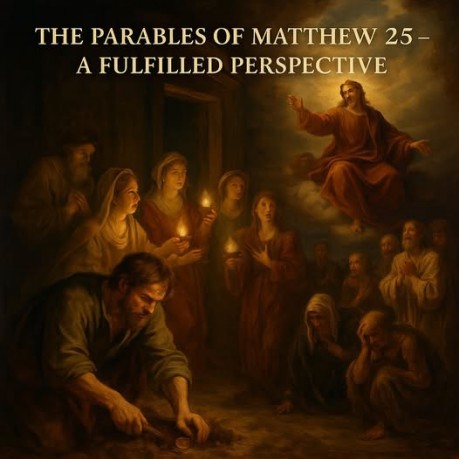
THE
PARABLES OF MATTHEW 25 – A FULFILLED PERSPECTIVE
Introduction 1. What do the talents
represent? In Matthew 25:14-30, the talents are
sums of money entrusted to servants according to their ability. Symbolically, they represent the
responsibilities, opportunities, and gifts given by God to His
people under the Old Covenant. These included the Law, the Temple
worship, the prophetic word, and the privilege of carrying God's
revelation to the nations (Romans 3:1-2). To the early church, the talents also
pictured the stewardship of the gospel message entrusted to the
apostles and disciples (1 Thessalonians 2:4). The faithful servants multiplied what
was given, using their opportunities to advance God's kingdom before
judgment fell. Matthew 25:30's "outer darkness"
mirrors Matthew 8:12, where Jesus spoke of covenantal Israel being
cast out, reinforcing the AD 70 fulfillment. 2. Is the servant burying his
talent the Jews burying Christ? The unfaithful servant in Matthew
25:18 represents Israel's rejection of their stewardship. They were given the promises,
prophecies, and Messiah Himself (Romans 9:4-5). Instead of receiving Him, they
rejected and killed Him (Acts 3:14-15). Burying the talent is not Christ's
burial but symbolizes their refusal to invest the truth they had
been given. This includes rejecting the Messiah
and His message. By doing so, they forfeited their
place as God's covenant people (Matthew 21:43). 3. What does the oil
represent? In Matthew 25:1-13, the wise virgins
have oil for their lamps and the foolish do not. Oil often represents the Holy Spirit
(1 Samuel 16:13, Zechariah 4:2-6). Here, it signifies the inner spiritual
preparation necessary to receive the Bridegroom. The wise virgins are those in Israel
who responded to Jesus in faith and obedience, receiving the Spirit
and being ready for His coming in judgment. The foolish represent those with
outward religion but no inner reality of faith. The "delay" in Matthew 25:5
parallels Matthew 24:48, referring to the time between His ascension
and the AD 70 judgment, showing that "sleeping" was
complacency in that generation. 4. When they ask Him to open,
is this after they die or on earth? In Matthew 25:11-12, the foolish
virgins come later, saying, "Lord, Lord, open up for us." This is not a post-death scene in
heaven or a rapture. The context is first-century
Jerusalem. Once judgment fell in AD 70, the
opportunity to enter the kingdom was closed to those who rejected
Him. The "door being shut" is
covenantal language marking the end of access for the Old Covenant
nation (Luke 13:25-28). This happened in history, not in a
future global removal of the church. 5. When and how did the sheep
get separated from the goats? In Matthew 25:31-46, the Son of Man
comes in His glory to judge the nations. This is tied to Matthew 24:30-31,
where He comes in the clouds in judgment, and to Matthew 19:28,
where He promised the apostles they would "sit on twelve
thrones, judging the twelve tribes of Israel." The separation took place in the
first-century judgment on Israel and surrounding nations. The "sheep" are those who
received and cared for Christ's brethren (His disciples) during the
tribulation (Matthew 10:40-42, 24:9-14). The "goats" are those who
rejected and persecuted them. This judgment occurred when Christ
came in power in AD 70 (Matthew 16:27-28). The sheep entered the joy of the
kingdom. The goats faced everlasting
punishment, which is eternal death, not eternal conscious torment
(Malachi 4:1-3, 2 Thessalonians 1:9). Conclusion
By Dan Maines
A
follow-up to MATTHEW 25 – A FULFILLED PROPHECY
PERSPECTIVE
Introduction, Audience,
and Timing
https://www.facebook.com/share/p/1CgkD57YcA/
Matthew 25 contains three
powerful parables: the Ten Virgins, the Talents, and the Sheep and
Goats. Each was spoken by Jesus shortly before His crucifixion, and
each is directly tied to His coming in judgment upon that generation
(Matthew 24:34). From the fulfilled perspective, these parables are
not about a distant future but about events tied to the end of the
Old Covenant age, culminating in the destruction of Jerusalem in AD
70.
Matthew
25 is not an open-ended prophecy awaiting fulfillment thousands of
years later. It is a covenantal warning to that generation, urging
readiness before the judgment that came upon Israel in AD 70. The
talents speak of faithful stewardship of God's truth, the oil speaks
of genuine spiritual life through the Spirit, the closed door marks
the end of the Old Covenant opportunity, and the sheep and goats
depict the real-time separation that took place in history when
Christ judged the nations. The only way into the New Covenant is
through Christ alone.
Links