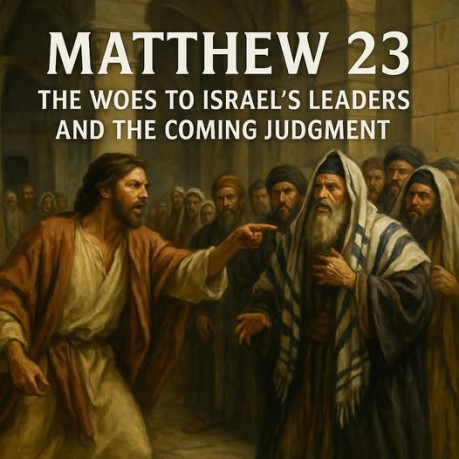
MATTHEW
23 – THE WOES TO ISRAEL'S LEADERS AND THE COMING JUDGMENT
Jesus delivers one of His most powerful indictments against the
religious leaders of His day. This chapter must be understood in its
covenantal context. It is not a generic rebuke for all time, but a
direct warning to the leaders of first century Israel, culminating
in a prophecy of judgment that would come in their generation. Verses 1–3: "Then Jesus spoke to the crowds and to His disciples,
saying: 'The scribes and the Pharisees have seated themselves in the
chair of Moses; therefore, whatever they tell you, do and comply
with it all, but do not do as they do; for they say things and do
not do them.'" Jesus acknowledges the scribes
and Pharisees' authority under the Mosaic covenant, but warns of
their hypocrisy. They sit in Moses' seat, meaning
they had teaching authority in Israel, but their lives contradicted
the Law. This sets the stage for judgment: those entrusted with
leadership were abusing their role. Verses 4–7: "And they tie up heavy burdens and lay them on people's
shoulders, but they themselves are unwilling to move them with so
much as their finger. And they do all their deeds to be noticed by
other people; for they broaden their phylacteries and lengthen the
tassels of their garments. And they love the place of honor at
banquets, and the seats of honor in the synagogues, and personal
greetings in the marketplaces, and being called Rabbi by the
people." The leaders made the Law a burden
rather than a guide to God. Their religiosity was theatrical.
It was about appearances and pride, not repentance or love. Their desire for titles and honor revealed their worldly
hearts. Verses 8–12: "But as for you, do not be called Rabbi; for only One is
your Teacher, and you are all brothers and sisters. And do not call
anyone on earth your father; for only One is your Father, He who is
in heaven. And do not be called leaders; for only One is your
Leader, that is, Christ. But the greatest of you shall be your
servant. Whoever exalts himself shall be humbled, and whoever
humbles himself shall be exalted." Jesus points His disciples away
from the pride of the Pharisees. The Kingdom would be led by
humility and servant leadership. The old covenant system was centered on hierarchy, but the
new would be centered on Christ. Verses 13–15: First Three
Woes "But woe to you, scribes and Pharisees, hypocrites, because
you shut the kingdom of heaven in front of people; for you do not
enter it yourselves, nor do you allow those who are entering to go
in. Woe to you, scribes and Pharisees, hypocrites, because you
travel around on sea and land to make one proselyte; and when he
becomes one, you make him twice as much a son of hell as
yourselves." These are not general rebukes.
Jesus directly condemns the leaders of His generation. They blocked access to the
Kingdom. They fought against Jesus and led others away from Him. Their missionary work only expanded their corruption. Verses 16–22: Fourth Woe "Woe to you, blind guides, who say, 'Whoever swears by the
temple, that is nothing; but whoever swears by the gold of the
temple is obligated.' You fools and blind men! Which is more
important, the gold or the temple that sanctified the gold?" Their religious oaths were
manipulative and dishonest. They misused the Law for personal
gain and set up loopholes to avoid accountability. Their blindness is spiritual. They valued the outward symbol
(gold) more than the presence of God (temple). Verses 23–24: Fifth Woe "Woe to you, scribes and Pharisees, hypocrites, for you
tithe mint and dill and cumin, and have neglected the weightier
provisions of the Law: justice and mercy and faithfulness; but these
are the things you should have done without neglecting the others.
You blind guides, who strain out a gnat and swallow a camel!" They majored in the minors. While obsessing over small laws,
they ignored the heart of the covenant. This was a fatal imbalance, and it exposed their corruption. Verses 25–26: Sixth Woe "Woe to you, scribes and Pharisees, hypocrites! For you
clean the outside of the cup and of the dish, but inside they are
full of robbery and self-indulgence. You blind Pharisee, first clean
the inside of the cup and of the dish, so that the outside of it may
also become clean." Their appearance of holiness was
a mask. Outward purity meant nothing when
their hearts were filled with greed and indulgence. True holiness begins from within. Verses 27–28: Seventh Woe "Woe to you, scribes and Pharisees, hypocrites! For you are
like whitewashed tombs, which on the outside appear beautiful, but
inside they are full of dead men's bones and all uncleanness. So you
too, outwardly appear righteous to people, but inwardly you are full
of hypocrisy and lawlessness." Jesus exposes the full contrast
between appearance and reality. They looked righteous but were
spiritually dead. Like tombs, they led others to death rather than life. Verses 29–33: Sons of
Murderers "Woe to you, scribes and Pharisees, hypocrites! For you
build the tombs of the prophets and decorate the monuments of the
righteous, and you say, 'If we had been living in the days of our
fathers, we would not have been partners with them in shedding the
blood of the prophets.' So you testify against yourselves, that you
are sons of those who murdered the prophets. Fill up, then, the
measure of the guilt of your fathers. You snakes, you offspring of
vipers, how will you escape the sentence of hell?" They claimed to honor the
prophets, yet were about to kill the greatest Prophet of all. Jesus knew they would soon
crucify Him and persecute His followers. Their guilt would culminate in the judgment of their
generation. Verses 34–36: The Verdict of
Judgment "Therefore, behold, I am sending you prophets, wise men, and
scribes; some of them you will kill and crucify, and some of them
you will flog in your synagogues, and persecute from city to city,
so that upon you will fall the guilt of all the righteous blood shed
on earth, from the blood of righteous Abel to the blood of
Zechariah, the son of Berechiah, whom you murdered between the
sanctuary and the altar. Truly I say to you, all these things will
come upon this generation." This is the climax of the
chapter. The blood of the righteous would
be avenged upon that generation. Their judgment was imminent and specific to the covenant
history of Israel. Verse 37–39: Lament Over
Jerusalem "Jerusalem, Jerusalem, who kills the prophets and stones
those who have been sent to her! How often I wanted to gather your
children together, the way a hen gathers her chicks under her wings,
and you were unwilling. Behold, your house is being left to you
desolate! For I say to you, from now on you will not see Me until
you say, 'Blessed is the One who comes in the name of the Lord!'" Jesus laments the city He loved. The house (temple) would be left
desolate. This is a prophetic declaration of the coming destruction
of Jerusalem in AD 70. The entire chapter leads up to this covenantal judgment. The
old system was ending. Conclusion: Matthew 23 is not merely a moral
lesson. It is a courtroom scene. Jesus is the Judge, the Pharisees
are the defendants, and the verdict is guilty. The punishment?
Desolation of their house and the end of their age. This chapter sets up Matthew 24, where
Jesus answers the disciples' question about when this judgment would
come. The events of AD 70 were not a surprise. They were the
inevitable covenantal consequence of rejecting the Son. Let us learn from their example. God
desires humble hearts, not hollow religion. May we honor the One who
came in the name of the Lord.
By Dan Maines
Links