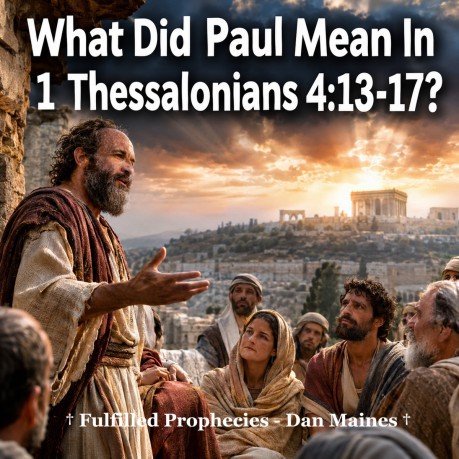
What Did Paul Mean In 1
Thessalonians 4:13-17? Introduction 1 Thessalonians 4:13 1 Thessalonians 4:14 1 Thessalonians 4:15 1 Thessalonians 4:16 1 Thessalonians 4:17 Daniel 12:1-2, 7 Matthew 24:30-31, 34 1 Corinthians 15:51-52, 54-55 Colossians 1:13 2 Corinthians 5:6, 8 Historical References How It Applies To Us Today Q & A Appendix Q: Was Paul teaching a future secret rapture in 1
Thessalonians 4:13-17? † This is the fulfilled perspective we proclaim at
Fulfilled Prophecies † Source Index
By Dan Maines
† First
Thessalonians 4:13-17 is one of the most misunderstood passages in
the New Testament. Futurists often use these verses to teach that
Jesus will someday return physically to earth, raise dead bodies from
their graves, and remove living Christians from the planet in an
event called the rapture. But is that what Paul was teaching?
†
Paul wasn't writing to Christians living thousands of years in his
future. He was writing to the first-century Thessalonian believers
who were grieving because some of their fellow Christians had died
before the promised coming of Christ. They wanted to know what would
happen to those who had fallen asleep in Jesus.
†
Paul's answer wasn't about escaping the earth. It was about
resurrection, victory over death, and being forever with the Lord. He
assured them that those who had died wouldn't be forgotten or
excluded when Christ fulfilled His promises.
†
The key to understanding this passage is recognizing its original
audience, the timing of Christ's coming, and the resurrection
promised in Daniel 12. When we compare Scripture with Scripture, we
discover that Paul was describing the completion of redemption at the
end of the Old Covenant age in AD 70, not an event still awaiting
fulfillment.
† We must also understand that
Paul used familiar prophetic language. Clouds represented divine
presence and judgment, trumpets announced significant covenant
events, and meeting the Lord described the gathering of His people
into His presence. These expressions must be understood through the
Old Testament prophets rather than modern expectations of a physical
evacuation.
But we do not want you
to be uninformed, brethren, about those who are asleep, so that you
will not grieve as do the rest who have no hope.
†
Paul began by addressing the Thessalonians' grief over believers who
had died. His concern wasn't that they might miss a future evacuation
from earth. He wanted them to understand that death wouldn't prevent
their loved ones from sharing in Christ's promised resurrection (1
Corinthians 15:22-23).
† The expression those
who are asleep refers to believers who had physically died. Sleep was
a familiar biblical description of death, but Paul's concern was
their promised resurrection and continued relationship with Christ
(John 11:11-14).
† Notice that Paul didn't
tell them to stop grieving. He told them not to grieve like those who
had no hope. Their hope rested in Jesus Christ, who had conquered
death and promised life to those who belonged to Him (John
11:25-26).
† This establishes the subject of
the entire passage. Paul was answering a question about deceased
believers and their participation in the resurrection, not
introducing a secret rapture doctrine (1 Corinthians 15:51-52).
For if we believe that
Jesus died and rose again, even so God will bring with Him those who
have fallen asleep in Jesus.
† Paul grounded
their hope in the historical death and resurrection of Jesus Christ.
Because Jesus had risen, those who belonged to Him could trust that
death wouldn't separate them permanently from His presence (Romans
8:38-39).
† Notice Paul's statement that God
would bring with Him those who had fallen asleep in Jesus. The
deceased believers weren't excluded from the promised gathering. They
would participate in Christ's victory over death (1 Corinthians
15:22-23).
† Paul's language points toward
the fulfillment of the resurrection promise. The faithful who had
died under the former covenant were awaiting the completion of
redemption, when access to God's presence would be fully established
(Hebrews 9:8; Hebrews 11:39-40).
† The
fulfilled perspective recognizes that Christ's resurrection
guaranteed the promised resurrection of His people. The completion of
that promise belonged to the first-century transition from the Old
Covenant age into the fully established New Covenant order (Daniel
12:1-2).
For this we say to you
by the word of the Lord, that we who are alive and remain until the
coming of the Lord, will not precede those who have fallen asleep.
†
Paul's words we who are alive and remain are important. He included
himself and his contemporary believers among those anticipating the
coming of the Lord. He wasn't describing a generation living
thousands of years later (1 Corinthians 15:51).
†
Paul assured the living believers that they wouldn't precede those
who had died. The resurrection promise included both groups, and
neither would be forgotten when Christ completed His promised work (1
Corinthians 15:52).
† Jesus had already
established the timeframe for His coming. He declared that some
standing before Him would live to see the Son of Man coming in His
kingdom, and He placed the fulfillment of His prophetic discourse
within that generation (Matthew 16:27-28; Matthew 24:34).
†
The coming of the Lord, or Parousia, refers to Christ's promised
royal presence and judgment. In the fulfilled perspective, this was
accomplished in AD 70 when Jerusalem and the Old Covenant temple
system were judged (Matthew 24:30; Luke 21:20-22).
†
Paul's expectation must be understood alongside the other New
Testament time statements. The apostles consistently described the
fulfillment as approaching in their own generation, not thousands of
years away (Romans 13:11-12; James 5:8-9).
For the Lord Himself
will descend from heaven with a shout, with the voice of the
archangel and with the trumpet of God, and the dead in Christ will
rise first.
† Paul described Christ's coming
using prophetic language associated with divine intervention,
judgment, and the gathering of God's people. The Lord descending from
heaven doesn't require a physical journey through the atmosphere.
Scripture frequently describes God coming down when He acts in
judgment (Isaiah 19:1; Micah 1:3-4).
† The
shout and voice of the archangel communicate divine authority and the
certainty of God's command. This wasn't an ordinary earthly
announcement. Paul was describing the decisive fulfillment of God's
resurrection promise (Daniel 12:1-2).
† The
trumpet of God connects directly with the last trumpet in Paul's
resurrection teaching. The trumpet announced the completion of the
promised transformation and the victory over death (1 Corinthians
15:51-54).
† The dead in Christ rising first
addresses the Thessalonians' original concern. Those who had died
wouldn't be left behind. Their resurrection was part of the promised
completion of redemption (Hebrews 11:39-40).
†
Daniel 12 identifies the resurrection with the time of unparalleled
distress and the shattering of the power of the holy people. That
places the resurrection within the judgment associated with the end
of Israel's Old Covenant order, not the end of the physical universe
(Daniel 12:1-2, 7).
† Jesus likewise
connected the great trumpet and gathering of the elect with His
coming in judgment, and He declared that those events would occur
within that generation (Matthew 24:30-31, 34).
Then we who are alive
and remain will be caught up together with them in the clouds to meet
the Lord in the air, and so we shall always be with the Lord.
†
This verse is the foundation of the modern rapture doctrine, but Paul
never said believers would disappear from the earth or that Jesus
would physically transport Christians into the sky. Those ideas are
imposed upon the passage rather than established by its stated
purpose (1 Corinthians 15:51-52).
† The
expression caught up describes being gathered into the Lord's
presence. In the fulfilled perspective, it represents the completed
union of the living and resurrected saints with Christ, not the
physical removal of Christians from the planet (Colossians 1:13;
Hebrews 12:22-23).
† Clouds frequently
symbolize divine glory, authority, and judgment. God was described as
coming on a cloud against Egypt, yet that prophecy didn't require Him
to appear physically in the atmosphere (Isaiah 19:1).
†
Meeting the Lord in the air expresses the triumph of Christ's people
and their participation in His heavenly kingdom. The emphasis isn't
the altitude of the meeting but the permanent relationship
established with the Lord (Ephesians 2:5-6).
†
Paul's concluding statement explains the entire purpose of the
promise. They would always be with the Lord. The goal was permanent
fellowship with Christ, not temporary removal from earth followed by
another return (John 14:2-3).
† Believers
living today already belong to Christ's established kingdom. When we
physically die, we don't wait for another resurrection event in the
distant future. We enter the Lord's presence because redemption has
been completed (2 Corinthians 5:6-8; Philippians 1:23).
Now at that time Michael,
the great prince who stands guard over the sons of your people, will
arise. And there will be a time of distress such as never occurred
since there was a nation until that time; and at that time your
people, everyone who is found written in the book, will be
rescued.
Many of those who sleep in the dust of the ground will
awake, these to everlasting life, but the others to disgrace and
everlasting contempt.
I heard the man dressed in linen, who was
above the waters of the river, as he raised his right hand and his
left toward heaven, and swore by Him who lives forever that it would
be for a time, times, and half a time; and as soon as they finish
shattering the power of the holy people, all these events will be
completed.
† Daniel connects the resurrection
with a particular time of distress involving his people. Jesus
identified the corresponding great tribulation with the judgment
approaching Jerusalem (Matthew 24:15-21).
†
The resurrection wasn't separated from that historical judgment by
thousands of years. Daniel connected its completion with the
shattering of the power of the holy people, understood in the
fulfilled perspective as the termination of Israel's Old Covenant
standing (Luke 21:20-22).
† Paul didn't
invent a different resurrection timetable. His teaching in
Thessalonians must agree with the resurrection promised through
Daniel (Acts 24:14-15).
And then the sign of
the Son of Man will appear in the sky, and then all the tribes of the
earth will mourn, and they will see the SON OF MAN COMING ON THE
CLOUDS OF THE SKY with power and great glory.
And He will send
forth His angels with A GREAT TRUMPET and THEY WILL GATHER TOGETHER
His elect from the four winds, from one end of the sky to the
other.
Truly I say to you, this generation will not pass away
until all these things take place.
† Jesus
described His coming with clouds, angels, a trumpet, and the
gathering of His elect. Paul used the same prophetic imagery in
Thessalonians. The passages describe the same covenantal fulfillment
(1 Thessalonians 4:16-17).
† Jesus didn't
leave the timing uncertain. He explicitly placed these events within
the lifetime of His contemporary generation (Matthew 16:27-28).
†
If Jesus placed His coming and gathering within that generation, we
cannot move Paul's corresponding description thousands of years into
our future without separating what Scripture connects (Luke 21:22).
Behold, I tell
you a mystery; we will not all sleep, but we will all be changed,
in
a moment, in the twinkling of an eye, at the last trumpet; for the
trumpet will sound, and the dead will be raised imperishable, and we
will be changed.
But when this perishable will have put on the
imperishable, and this mortal will have put on immortality, then will
come about the saying that is written, DEATH IS SWALLOWED UP in
victory.
O DEATH, WHERE IS YOUR VICTORY? O DEATH, WHERE IS YOUR
STING?
† Paul again included living believers
in the anticipated transformation. His words we will not all sleep
agree with his statement about those alive and remaining until the
coming of the Lord (1 Thessalonians 4:15).
†
Both passages connect the resurrection with the trumpet. They aren't
describing two different resurrection events separated by thousands
of years (Matthew 24:31).
† The victory over
death is central. In the covenantal resurrection perspective, Christ
removed the condemnation and separation associated with Adam and the
Law, establishing complete access to God through the New Covenant
(Romans 8:1-2; Hebrews 10:19-22).
† The
promised transformation wasn't about abandoning the physical world.
It concerned the completed victory of Christ and the everlasting life
secured for His people (John 11:25-26).
For He rescued us from the
domain of darkness, and transferred us to the kingdom of His beloved
Son,
† Paul explicitly stated that believers
had already been transferred into Christ's kingdom. Their citizenship
in that kingdom wasn't waiting for a future physical rapture
(Philippians 3:20).
† The kingdom is
spiritual and belongs to Christ's redeemed people. Entry into it
doesn't require leaving the earth or physically traveling into heaven
(John 18:36; Romans 14:17).
† The fulfillment
of the resurrection promise completed the transition into the fully
established New Covenant order, but believers were already
participating in Christ's kingdom before AD 70 (Hebrews 12:22-28).
Therefore, being always
of good courage, and knowing that while we are at home in the body we
are absent from the Lord--
we are of good courage, I say, and
prefer rather to be absent from the body and to be at home with the
Lord.
† Paul taught that being absent from
the body meant being at home with the Lord. He didn't describe
believers waiting in graves for a future worldwide resurrection
(Philippians 1:21-23).
† The completed
resurrection promise means that believers today have immediate access
to Christ's presence when physical life ends (Revelation 14:13).
†
We don't need another trumpet, another coming, or another covenantal
resurrection. Christ has accomplished the redemption promised to His
people (Hebrews 9:12; Hebrews 10:14).
†
Josephus, in The Jewish War, Books 5-6, described the terrible
suffering, famine, destruction, and slaughter associated with
Jerusalem's fall in AD 70. His historical account provides important
background for understanding the first-century judgment described by
Jesus (Luke 21:20-24).
† Josephus also
described the destruction of the temple, the center of Israel's Old
Covenant sacrificial worship. That historical event is significant to
the fulfilled perspective because Hebrews described the former
covenant as becoming obsolete and disappearing (Hebrews 8:13).
†
Eusebius, in Ecclesiastical History, Book 3, Chapter 5, reported that
Christians in Jerusalem were instructed to leave the city and settle
in Pella before its destruction. His account supports the historical
setting of Jesus' warning to flee Judea (Luke 21:20-21).
†
Tacitus, in Histories, Book 5, recorded the Roman conflict involving
Jerusalem and the Jewish people. His writings provide additional
historical testimony concerning the first-century war (Matthew
24:15-21).
† These historians document the
historical setting of Jerusalem's destruction. They don't
independently establish that the resurrection occurred in AD 70. That
theological conclusion comes from comparing the biblical resurrection
promises with their stated timeframes (Daniel 12:1-7; Matthew 24:34).
†
We don't need to live in fear of a future rapture, a coming
tribulation, or another destruction of the world. Jesus fulfilled His
promises to His original audience, and His kingdom is established
(Matthew 24:34; Colossians 1:13).
† When
someone we love dies in Christ, we can grieve with hope. Physical
death doesn't destroy our relationship with Him or prevent us from
entering His presence (John 11:25-26; 2 Corinthians 5:8).
†
We don't have to wait for Christ to establish His kingdom. We're
already citizens of His heavenly kingdom and members of His New
Covenant people (Hebrews 12:22-23; Philippians 3:20).
†
The message of Thessalonians remains a source of comfort. The
original resurrection promise has been fulfilled, and the continuing
blessing is everlasting fellowship with the Lord (Revelation
14:13).
† Our responsibility isn't to search
the skies for an event Jesus promised to His own generation. It's to
live faithfully in the kingdom He established, proclaim His completed
redemption, and share the hope of everlasting life (Ephesians 2:8-10;
Colossians 3:1-4).
A: No. In the fulfilled
perspective, Paul was comforting first-century believers concerning
the resurrection of those who had died in Christ. The passage doesn't
teach a secret removal of Christians from earth (1 Corinthians
15:51-52; Matthew 24:30-34).
Q: Who were those
who had fallen asleep?
A: They were believers
who had physically died before Christ's promised coming. Paul assured
the Thessalonians that their deceased brothers and sisters wouldn't
miss the resurrection (1 Thessalonians 4:13-16; John 11:11-14).
Q:
What did Paul mean by we who are alive and remain?
A:
He was addressing his own generation of believers who anticipated the
promised coming of Christ. His language agrees with Jesus'
first-century timeframe (Matthew 16:27-28; Matthew 24:34).
Q:
Did Jesus physically descend through the atmosphere in AD 70?
A:
The fulfilled perspective understands His descent as prophetic
language describing His royal presence and judgment. Scripture uses
similar language for divine judgments that didn't require a visible
bodily descent (Isaiah 19:1; Micah 1:3-4).
Q:
What did the trumpet represent?
A: It announced
God's decisive action in completing the resurrection promise and
gathering His people. Paul connected the trumpet with the
resurrection and victory over death (1 Corinthians 15:51-54; Matthew
24:31).
Q: What does meeting the Lord in the
air mean?
A: In the fulfilled perspective, it
symbolizes the gathering of Christ's people into His victorious
heavenly presence. The central promise is that believers would always
be with the Lord (Ephesians 2:5-6; Hebrews 12:22-23).
Q:
When did the resurrection promised in this passage occur?
A:
The fulfilled perspective places its completion in AD 70, when
Jerusalem's Old Covenant order was judged. Daniel connected the
resurrection with the shattering of the power of the holy people
(Daniel 12:1-2, 7; Luke 21:20-22).
Q: Were
living Christians physically removed from earth in AD 70?
A:
No. The fulfilled perspective understands their being caught up as
covenantal participation in Christ's completed victory and
established kingdom, not a physical disappearance (Colossians 1:13;
Hebrews 12:22-28).
Q: What happens to believers
when they die today?
A: They enter the presence
of the Lord. They don't need to wait for another resurrection at the
end of world history (2 Corinthians 5:8; Philippians 1:23; Revelation
14:13).
Q: What is the central message of 1
Thessalonians 4:13-17?
A: Christ's people,
whether deceased or living at His promised coming, wouldn't be
separated from Him. The ultimate assurance was permanent fellowship
with the Lord (John 11:25-26; Romans 8:38-39).
© Fulfilled Prophecies - Dan
Maines.
† 1
Thessalonians 4:13-17; Daniel 12:1-2, 7; Matthew 24:30-31, 34; 1
Corinthians 15:51-52, 54-55; Colossians 1:13; 2 Corinthians 5:6, 8.
†
Flavius Josephus, The Jewish War, Books 5-6; Eusebius, Ecclesiastical
History, Book 3, Chapter 5; Tacitus, Histories, Book 5.
Links