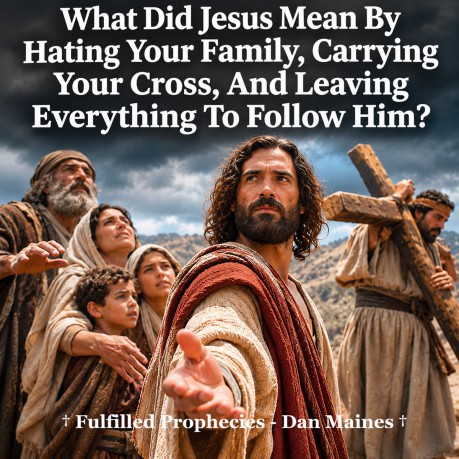
What Did Jesus Mean By Hating
Your Family, Carrying Your Cross, And Leaving Everything To Follow
Him? Luke 14:26-27 Matthew 10:37-39 Luke 9:23-24 Matthew 19:28-29 Mark 10:29-30 John 13:34-35 Romans 8:16-17 Hebrews 12:22-23 Historical References How It Applies To Us Today Q & A Appendix † This is the fulfilled perspective we proclaim at
Fulfilled Prophecies † Source Index
By Dan Maines
Introduction
†
Jesus made some of His strongest statements about discipleship when
He told His followers they must hate their families, carry their
crosses, and be willing to leave everything behind. At first glance,
these words seem to contradict His commandments to love one another
and honor our parents. However, when we examine the historical
setting and compare Scripture with Scripture, His meaning becomes
clear. Jesus wasn't commanding hatred toward family members. He was
demanding complete loyalty to Himself above every earthly
relationship.
† In Matthew 19:28-29, Jesus
also promised His apostles twelve thrones, authority to judge the
twelve tribes of Israel, and eternal life for those who sacrificed
everything for His name. These promises weren't disconnected from the
approaching end of the Old Covenant age. They belonged to the
first-century transition from the Old Covenant order into the
completed New Covenant kingdom (Matthew 16:27-28; Matthew 24:34).
†
We must distinguish between the specific promises Jesus made to His
apostles and the continuing principles of discipleship that apply to
believers today. Understanding that distinction prevents us from
turning first-century promises into events that must still happen in
our future (Luke 21:22; Hebrews 8:13).
If anyone comes to Me, and
does not hate his own father and mother and wife and children and
brothers and sisters, yes, and even his own life, he cannot be My
disciple. Whoever does not carry his own cross and come after Me
cannot be My disciple.
† Jesus used strong
comparative language to establish the priority of discipleship. The
word hate must be understood alongside Matthew 10:37, where Jesus
explained that loving father or mother more than Him made someone
unworthy of Him. The issue wasn't emotional hostility but divided
loyalty (Matthew 10:37).
† In the first
century, following Jesus could result in rejection by one's family,
exclusion from the synagogue, and persecution by religious
authorities. His disciples had to decide whether family approval or
obedience to Christ would govern their lives (John 9:22; John
16:2).
† Carrying one's cross wasn't a
reference to ordinary inconveniences. Under Roman rule, the cross
represented suffering, humiliation, and death. Jesus was warning His
followers that discipleship could cost them their lives (Matthew
10:38-39).
† Jesus wasn't abolishing family
responsibilities. He was teaching that no earthly relationship could
take the place of His authority. A person could love family deeply
while refusing to abandon Christ to satisfy family demands (Ephesians
6:1-3; John 13:34-35).
He who loves father or
mother more than Me is not worthy of Me; and he who loves son or
daughter more than Me is not worthy of Me. And he who does not take
his cross and follow after Me is not worthy of Me. He who has found
his life will lose it, and he who has lost his life for My sake will
find it.
† Matthew explains what Luke meant
by hate. Jesus didn't say that loving parents or children was wrong.
He said that loving them more than Him was wrong. The comparison
concerns priority, not the destruction of natural affection (Luke
14:26).
† The original disciples faced a
genuine choice between preserving their earthly security and
remaining faithful to Christ. Some would lose their lives because
they refused to deny Him (Matthew 24:9; Revelation 12:11).
†
Finding one's life referred to protecting earthly existence at the
expense of faithfulness. Losing one's life for Christ meant
surrendering that security rather than abandoning Him. Jesus promised
that faithfulness to Him was greater than anything this world could
take away (John 12:25).
† These words also
establish an enduring principle. Our relationship with Christ must
govern every other relationship, but that loyalty must be expressed
through love, righteousness, and obedience rather than cruelty or
neglect (John 14:15; 1 John 4:20-21).
And He was saying to them all,
If anyone wishes to come after Me, he must deny himself, and take up
his cross daily and follow Me. For whoever wishes to save his life
will lose it, but whoever loses his life for My sake, he is the one
who will save it.
† Jesus described
discipleship as a daily commitment. Denying oneself meant
surrendering self-rule and placing His authority above personal
desires, ambitions, and worldly security (Galatians 2:20).
†
The first-century disciples understood the danger of carrying a cross
because Roman crucifixion was a public reality. Jesus wasn't
promising an easy life. He was preparing them for opposition and
suffering as they proclaimed His kingdom (Acts 14:22).
†
The command to follow Christ remains meaningful today, although the
historical circumstances have changed. We aren't waiting for the
destruction of Jerusalem or the completion of the Old Covenant age.
We follow the King whose kingdom has already been established
(Colossians 1:13; Hebrews 12:28).
† Taking up
our cross today means remaining faithful when obedience becomes
costly. It doesn't mean deliberately seeking suffering or abandoning
legitimate responsibilities. It means that our loyalty to Christ
isn't for sale (Romans 12:1-2).
And Jesus said to them,
Truly I say to you, that you who have followed Me, in the
regeneration when the Son of Man will sit on His glorious throne, you
also shall sit upon twelve thrones, judging the twelve tribes of
Israel. And everyone who has left houses or brothers or sisters or
father or mother or children or farms for My name's sake, will
receive many times as much, and will inherit eternal life.
†
Jesus was speaking directly to His apostles in response to Peter's
question about what they would receive for leaving everything to
follow Him. The promise of twelve thrones was specifically connected
to those apostles and the twelve tribes of Israel (Matthew 19:27;
Luke 22:28-30).
† The regeneration described
the renewal associated with Christ's kingdom and the transition from
the Old Covenant order into the New Covenant order. Jesus wasn't
describing the physical destruction and recreation of planet Earth.
Scripture identifies the passing covenant order as approaching its
end in the first century (Hebrews 8:13; 2 Corinthians 5:17).
†
The Son of Man sitting upon His glorious throne concerns His royal
authority. Jesus received all authority following His resurrection,
and His reign was already being proclaimed by the apostles before
Jerusalem fell (Matthew 28:18; Acts 2:30-36).
†
The twelve thrones represented apostolic authority in relation to
Israel. The apostles proclaimed the gospel, established the
foundation of the church, and bore witness against the unbelieving
covenant nation. Their authority came from Christ, not from earthly
political power (Ephesians 2:20; Acts 13:46).
†
The judgment of the twelve tribes must be understood within the
first-century judgment upon covenant Israel. Jesus had already
declared that judgment would come upon that generation, and
Jerusalem's destruction in AD 70 marked the public end of the Old
Covenant system (Matthew 23:35-36; Luke 21:20-22).
†
Jesus also promised that those who sacrificed homes, possessions, and
family relationships for His name would receive far more than they
surrendered. This wasn't a guarantee of financial wealth. It was a
promise that belonging to Christ and His kingdom provided an
inheritance greater than earthly possessions (Mark 10:29-30; Romans
8:16-17).
† Eternal life wasn't postponed
until the physical world ended. Jesus identified eternal life with
knowing the Father and Himself, and believers already possessed that
life through faith in Him (John 17:3; John 5:24).
Jesus said, Truly I say to
you, there is no one who has left house or brothers or sisters or
mother or father or children or farms, for My sake and for the
gospel's sake, but that he will receive a hundred times as much now
in the present age, houses and brothers and sisters and mothers and
children and farms, along with persecutions; and in the age to come,
eternal life.
† Mark supplies an important
detail. Jesus said His followers would receive blessings in the
present age while also experiencing persecutions. He didn't promise
that following Him would eliminate hardship (John 16:33).
†
The hundredfold blessing included the enlarged spiritual family
created through the gospel. Believers who lost family relationships
because of their faith found brothers, sisters, and spiritual support
among God's people (Acts 2:44-47; Acts 4:32-35).
†
The age to come was the approaching New Covenant age, not a distant
physical world awaiting creation thousands of years later. The Old
Covenant was becoming obsolete, and its passing was near when Hebrews
was written (Hebrews 8:13; Hebrews 9:26).
†
The promise of eternal life was fulfilled through Christ's completed
redemptive work. We now live under the established New Covenant,
where eternal life belongs to those who are in Him (John 3:16; 1 John
5:11-12).
A new commandment I give to
you, that you love one another, even as I have loved you, that you
also love one another. By this all men will know that you are My
disciples, if you have love for one another.
†
This passage settles any suggestion that Jesus commanded literal
hatred toward family members. His disciples were commanded to love
one another according to the example He personally established (John
15:12).
† Jesus never taught that devotion to
Him justified cruelty, abandonment, or mistreatment of others. He
condemned religious traditions that allowed people to avoid caring
for their parents while claiming devotion to God (Mark 7:9-13).
†
The defining evidence of discipleship isn't hostility toward family
or society. It's love that remains faithful to Christ even when
others reject that faith (Matthew 5:44; 1 John 4:7-8).
†
We can love our families without allowing them to determine what we
believe. Christ must remain first, but His commandments require us to
demonstrate that loyalty through love and truth (Ephesians 4:15).
The Spirit Himself testifies
with our spirit that we are children of God, and if children, heirs
also, heirs of God and fellow heirs with Christ, if indeed we suffer
with Him so that we may also be glorified with Him.
†
Paul identified believers as God's children and heirs. Their
inheritance came through their relationship with Christ, not through
ownership of earthly property or membership in the physical nation of
Israel (Galatians 3:26-29).
† The
first-century saints experienced suffering while awaiting the
completion of the covenant transition. Their inheritance was tied to
the redemption Christ accomplished, not to the restoration of an
earthly political kingdom (Romans 8:18-23; Hebrews 9:15).
†
Today, believers share in the blessings of the completed New
Covenant. We don't need to wait for another coming of Christ to
establish His kingdom or provide access to eternal life (Colossians
1:13; Hebrews 10:19-22).
† The inheritance
Jesus promised is greater than anything a disciple might surrender.
Earthly relationships and possessions are temporary, but life in
Christ isn't dependent upon them (2 Corinthians 5:1-8; Philippians
1:23).
But you have come to Mount
Zion and to the city of the living God, the heavenly Jerusalem, and
to myriads of angels, to the general assembly and church of the
firstborn who are enrolled in heaven, and to God, the Judge of all,
and to the spirits of the righteous made perfect,
†
The writer of Hebrews told first-century believers that they had
already come to heavenly Jerusalem. This demonstrates that the
promised kingdom wasn't merely a future geographical destination
(Galatians 4:26).
† The church belongs to the
heavenly Jerusalem through Christ. The completed passing of the Old
Covenant order in AD 70 confirmed the removal of the former covenant
system and the establishment of the New Covenant order (Hebrews 8:13;
Revelation 21:2).
† The apostles'
foundational authority, the inheritance of believers, and the
heavenly Jerusalem belong to the same redemptive accomplishment.
These promises don't require a future rebuilding of national Israel's
temple or government (Ephesians 2:19-22; Revelation 21:9-10).
†
We now belong to the kingdom that cannot be shaken. Our calling is to
live faithfully under Christ's authority, loving others and
recognizing that our greatest inheritance is already found in Him
(Hebrews 12:28; Colossians 3:1-4).
†
Josephus, writing in The Jewish War, described the destruction of
Jerusalem and its temple in AD 70. His account provides historical
evidence of the judgment that brought the Old Covenant temple system
to its visible end. Josephus wasn't interpreting Jesus' promises
about the twelve thrones, but his history confirms the destruction of
the city and sanctuary (Luke 21:20-22).
†
Eusebius, in Ecclesiastical History, Book 3, Chapter 5, recorded the
tradition that Christians departed Jerusalem and settled in Pella
before the city's destruction. This tradition illustrates the
seriousness with which early believers regarded the approaching
danger (Matthew 24:15-16).
† John Chrysostom,
in his homilies on Matthew, explained the priority of loving Christ
above family relationships. His discussion of Matthew 10:37 supports
the distinction between loving family members and placing them above
Christ (Matthew 10:37).
† These historical
writers help us understand the circumstances of early Christianity,
but Scripture remains our authority for identifying the meaning and
fulfillment of Christ's promises (Acts 17:11).
†
Jesus must remain first in our lives. This doesn't mean we should
hate our parents, spouses, children, or other relatives. It means
that no relationship should require us to abandon our faithfulness to
Christ (Matthew 10:37).
† Carrying our cross
means remaining committed to Christ even when doing so involves
rejection, sacrifice, or suffering. It isn't a command to manufacture
hardship or neglect our responsibilities (Luke 9:23).
†
We must remember that the twelve thrones were promised specifically
to the apostles in connection with Israel's covenant judgment. We
aren't waiting for twelve physical thrones to appear in a future
earthly government (Matthew 19:28; Ephesians 2:20).
†
We don't follow Christ to become wealthy. Our inheritance is eternal
life, fellowship with God, and membership in His kingdom. Those
blessings are greater than anything the world can offer (Romans
8:16-17).
† Our love for Christ should make
us more loving toward others, not less. A believer who uses Luke
14:26 to justify hatred has misunderstood the very Lord who commanded
His disciples to love one another (John 13:34-35).
†
We aren't waiting for the Old Covenant age to end. That transition
was completed in AD 70. We live in the established New Covenant
kingdom, where Christ reigns and His people possess eternal life
through Him (Hebrews 12:22-28; John 5:24).
Q: Did
Jesus literally command His disciples to hate their families?
A:
No. Matthew 10:37 explains that Jesus was demanding greater loyalty
to Himself than to any family relationship. He also commanded His
disciples to love one another (Matthew 10:37; John 13:34-35).
Q:
What did carrying one's cross mean in the first century?
A:
It meant accepting the possibility of persecution, rejection,
suffering, and even death rather than denying Christ. Roman
crucifixion made this warning especially serious (Luke 9:23-24;
Matthew 10:38-39).
Q: Does carrying our cross
mean abandoning our families today?
A: No.
Christ must come first, but Scripture also commands believers to
honor parents, love others, and fulfill family responsibilities
(Ephesians 6:1-3; 1 Timothy 5:8).
Q: Who was
promised the twelve thrones?
A: Jesus
specifically promised them to the apostles who had followed Him. The
twelve thrones represented their authority in relation to the twelve
tribes of Israel (Matthew 19:28; Luke 22:28-30).
Q:
What was the regeneration Jesus mentioned?
A:
From the fulfilled perspective, it referred to the renewal associated
with Christ's kingdom and the transition into the completed New
Covenant order, rather than the physical recreation of the planet
(Matthew 19:28; Hebrews 8:13).
Q: When did the
judgment associated with Israel's covenant order occur?
A:
It reached its historical fulfillment in the first century,
culminating in Jerusalem's destruction in AD 70, within the
generation Jesus identified (Matthew 23:35-36; Matthew 24:34; Luke
21:20-22).
Q: Did Jesus promise His followers
that they would become financially wealthy?
A:
No. Mark 10:29-30 included persecutions alongside the promised
blessings. The spiritual family, kingdom inheritance, and eternal
life are greater than material wealth (Mark 10:29-30).
Q:
What does it mean to inherit eternal life?
A:
It means possessing life through Christ. Believers already have
eternal life in Him, and physical death doesn't separate them from
His presence (John 5:24; 2 Corinthians 5:8).
Q:
Are we still waiting for Christ to establish His kingdom?
A:
No. From the fulfilled perspective, Christ established His kingdom,
completed the covenant transition, and brought the promised New
Covenant order into its fullness by AD 70 (Colossians 1:13; Hebrews
12:28).
Q: What is the main lesson of these
passages?
A: Jesus must come before everything
else. True discipleship requires faithfulness, sacrifice, and love,
while our greatest inheritance is found in Christ and His completed
kingdom (Luke 14:26-27; Matthew 19:28-29).
© Fulfilled Prophecies - Dan
Maines.
† Luke
14:26-27; Matthew 10:37-39; Luke 9:23-24; Matthew 19:28-29; Mark
10:29-30; John 13:34-35; Romans 8:16-17; Hebrews 12:22-23.
†
Flavius Josephus, The Jewish War; Eusebius, Ecclesiastical History,
Book 3, Chapter 5; John Chrysostom, Homilies on the Gospel of
Matthew.
Links