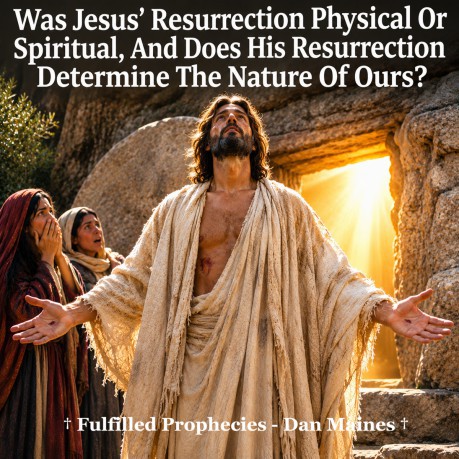
Was Jesus' Resurrection
Physical Or Spiritual, And Does His Resurrection Determine The Nature
Of Ours? Introduction Matthew 28:2, 6 Luke 24:39, 42-43 John 20:19, 27 Acts 2:31 1 Corinthians 15:20, 44, 50 Romans 6:4-5 Ephesians 2:5-6 Matthew 27:51-53 Ezekiel 37:11-12, 14 Daniel 12:2, 7 2 Corinthians 5:1, 8 Historical References How It Applies To Us Today Q & A Appendix † This is the fulfilled perspective we proclaim at
Fulfilled Prophecies † Source Index
By Dan Maines
† One of the
most important questions concerning the resurrection is whether Jesus
was raised physically or spiritually, and whether His resurrection
establishes the exact pattern for the resurrection promised to
believers.
† Scripture tells us that Jesus'
tomb was empty, His disciples touched Him, He ate food, and Thomas
was invited to examine His wounds. Yet Paul also taught that
believers would receive a spiritual body and that flesh and blood
cannot inherit the kingdom of God.
† If Jesus
was raised physically, how did He leave a sealed tomb? If His
resurrection was spiritual, what happened to His physical body? And
if Christ is the firstfruits, does that require every believer to
experience the same physical resurrection?
†
We must also examine Matthew 27:51-53, where saints were raised and
appeared in Jerusalem, and determine whether this event fulfilled
Ezekiel 37 or served another purpose.
† The
answer requires distinguishing Christ's historical resurrection, His
victory over covenant death, and the resurrection promised to His
first-century people. These events are connected, but Scripture
doesn't necessarily describe them as identical in every detail.
And behold, a severe
earthquake had occurred, for an angel of the Lord descended from
heaven and came and rolled away the stone and sat upon it.
He is
not here, for He has risen, just as He said. Come, see the place
where He was lying.
† Matthew establishes
that Jesus' tomb was empty. The angel didn't announce that Jesus'
spirit had departed while His dead body remained inside. The place
where His body had been lying was empty (Luke 24:3).
†
Notice that the angel rolled away the stone, but Matthew doesn't say
the stone was moved to allow Jesus to escape. Jesus had already risen
when the women received the announcement (Mark 16:6).
†
The stone was removed so the witnesses could see the empty tomb.
Scripture doesn't explain the precise mechanics of how Jesus left the
tomb, and we shouldn't invent an explanation (John 20:8-9).
†
His resurrection was a supernatural act of God. A sealed entrance
couldn't prevent the One whom God raised from the dead from appearing
alive (Acts 2:24).
See My hands and My feet,
that it is I Myself; touch Me and see, for a spirit does not have
flesh and bones as you see that I have.
They gave Him a piece of
a broiled fish;
and He took it and ate it before them.
†
Jesus specifically denied that He was merely a spirit appearing
before His disciples. He invited them to examine His hands and feet
because His resurrection involved a real, tangible body (John
20:20).
† His eating wasn't necessary to
prove that He needed physical nourishment. It demonstrated that the
person standing before them was the same Jesus who had been crucified
(Acts 10:40-41).
† This creates a serious
problem for the claim that Jesus experienced only a spiritual
resurrection. The testimony of the witnesses identifies bodily
continuity between the crucified Jesus and the risen Lord (John
2:19-22).
† However, His resurrection body
was no longer subject to ordinary mortal limitations. He would never
die again, and death no longer had mastery over Him (Romans 6:9).
So when it was evening on
that day, the first day of the week, and when the doors were shut
where the disciples were, for fear of the Jews, Jesus came and stood
in their midst and said to them, Peace be with you.
Then He said
to Thomas, Reach here with your finger, and see My hands; and reach
here your hand and put it into My side; and do not be unbelieving,
but believing.
† Jesus appeared among His
disciples while the doors were shut. John doesn't explain how He
entered, but the account demonstrates that His resurrected existence
wasn't restricted in the same way as ordinary mortal life (Luke
24:31).
† Thomas was invited to examine the
wounds of the crucifixion. Jesus didn't present Himself as an
unrelated spiritual replacement for the body that had died (John
20:25-29).
† We shouldn't conclude that His
body was imaginary simply because He appeared behind closed doors.
The same account emphasizes His physical wounds and personal identity
(Luke 24:39).
† The distinction is between a
mortal body subject to death and the risen Christ who had conquered
death. His resurrection was bodily, but His resurrected life was no
longer mortal (Romans 6:9).
he looked ahead and spoke of the
resurrection of the Christ, that HE WAS NEITHER ABANDONED TO HADES,
NOR DID His flesh SUFFER DECAY.
† Peter
connected Christ's resurrection with the promise that His flesh
wouldn't suffer decay. This confirms that Jesus' resurrection wasn't
merely the survival of His spirit after death (Psalm 16:10).
†
His body wasn't left to decay in the tomb. God raised the crucified
Jesus, and the apostles testified that He was alive (Acts 2:32).
†
Christ's resurrection established His victory over death and
confirmed that He was the promised Messiah. His bodily resurrection
is a historical foundation of the gospel (Romans 1:4).
But now Christ
has been raised from the dead, the first fruits of those who are
asleep.
it is sown a natural body, it is raised a spiritual
body. If there is a natural body, there is also a spiritual body.
Now
I say this, brethren, that flesh and blood cannot inherit the kingdom
of God; nor does the perishable inherit the imperishable.
†
Paul identifies Christ as the firstfruits, meaning His resurrection
guarantees the promised harvest. The firstfruits establish the
certainty and source of the resurrection, but we must examine the
surrounding passages to determine its nature (1 Corinthians
15:21-23).
† Jesus was physically raised and
demonstrated His victory through an empty tomb. That doesn't
automatically prove every believer must leave an empty grave or
return to earthly life in a restored biological body (2 Corinthians
5:1-8).
† Paul distinguished the natural body
from the spiritual body. Spiritual doesn't mean unreal or
nonexistent. It describes life belonging to the Spirit rather than
the mortal order governed by corruption (1 Corinthians 15:42-49).
†
The fulfilled perspective understands the corporate resurrection as
the completion of the transition from Adamic condemnation and the Old
Covenant order into the completed New Covenant life in Christ (Romans
5:17-21).
† Christ's resurrection is the
foundation and guarantee of ours, but the firstfruits illustration
doesn't require every aspect of His historical resurrection to be
reproduced physically in every believer (Colossians 1:18).
†
The central question is whether Paul's promised resurrection
concerned the restoration of biological bodies or the removal of
covenant death and the full inheritance of life in Christ (1
Corinthians 15:54-57).
Therefore we have been buried
with Him through baptism into death, so that as Christ was raised
from the dead through the glory of the Father, so we too might walk
in newness of life.
For if we have become united with Him in the
likeness of His death, certainly we shall also be in the likeness of
His resurrection,
† Paul connected believers
with Christ's death and resurrection without teaching that every
believer had to experience crucifixion and physical emergence from a
tomb (Galatians 2:20).
† Believers were
united with Christ through participation in His death and
resurrection. That union brought newness of life while they were
still physically alive (Colossians 2:12-13).
†
This establishes an important principle. Sharing in Christ's
resurrection doesn't require reproducing every physical detail of His
personal resurrection (Ephesians 2:5-6).
†
Christ accomplished redemption through historical events. Believers
receive the benefits of those events through union with Him (Romans
8:1-2).
even when we were dead in
our transgressions, made us alive together with Christ (by grace you
have been saved),
and raised us up with Him, and seated us with
Him in the heavenly places in Christ Jesus,
†
Paul described believers as already made alive, raised, and seated
with Christ. They hadn't physically died and emerged from graves, yet
their resurrection participation was real (Colossians 3:1-3).
†
Their former death was connected with transgressions, not merely the
cessation of biological life. Their new life was found in Christ
(John 5:24).
† This supports understanding
the resurrection corporately and covenantally. Christ's physical
resurrection made possible the spiritual life and inheritance of His
people (Romans 6:11).
† It also explains why
the fulfilled resurrection needn't be demonstrated through empty
graves across the Roman world (2 Corinthians 5:1).
And behold, the veil of the
temple was torn in two from top to bottom; and the earth shook and
the rocks were split.
The tombs were opened, and many bodies of
the saints who had fallen asleep were raised;
and coming out of
the tombs after His resurrection they entered the holy city and
appeared to many.
† Matthew describes an
extraordinary event associated with Jesus' death and resurrection.
The temple veil was torn, the earth shook, and tombs were opened
(Hebrews 10:19-20).
† Matthew explicitly says
many bodies of the saints were raised. We shouldn't dismiss that
statement or replace it with an exclusively invisible spiritual event
without textual evidence (John 11:43-44).
†
Notice the distinction in timing. The tombs were opened in connection
with Jesus' death, but the saints came out and appeared after His
resurrection (1 Corinthians 15:20).
† Their
appearance demonstrated that Christ's victory over death had
consequences beyond Himself. However, Matthew doesn't identify these
saints, describe their subsequent lives, or explain whether they
later died again (John 5:28-29).
† Matthew
also doesn't identify this event as the completed resurrection
promised in Daniel 12. It occurred around AD 30, while Daniel
connected the completion of his resurrection prophecy with the
shattering of the holy people's power (Daniel 12:2, 7).
†
Therefore, Matthew 27 can be understood as a historical sign
anticipating the greater covenantal resurrection without requiring
that the entire resurrection promise was completed at the cross
(Hebrews 9:26-28).
Then He said to me, Son
of man, these bones are the whole house of Israel; behold, they say,
'Our bones are dried up and our hope has perished. We are completely
cut off.'
Therefore prophesy and say to them, 'Thus says the
Lord GOD, Behold, I will open your graves and cause you to come up
out of your graves, My people; and I will bring you into the land of
Israel.
I will put My Spirit within you and you will come to
life, and I will place you on your own land. Then you will know that
I, the LORD, have spoken and done it, declares the LORD.'
†
God Himself identifies the dry bones as the whole house of Israel.
The vision concerns a people who believed their hope had perished and
that they had been completely cut off (Ezekiel 37:11).
†
The opening of graves symbolizes God's restoration of His covenant
people. The promise includes the Spirit, renewed life, and
restoration to their land (Ezekiel 37:21-27).
†
Ezekiel's prophecy originally addressed Israel's national restoration
from exile. Its imagery also provides a theological background for
understanding spiritual restoration and resurrection life under the
New Covenant (John 5:24-25).
† Matthew 27
uses related grave-opening imagery, but Matthew never explicitly says
that Ezekiel 37 was fulfilled by the saints who appeared in Jerusalem
(Matthew 27:52-53).
† The connection is
meaningful, but it shouldn't be presented as a direct quotation or
explicit fulfillment statement. Ezekiel describes corporate
restoration, while Matthew reports a particular resurrection event
(Romans 11:15).
† Both passages demonstrate
God's authority to bring life where death and hopelessness had
prevailed, but they must be interpreted according to their individual
contexts (2 Corinthians 3:6).
Many of those who sleep in
the dust of the ground will awake, these to everlasting life, but the
others to disgrace and everlasting contempt.
I heard the man
dressed in linen, who was above the waters of the river, as he raised
his right hand and his left toward heaven, and swore by Him who lives
forever that it would be for a time, times, and half a time; and as
soon as they finish shattering the power of the holy people, all
these events will be completed.
† Daniel
describes the resurrection and then provides the time marker for the
completion of the events in his prophecy (Daniel 12:1-7).
†
The resurrection was connected with the period when the power of the
holy people would be completely shattered. From the fulfilled
perspective, this points to the destruction of Jerusalem and the
temple in AD 70 (Luke 21:20-22).
† Jesus'
bodily resurrection around AD 30 was the foundation of redemption.
The resurrection promised to the covenant people reached its
prophetic completion with the passing of the Old Covenant order in AD
70 (Hebrews 8:13).
† This distinction allows
us to affirm Jesus' literal bodily resurrection without requiring a
worldwide resurrection of biological corpses in AD 70 (1 Corinthians
15:50).
† Christ was raised from the dead as
the victorious Messiah. His people received the completed inheritance
of resurrection life through the New Covenant (Hebrews 12:22-24).
For we know that if the
earthly tent which is our house is torn down, we have a building from
God, a house not made with hands, eternal in the heavens.
we are
of good courage, I say, and prefer rather to be absent from the body
and to be at home with the Lord.
† Paul
contrasted the earthly tent with an eternal dwelling from God. His
hope wasn't expressed as returning to another temporary existence in
a mortal body (Philippians 1:23).
† The
fulfilled perspective understands the completed resurrection as
opening the way into God's presence, so believers who die are
immediately with Christ (Revelation 14:13).
†
This doesn't mean Jesus' physical resurrection was unnecessary. His
victory over death established the life and inheritance His people
now possess (John 11:25-26).
† We must
distinguish the bodily resurrection of Christ, the corporate
resurrection of His covenant people, and the believer's immediate
presence with the Lord after physical death (Colossians 3:3-4).
†
Josephus, writing in The Jewish War, Books 6-7, described the
destruction of Jerusalem and its temple in AD 70. His historical
account establishes the catastrophic end of the temple system, which
the fulfilled perspective connects with Daniel's prophecy.
†
Eusebius, in Ecclesiastical History, Book 3, Chapter 5, recorded the
tradition that Christians departed Jerusalem and settled in Pella
before the city's destruction. This provides historical context for
Jesus' warning concerning Jerusalem (Luke 21:20-22).
†
Ignatius of Antioch, in his Letter to the Smyrnaeans, Chapter 3,
emphasized that the risen Jesus possessed flesh and was not merely a
disembodied spirit. This demonstrates that early Christians strongly
affirmed Christ's bodily resurrection.
†
Irenaeus, in Against Heresies, Book 5, defended bodily resurrection.
His testimony demonstrates that early Christian writers didn't
universally interpret the resurrection in the covenantal manner
presented in this study.
† These historical
writers help establish the setting and early interpretations, but
Scripture remains the authority for determining the nature and timing
of the resurrection.
†
We don't have to deny Jesus' physical resurrection to affirm the
fulfilled resurrection of His people. His empty tomb, His wounds, and
His appearances demonstrate that God truly raised Him from the dead
(Luke 24:39).
† We also don't have to insist
that our resurrection must reproduce every physical detail of His
resurrection. Believers participate in His death and resurrection
through union with Him (Romans 6:4-5).
†
Jesus' resurrection established the foundation of redemption, and the
completed New Covenant brought His people into the inheritance He
secured (Ephesians 2:5-6).
† We shouldn't
confuse the saints raised in Matthew 27 with the completed
resurrection of Daniel 12. The two events belong to the same
redemptive story, but Scripture doesn't identify them as the same
event (Matthew 27:52-53; Daniel 12:2, 7).
†
We can rejoice that Christ has conquered death and that believers who
depart this earthly life are at home with the Lord (2 Corinthians
5:8).
† Our hope isn't another future
destruction of the world or a future resurrection of biological
bodies. Our hope rests in the finished work of Jesus Christ and the
eternal life already available through Him (John 5:24).
Q: Was
Jesus raised physically or spiritually?
A:
Jesus was bodily raised from the dead. He had flesh and bones,
displayed His wounds, and ate before His disciples. His resurrected
body was no longer subject to death (Luke 24:39-43; Romans 6:9).
Q:
How did Jesus leave the sealed tomb?
A:
Scripture doesn't explain the exact mechanism. It tells us that the
stone was rolled away and the tomb was empty. The stone's removal
allowed witnesses to examine the tomb, but the text doesn't say Jesus
needed the entrance opened to leave (Matthew 28:2, 6).
Q:
Did Jesus pass through solid stone?
A:
Scripture doesn't explicitly say that. His appearance behind shut
doors demonstrates supernatural ability, but it doesn't establish
precisely how He left the tomb (John 20:19).
Q:
Does firstfruits mean our resurrection must be physically identical
to His?
A: Firstfruits establishes Christ as
the foundation and guarantee of the resurrection harvest. The
fulfilled perspective distinguishes His bodily resurrection from the
corporate covenantal resurrection of His people (1 Corinthians 15:20,
44, 50).
Q: Why did Jesus have a physical body
after His resurrection?
A: His bodily
appearances demonstrated that the crucified Jesus had truly been
raised. His wounds confirmed His identity, and His resurrection
established His victory over death (John 20:27; Acts 2:31).
Q:
What happened to Jesus' physical body?
A:
Scripture teaches that His flesh didn't suffer decay and that He was
raised from the dead. It doesn't describe His physical body being
abandoned while only His spirit departed (Acts 2:31).
Q:
Were the saints in Matthew 27 physically raised?
A:
Matthew says many bodies of the saints were raised, came out of the
tombs after Jesus' resurrection, and appeared to many. The passage
doesn't explain what happened to them afterward (Matthew
27:52-53).
Q: Did Matthew 27 fulfill Ezekiel
37?
A: Both passages contain resurrection
imagery, but Ezekiel identifies the dry bones as the whole house of
Israel and describes restoration. Matthew doesn't explicitly identify
the raised saints as the fulfillment of Ezekiel's vision (Ezekiel
37:11-14; Matthew 27:52-53).
Q: When was the
resurrection promised in Daniel 12 fulfilled?
A:
The fulfilled perspective connects its completion with the shattering
of the holy people's covenantal power in AD 70, when Jerusalem and
the temple were destroyed (Daniel 12:2, 7; Luke 21:20-22).
Q:
What happens to believers when they physically die today?
A:
Believers are immediately at home with the Lord. They don't need to
wait for another future resurrection event to enter His presence (2
Corinthians 5:1, 8; Philippians 1:23).
Q: Can
we affirm Christ's bodily resurrection while understanding our
resurrection covenantally?
A: Yes, within the
fulfilled perspective, because Christ's historical bodily
resurrection and the covenantal resurrection of His people are
distinguished while remaining inseparably connected through His
victory over death (Romans 6:4-5; Ephesians 2:5-6).
© Fulfilled Prophecies - Dan
Maines.
† Matthew
28:2, 6; Luke 24:39, 42-43; John 20:19, 27; Acts 2:31; 1 Corinthians
15:20, 44, 50; Romans 6:4-5; Ephesians 2:5-6; Matthew 27:51-53;
Ezekiel 37:11-12, 14; Daniel 12:2, 7; 2 Corinthians 5:1, 8.
†
Flavius Josephus, The Jewish War, Books 6-7; Eusebius, Ecclesiastical
History, Book 3, Chapter 5; Ignatius of Antioch, Letter to the
Smyrnaeans, Chapter 3; Irenaeus, Against Heresies, Book 5.
Links