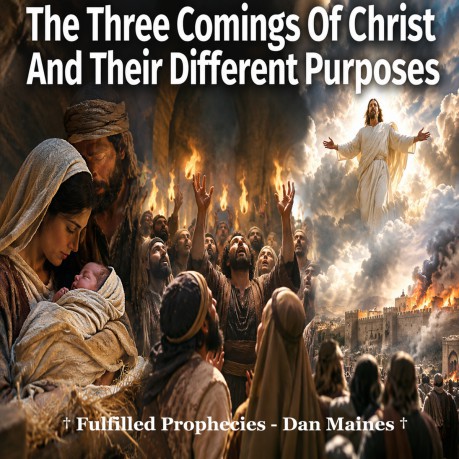
The Three Comings Of Christ
And Their Different Purposes God Foretold Israel's Covenant Unfaithfulness The Song Of Moses Was A Witness Against Israel Deuteronomy 32:20, 43 God Promised A Faithful Prophet Greater Than
Moses The First Coming: Christ Was Born Of A Woman Malachi Foretold The Messenger And The Lord's
Coming Malachi 4:5-6 The Second Coming In This Sequence: The Spirit Sent In
Jesus' Name John 16:7, 13 Pentecost Demonstrated The Spirit's Arrival The Spirit Made The New Covenant Ministry Possible The Old Covenant Was Ready To Disappear The Third Coming: Christ On The Clouds In Judgment Matthew 26:64 Luke 21:20, 22, 27, 32 Historical References How It Applies To Us Today Q & A Appendix † This is the fulfilled perspective we proclaim at
Fulfilled Prophecies †
By Dan Maines
Introduction
†
Scripture reveals three distinct ways Christ came to accomplish God's
plan of redemption. First, He came in the flesh, born of a woman
under the Law, to fulfill the promises made to Israel and establish
the New Covenant through His sacrifice. Second, He came to His
disciples through the Holy Spirit, sent in His name at Pentecost, to
teach, strengthen, and guide the first-century believers through the
covenant transition. Third, He came on the clouds in judgment against
unfaithful covenant Israel, bringing the Old Covenant age to its
final conclusion in AD 70.
† These weren't
three separate plans. They were three connected stages in one divine
purpose. God knew Israel would break His covenant, foretold their
judgment, promised a faithful Prophet, sent His Son, empowered His
followers through the Spirit, and completed the covenant transition
through judgment (Deuteronomy 31:16-21; 18:15-19; Hebrews 8:13).
†
Understanding these three comings helps us recognize why the Holy
Spirit was essential to the success of the New Covenant. The
first-century believers weren't simply being asked to change their
religious practices. They were being called to leave the covenant
system their ancestors had followed for centuries, even when doing so
could cost them their lives (Acts 2:38; 2 Corinthians 3:6).
Deuteronomy
31:16-17
The LORD said to Moses, Behold, you are about
to lie down with your fathers; and this people will arise and play
the harlot with the strange gods of the land, into the midst of which
they are going, and will forsake Me and break My covenant which I
have made with them.
Then My anger will be kindled against them
in that day, and I will forsake them and hide My face from them, and
they will be consumed, and many evils and troubles will come upon
them; so that they will say in that day, 'Is it not because our God
is not among us that these evils have come upon us?'
†
Before Israel entered the Promised Land, God already knew they would
become unfaithful and break His covenant. Their future rebellion
wasn't a surprise to Him (Deuteronomy 31:21).
†
God warned that covenant unfaithfulness would bring judgment. The
destruction of Jerusalem in AD 70 was the final historical expression
of the covenant judgment Jesus later announced (Luke 21:20-22).
†
This establishes an important foundation. Christ's coming in judgment
wasn't an unexpected development. It belonged to the covenant history
God had revealed through Moses (Deuteronomy 32:20; Matthew 24:34).
Deuteronomy
31:19, 21
Now therefore, write this song for
yourselves, and teach it to the sons of Israel; put it on their lips,
so that this song may be a witness for Me against the sons of
Israel.
Then it shall come about, when many evils and troubles
have come upon them, that this song will testify before them as a
witness (for it shall not be forgotten from the lips of their
descendants); for I know their intent which they are developing
today, before I have brought them into the land which I swore.
†
God commanded Moses to teach Israel a song that would serve as a
continuing witness against their future unfaithfulness. The song
wasn't merely worship music. It was covenant testimony (Deuteronomy
32:1-43).
† Every generation was to remember
what God had warned. When judgment arrived, Israel couldn't claim God
had never revealed the consequences of breaking His covenant
(Deuteronomy 31:21).
† Deuteronomy 32
explains the covenant accusations, Israel's rebellion, and God's
promised vengeance. These themes provide the background for Jesus'
warnings concerning Jerusalem (Matthew 23:35-36; Luke 21:22).
Then He said, I will
hide My face from them, I will see what their end shall be; For they
are a perverse generation, Sons in whom is no faithfulness.
Rejoice,
O nations, with His people; For He will avenge the blood of His
servants, And will render vengeance on His adversaries, And will
atone for His land and His people.
† The Song
of Moses identifies covenant unfaithfulness as the reason judgment
would come. God wasn't abandoning His promises. He was carrying out
the consequences already revealed (Deuteronomy 31:16-17).
†
The song also anticipates the vindication of God's servants and the
inclusion of the nations in rejoicing. Judgment and redemption belong
together in God's covenant purpose (Romans 15:10).
†
Jesus later identified His own generation as the one upon whom
judgment for the blood of the righteous would come. This connects the
covenant warnings of Moses with the first-century judgment against
Jerusalem (Matthew 23:35-36).
Deuteronomy 18:15, 18-19
The
LORD your God will raise up for you a prophet like me from among you,
from your countrymen, you shall listen to him.
I will raise up a
prophet from among their countrymen like you, and I will put My words
in his mouth, and he shall speak to them all that I command him.
It
shall come about that whoever will not listen to My words which he
shall speak in My name, I Myself will require it of him.
†
God promised that another Prophet would arise from among Israel's own
people. This Prophet would speak God's words with divine authority
(Acts 3:22-23).
† Jesus fulfilled this
promise. Moses was faithful as a servant, but Christ was faithful as
the Son over God's house. The people were commanded to listen to Him
(Hebrews 3:5-6).
† Rejecting Jesus meant
rejecting the very Prophet Moses had announced. Israel couldn't claim
faithfulness to Moses while refusing the One Moses told them to hear
(John 5:46; Acts 3:23).
† The transition from
Moses to Christ wasn't a rejection of God's original purpose. It was
the fulfillment of that purpose. The Law pointed forward to Christ,
and Christ brought what the Law couldn't accomplish (Galatians
3:24-25).
Galatians
4:4-5
But when the fullness of the time came, God sent
forth His Son, born of a woman, born under the Law,
so that He
might redeem those who were under the Law, that we might receive the
adoption as sons.
† Christ's first coming was
physical and historical. He was born of a woman and entered the world
under the Law of Moses (Luke 2:6-7).
† His
purpose was redemption. He came to fulfill the Law, reveal the
Father, offer Himself for sin, and establish the New Covenant through
His blood (Matthew 5:17; Luke 22:20).
† Jesus
didn't come to preserve the Old Covenant indefinitely. He came to
accomplish what it anticipated and bring God's people into the
promised relationship of sonship (Hebrews 8:6-13).
†
His birth began the earthly ministry through which the promised
Prophet would teach Israel, expose covenant unfaithfulness, and
prepare His disciples for the coming kingdom (Matthew 4:17; John
1:17).
Malachi 3:1-3
Behold, I am
going to send My messenger, and he will clear the way before Me. And
the Lord, whom you seek, will suddenly come to His temple; and the
messenger of the covenant, in whom you delight, behold, He is coming,
says the LORD of hosts.
But who can endure the day of His
coming? And who can stand when He appears? For He is like a refiner's
fire and like fullers' soap.
He will sit as a smelter and
purifier of silver, and He will purify the sons of Levi and refine
them like gold and silver, so that they may present to the LORD
offerings in righteousness.
† Malachi
foretold a messenger who would prepare the way before the Lord. Jesus
identified John the Baptist as that messenger (Matthew 11:10).
†
Jesus came to the temple during His earthly ministry, confronting
religious corruption and announcing judgment against the unfaithful
leadership (Matthew 21:12-13; 23:38).
†
Malachi's refining language reveals purification and separation.
Christ was establishing a people whose righteousness wouldn't depend
upon the old temple sacrifices but upon His completed work (Hebrews
10:10-14).
† The apostles became servants of
the New Covenant through the Spirit. Their ministry carried forward
the purification and transformation begun by Christ, although Malachi
specifically names the sons of Levi in his prophecy (2 Corinthians
3:6; 1 Peter 2:5).
Behold, I am going to send you
Elijah the prophet before the coming of the great and terrible day of
the LORD.
He will restore the hearts of the fathers to their
children and the hearts of the children to their fathers, so that I
will not come and smite the land with a curse.
†
Malachi connected the coming of Elijah with the approaching Day of
the Lord. The messenger would prepare the people before judgment
arrived (Luke 1:16-17).
† John the Baptist
fulfilled this prophetic role. He came in the spirit and power of
Elijah, calling Israel to repentance and preparing the way for Jesus
(Matthew 11:14).
† This places Malachi's
prophecy within the first-century ministry of John and Jesus. The
promised messenger appeared before the judgment that brought the Old
Covenant age to its conclusion (Matthew 3:7-12).
John 14:26
But the
Helper, the Holy Spirit, whom the Father will send in My name, He
will teach you all things, and bring to your remembrance all that I
said to you.
† Jesus promised His disciples
that the Father would send the Holy Spirit in His name. This wasn't
another physical birth or an appearance on judgment clouds. It was
Christ continuing His work among His people through the Spirit (John
14:16-18).
† The Spirit would remind the
apostles of Jesus' teachings and guide them into truth. They wouldn't
be left to establish the New Covenant through human strength or
memory alone (John 16:13).
† This spiritual
coming was essential because the disciples faced persecution,
rejection, and the difficult transition away from the Mosaic covenant
system (John 15:18-20; Hebrews 8:13).
†
Strictly speaking, the Holy Spirit is distinct from the Son. Jesus
described the Spirit as the Helper sent in His name. Calling this
Christ's spiritual coming describes His promised presence through the
Spirit, not another bodily appearance (John 14:18, 26).
But I tell you the truth, it
is to your advantage that I go away; for if I do not go away, the
Helper will not come to you; but if I go, I will send Him to you.
But
when He, the Spirit of truth, comes, He will guide you into all the
truth; for He will not speak on His own initiative, but whatever He
hears, He will speak; and He will disclose to you what is to come.
†
Jesus said His departure would benefit the disciples because the
Helper would come. His physical absence wouldn't mean abandonment
(John 14:18).
† The Spirit would guide them
into truth and disclose what was coming. This was especially
important during the approaching covenant crisis Jesus had already
foretold (Matthew 24:4-34).
† The apostles
needed divine understanding and courage. They were being sent into a
world where loyalty to Christ could mean rejection by their own
religious communities and even death (John 16:2-3; Acts 7:54-60).
†
Without the Spirit's promised ministry, the apostles couldn't have
fulfilled their appointed mission in the way Jesus intended. The
Spirit was central to the establishment and proclamation of the New
Covenant (Acts 1:8).
Acts
2:1, 4
When the day of Pentecost had come, they were
all together in one place.
And they were all filled with the
Holy Spirit and began to speak with other tongues, as the Spirit was
giving them utterance.
† Pentecost marked the
fulfillment of Jesus' promise that His disciples would receive power
from the Holy Spirit (Acts 1:8).
† The
apostles were empowered to proclaim Christ publicly. Peter stood
before the people and announced that Jesus had been raised and
exalted (Acts 2:32-36).
† The same disciples
who had previously struggled with fear now proclaimed the gospel
boldly. The Spirit strengthened them for the work of gathering people
into the New Covenant (Acts 4:8-13).
†
Pentecost wasn't the final judgment coming on the clouds. It was the
empowering presence of God preparing the church for its first-century
mission (Luke 21:12-15).
2
Corinthians 3:6-8
who also made us adequate as servants
of a new covenant, not of the letter but of the Spirit; for the
letter kills, but the Spirit gives life.
But if the ministry of
death, in letters engraved on stones, came with glory, so that the
sons of Israel could not look intently at the face of Moses because
of the glory of his face, fading as it was,
how will the
ministry of the Spirit fail to be even more with glory?
†
Paul contrasted the ministry engraved on stones with the ministry of
the Spirit. The Old Covenant had glory, but its glory was fading
before the greater glory of the New Covenant (2 Corinthians
3:9-11).
† Leaving Moses wasn't easy.
Generations had lived under the Law, observed its ceremonies, and
regarded the temple as the center of covenant worship. Accepting
Christ required recognizing that the promised fulfillment had arrived
(Galatians 3:23-25).
† The Spirit enabled
believers to understand that righteousness and life came through
Christ rather than through continued dependence upon the Mosaic
covenant (Romans 8:1-4).
† This explains why
the spiritual coming was so important. Christ's sacrifice established
the New Covenant, and the Spirit empowered its messengers to proclaim
it despite intense opposition (Hebrews 9:15; Acts 4:29-31).
Hebrews
8:13
When He said, A new covenant, He has made the
first obsolete. But whatever is becoming obsolete and growing old is
ready to disappear.
† Hebrews identifies the
Old Covenant as obsolete and approaching its final disappearance. The
New Covenant had already been established through Christ (Hebrews
9:15).
† The temple and its sacrifices
continued physically for a time, but their covenant authority had
been superseded by Jesus' completed sacrifice (Hebrews 10:9-14).
†
This transition explains the urgency of the apostolic ministry.
Believers were being called to leave the old order before its visible
center was destroyed in AD 70 (Matthew 24:15-16).
†
The Spirit helped them understand and endure that transition. Their
confidence wasn't in the survival of the temple but in the unshakable
kingdom they were receiving (Hebrews 12:27-28).
Matthew
24:30, 34
And then the sign of the Son of Man will
appear in the sky, and then all the tribes of the earth will mourn,
and they will see the SON OF MAN COMING ON THE CLOUDS OF THE SKY with
power and great glory.
Truly I say to you, this generation will
not pass away until all these things take place.
†
Jesus described His coming on the clouds as an event connected to the
judgment He had announced against Jerusalem. The language recalls
Daniel's vision of the Son of Man receiving dominion and kingdom
authority (Daniel 7:13-14).
† Cloud-coming
language also appears in Old Testament descriptions of divine
judgment. God didn't need to appear physically on earth for His
judgment to be historically revealed (Isaiah 19:1).
†
Jesus established the time frame by declaring that His own generation
wouldn't pass away before all these things occurred. This places the
fulfillment within the first century (Matthew 24:34).
†
The destruction of Jerusalem and its temple in AD 70 demonstrated
that the Old Covenant order had reached its appointed end. Christ's
kingdom wasn't destroyed with the temple because His kingdom belonged
to the New Covenant (Hebrews 12:28).
Jesus said to him, You have
said it yourself; nevertheless I tell you, hereafter you will see THE
SON OF MAN SITTING AT THE RIGHT HAND OF POWER, and COMING ON THE
CLOUDS OF HEAVEN.
† Jesus addressed the high
priest directly and announced His vindication and heavenly authority.
Those who condemned Him would face the consequences of rejecting
God's Son (Matthew 23:37-38).
† His coming on
the clouds represented royal authority and covenant judgment, not a
future physical return to establish an earthly political kingdom
(Daniel 7:13-14).
† The judgment against
Jerusalem vindicated Christ's prophetic warnings and revealed that
the rejected Messiah was reigning at the Father's right hand (Acts
2:34-36).
But when you see
Jerusalem surrounded by armies, then recognize that her desolation is
near.
because these are days of vengeance, so that all things
which are written will be fulfilled.
Then they will see THE SON
OF MAN COMING IN A CLOUD with power and great glory.
Truly I say
to you, this generation will not pass away until all things take
place.
† Luke provides the historical setting
by identifying Jerusalem surrounded by armies. Jesus wasn't
describing an event thousands of years beyond His audience (Luke
21:20).
† He called those days the days of
vengeance, connecting Jerusalem's judgment with the covenant warnings
already revealed through Moses and the prophets (Deuteronomy
32:43).
† The same generation that heard
Jesus' warnings would witness their fulfillment. The Roman
destruction of Jerusalem in AD 70 brought the temple system to its
visible end (Luke 21:32).
† The three comings
therefore served distinct purposes. Christ came in the flesh to
redeem, He sent the Spirit to empower and guide, and He came in
judgment to bring the unfaithful Old Covenant order to its appointed
conclusion (Galatians 4:4-5; John 14:26; Matthew 24:34).
†
Josephus, writing in The Jewish War, Books 5-6, described the siege
of Jerusalem, famine, internal violence, and destruction of the
temple in AD 70. His account provides historical evidence for the
catastrophe Jesus foretold (Luke 21:20-22).
†
Eusebius, in Ecclesiastical History, Book 3, Chapter 5, reported the
tradition that Christians in Jerusalem were instructed to leave the
city and settle at Pella before the war. This tradition reflects the
early Christian understanding of Jesus' warning to flee (Matthew
24:15-16).
† Tacitus, in Histories, Book 5,
described the Jewish revolt and Roman campaign against Jerusalem. His
Roman perspective independently confirms the historical setting of
the first-century judgment (Luke 21:20).
†
These historical writers document the destruction and its setting.
They don't independently establish every theological conclusion, but
their accounts are consistent with the first-century events central
to the fulfilled perspective (Matthew 24:34).
†
God knew Israel's future before it happened, and He faithfully
carried out His covenant promises. We can trust His Word because His
purposes weren't defeated by human unfaithfulness (Deuteronomy 31:21;
Hebrews 10:23).
† The first-century believers
faced an enormous challenge. They had to let go of the covenant
system their families had known for generations and recognize that
Jesus had fulfilled its purpose (Hebrews 8:13).
†
Christians today often face a similar challenge when examining
fulfilled prophecy. Letting go of futurism can be difficult because
familiar interpretations may have been taught and believed for an
entire lifetime (Matthew 24:34).
† The answer
isn't to attack those who disagree. It's to examine the Scriptures
carefully, respect their original audience, and allow Jesus' own time
statements to guide our understanding (Acts 17:11).
†
The Holy Spirit wasn't an afterthought in God's plan. He was
essential to the apostolic mission, strengthening believers who faced
persecution and helping them proclaim the New Covenant to others
(John 16:13; Acts 1:8).
† Today we live under
the completed New Covenant. We don't need another sacrifice, another
Pentecost, or another coming in judgment to finish what Christ
accomplished (Hebrews 10:12-14).
† Our
responsibility is to proclaim Christ, live faithfully, love one
another, and help others understand the redemption already
accomplished through Him (John 13:34-35; Colossians 1:13-14).
Q: What
were the three comings of Christ discussed in this study?
A:
His physical coming through birth, His promised presence through the
sending of the Holy Spirit at Pentecost, and His coming on the clouds
in first-century covenant judgment (Galatians 4:4-5; John 14:26;
Matthew 24:30-34).
Q: Did God know Israel would
break His covenant?
A: Yes. God foretold their
unfaithfulness before they entered the Promised Land and commanded
the Song of Moses to serve as a witness against them (Deuteronomy
31:16-21).
Q: Why was the Song of Moses
important?
A: It testified to Israel's covenant
obligations, warned of judgment for unfaithfulness, and announced
God's vindication of His servants (Deuteronomy 32:20, 43).
Q:
Who was the Prophet Moses promised?
A: Jesus
Christ. Peter identified Jesus as the Prophet whom Israel was
commanded to hear (Deuteronomy 18:15-19; Acts 3:22-23).
Q:
Who fulfilled Malachi's prophecy about Elijah?
A:
John the Baptist, who prepared the way for Jesus before the
approaching Day of the Lord (Malachi 4:5-6; Matthew 11:14).
Q:
Was Pentecost another physical coming of Jesus?
A:
No. It was the coming of the Holy Spirit sent in Jesus' name, through
whom Christ continued His work among His disciples (John 14:18, 26;
Acts 2:1-4).
Q: Why was the Holy Spirit so
important to the New Covenant?
A: The Spirit
taught, guided, strengthened, and empowered the apostles to proclaim
Christ despite persecution and the difficult transition away from
Moses (John 16:13; 2 Corinthians 3:6-8).
Q:
When did Christ come on the clouds in judgment?
A:
From the fulfilled perspective, His coming in judgment was manifested
in the destruction of Jerusalem in AD 70, within the generation Jesus
addressed (Matthew 24:30-34; Luke 21:20-32).
Q:
Why is leaving futurism sometimes difficult?
A:
Like the first-century struggle to leave the Mosaic covenant, people
can become deeply attached to familiar teachings. Scripture must
remain our authority over inherited interpretations (Acts 17:11;
Matthew 24:34).
Q: Are Christians waiting for
another covenant-changing coming of Christ?
A:
No. The fulfilled perspective understands Christ's redemptive work
and the first-century covenant transition as completed. Believers now
live under the established New Covenant (Hebrews 8:13; 10:12-14).
© Fulfilled Prophecies - Dan
Maines.
Source Index
†
Deuteronomy 31:16-17, 19, 21; Deuteronomy 32:20, 43; Deuteronomy
18:15, 18-19; Galatians 4:4-5; Malachi 3:1-3; Malachi 4:5-6; John
14:26; John 16:7, 13; Acts 2:1, 4; 2 Corinthians 3:6-8; Hebrews 8:13;
Matthew 24:30, 34; Matthew 26:64; Luke 21:20, 22, 27, 32.
†
Flavius Josephus, The Jewish War, Books 5-6; Eusebius, Ecclesiastical
History, Book 3, Chapter 5; Tacitus, Histories, Book 5.
Links