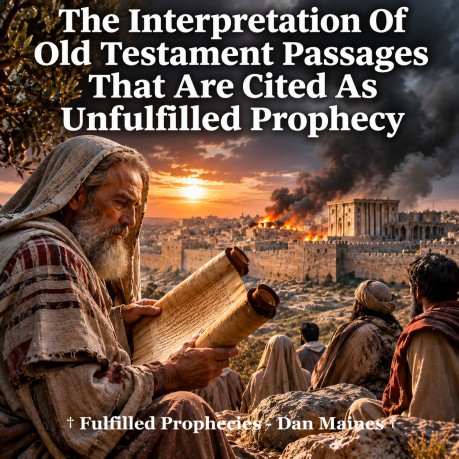
The Interpretation Of Old
Testament Passages That Are Cited As Unfulfilled Prophecy Introduction The Promise Of A New Heavens And A New Earth The Wolf Dwelling With The Lamb The Restoration Of David's Fallen Kingdom The Promise Of A New Covenant With Israel The Temple And God's Dwelling Among His People The Outpouring Of The Holy Spirit The Resurrection And The Time Of The End The Lord Standing On The Mount Of Olives The Mountain Of The Lord In The Last Days The Shaking Of Heaven And Earth The Promise Of An Everlasting New Creation Historical References How It Applies To Us Today Q & A Appendix † This is the fulfilled perspective we proclaim at
Fulfilled Prophecies † Source Index
By Dan Maines
† Many
Christians believe the Old Testament contains prophecies that remain
unfulfilled. They point to promises concerning Israel, the
restoration of Jerusalem, the rebuilding of the temple, the
resurrection of the dead, the reign of the Messiah, and the creation
of new heavens and a new earth.
† But here's
the problem. Many of these interpretations overlook how Jesus and His
apostles explained the Old Testament. They take prophecies that the
New Testament identifies with Christ and His first-century kingdom
and move them thousands of years into our future (Luke 24:44; Acts
3:24).
† We must remember that the Old
Testament prophets frequently used symbolic language to describe
covenant changes, national judgments, and spiritual restoration.
Mountains represented kingdoms, heavenly disturbances represented the
downfall of nations, and Jerusalem represented God's covenant people
(Isaiah 13:10; Daniel 2:44; Galatians 4:26).
†
The fulfilled perspective doesn't deny the promises of the Old
Testament. It recognizes their fulfillment through Jesus Christ, the
establishment of the New Covenant, and the completion of the Old
Covenant age in AD 70 (Matthew 5:17; Hebrews 8:13).
†
Let's examine several passages commonly cited as unfulfilled prophecy
and allow Scripture to explain their meaning.
Isaiah
65:17-18
For behold, I create new heavens and a new
earth; And the former things will not be remembered or come to
mind.
But be glad and rejoice forever in what I create; For
behold, I create Jerusalem for rejoicing And her people for
gladness.
† Futurists commonly interpret this
passage as predicting the destruction of the physical universe and
the creation of another planet. But Isaiah connects the new heavens
and new earth with the creation of Jerusalem as a place of rejoicing
(Revelation 21:1-2).
† In prophetic language,
heavens and earth can represent an established covenant order. Isaiah
was describing the passing of the former covenant arrangement and the
establishment of the New Covenant through Christ (Isaiah 51:16;
Hebrews 8:13).
† The New Jerusalem isn't a
future physical city descending onto a reconstructed planet. John
identifies the bride as the holy city, and Hebrews identifies the
heavenly Jerusalem with the assembly of believers (Revelation
21:9-10; Hebrews 12:22-23).
† Isaiah's
promise reached its covenantal fulfillment when the Old Covenant
order passed away in AD 70. God's people now belong to the New
Covenant creation in Christ (2 Corinthians 5:17; Galatians 6:15).
Isaiah 11:6, 9
And
the wolf will dwell with the lamb, And the leopard will lie down with
the young goat, And the calf and the young lion and the fatling
together; And a little boy will lead them.
They will not hurt or
destroy in all My holy mountain, For the earth will be full of the
knowledge of the LORD As the waters cover the sea.
†
Some interpret this prophecy as predicting a future world where wild
animals become physically harmless. But Isaiah's subject is the
righteous reign of the Messiah and the peace established under His
authority (Isaiah 11:1-5).
† The wolf and
lamb illustrate the reconciliation of those formerly separated by
hostility. Christ brought Jews and Gentiles together into one body
and established peace through His cross (Ephesians 2:14-16).
†
God's holy mountain represents His established kingdom, not
necessarily a geographical mountain where animals must change their
behavior (Daniel 2:35, 44; Hebrews 12:22).
†
The knowledge of the Lord spread through the preaching of the gospel.
Paul declared that the gospel had been proclaimed in all creation
under heaven before AD 70 (Colossians 1:23).
†
Isaiah's prophetic picture describes the peace and unity found in
Christ's kingdom, not an unfulfilled zoological prediction (Romans
15:12; Ephesians 2:17).
Amos
9:11-12
In that day I will raise up the fallen booth of
David, And wall up its breaches; I will also raise up its ruins And
rebuild it as in the days of old;
That they may possess the
remnant of Edom And all the nations who are called by My name,
Declares the LORD who does this.
† This
passage is frequently used to support a future restoration of
Israel's political kingdom. But the apostles already explained its
fulfillment during the first century (Acts 15:13-18).
†
At the Jerusalem Council, James cited Amos to explain why Gentiles
were entering God's people through faith in Jesus Christ. He didn't
postpone the prophecy until a future millennium (Acts 15:14-19).
†
David's fallen booth was restored through the resurrection and
exaltation of Jesus, the promised descendant of David who received
His kingdom (Acts 2:29-36).
† The inclusion
of the nations was evidence that the restoration promised by Amos was
taking place. The Messiah's kingdom wasn't restricted to a
geographical nation (Romans 15:8-12; Ephesians 2:19).
Jeremiah
31:31, 33
Behold, days are coming, declares the LORD,
when I will make a new covenant with the house of Israel and with the
house of Judah,
But this is the covenant which I will make with
the house of Israel after those days, declares the LORD, I will put
My law within them and on their heart I will write it; and I will be
their God, and they shall be My people.
†
Some teach that Jeremiah's promise remains unfulfilled because modern
national Israel hasn't entered the New Covenant. But Hebrews
explicitly applies Jeremiah's prophecy to the covenant established
through Jesus Christ (Hebrews 8:6-13).
†
Jesus identified His blood as the blood of the New Covenant. He
didn't announce a covenant that would remain unavailable for
thousands of years (Luke 22:20).
† The
apostles preached the New Covenant during the first century, and
believers were already receiving its blessings through faith (2
Corinthians 3:6; Hebrews 10:15-18).
† The Old
Covenant was becoming obsolete when Hebrews was written. Its
remaining institutional system disappeared with Jerusalem and the
temple in AD 70 (Hebrews 8:13; Matthew 24:1-2).
†
God's covenant people are now identified through their relationship
with Christ rather than their physical ancestry (Galatians 3:26-29;
Romans 9:6-8).
Ezekiel
37:26-27
I will make a covenant of peace with them; it
will be an everlasting covenant with them. And I will place them and
multiply them, and will set My sanctuary in their midst forever.
My
dwelling place also will be with them; and I will be their God, and
they will be My people.
† Futurists often
connect Ezekiel's temple prophecies with a future physical temple in
Jerusalem. But Ezekiel connects God's sanctuary with an everlasting
covenant of peace (Ezekiel 37:24-28).
† Jesus
established that peace through His sacrifice. The New Testament
identifies believers as God's temple, built together into a dwelling
place of God in the Spirit (Ephesians 2:19-22).
†
Paul declared that God's people were His temple and that His Spirit
dwelled among them. He didn't tell Christians to wait for another
building in Jerusalem (1 Corinthians 3:16; 2 Corinthians 6:16).
†
The physical temple belonged to the Old Covenant system. Christ's
completed sacrifice removed the need for its priesthood, altar, and
repeated sacrifices (Hebrews 9:11-12; 10:11-18).
†
God's promised dwelling among His people is fulfilled in His New
Covenant community, not through the restoration of animal sacrifices
(Revelation 21:3, 22).
Joel 2:28-29
It
will come about after this That I will pour out My Spirit on all
mankind; And your sons and daughters will prophesy, Your old men will
dream dreams, Your young men will see visions.
Even on the male
and female servants I will pour out My Spirit in those days.
†
Some Christians place Joel's prophecy into a future worldwide
revival. But Peter explicitly identified the events of Pentecost as
the fulfillment of what Joel had spoken (Acts 2:16-21).
†
The outpouring of the Spirit accompanied the establishment of the New
Covenant and confirmed the authority of the apostles who proclaimed
Christ (Acts 2:32-33; Hebrews 2:3-4).
†
Joel's prophecy also included signs associated with the coming Day of
the Lord. Jesus connected that judgment with Jerusalem's destruction
within His own generation (Joel 2:30-31; Matthew 24:29-34).
†
The miraculous gifts served their purpose during the foundational
period of the church. The Spirit continues to dwell in believers, but
the first-century prophetic signs don't need another fulfillment (1
Corinthians 13:8-10; Ephesians 2:20).
Daniel
12:1-2, 7
Now at that time Michael, the great prince
who stands guard over the sons of your people, will arise. And there
will be a time of distress such as never occurred since there was a
nation until that time; and at that time your people, everyone who is
found written in the book, will be rescued.
Many of those who
sleep in the dust of the ground will awake, these to everlasting
life, but the others to disgrace and everlasting contempt.
I
heard the man dressed in linen, who was above the waters of the
river, as he raised his right hand and his left toward heaven, and
swore by Him who lives forever that it would be for a time, times,
and half a time; and as soon as they finish shattering the power of
the holy people, all these events will be completed.
†
Daniel connects the resurrection with a time of unprecedented
distress and the shattering of the power of the holy people. These
events belong together in the prophecy (Daniel 12:1-7).
†
Jesus used Daniel's language when describing the great tribulation
that would come upon Jerusalem during the generation standing before
Him (Matthew 24:21, 34).
† The power of the
holy people was their covenant standing under the Law, represented by
Jerusalem, the temple, and its priesthood. That entire Old Covenant
arrangement reached its historical end in AD 70 (Hebrews 8:13;
10:9).
† Daniel didn't place the resurrection
thousands of years after that covenantal destruction. He connected
the completion of these events with the shattering of the holy
people's power (Daniel 12:7).
† From the
fulfilled perspective, the resurrection was the promised deliverance
from covenant death, accomplished through Christ at the completion of
the Old Covenant age (1 Corinthians 15:54-57; Revelation 20:12-15).
†
Believers who die today don't wait in Hades for another resurrection
event. They depart to be with Christ because the promised redemption
has been accomplished (Philippians 1:23; 2 Corinthians 5:8).
Zechariah
14:4, 9
In that day His feet will stand on the Mount of
Olives, which is in front of Jerusalem on the east; and the Mount of
Olives will be split in its middle from east to west by a very large
valley, so that half of the mountain will move toward the north and
the other half toward the south.
And the LORD will be king over
all the earth; in that day the LORD will be the only one, and His
name the only one.
† Many interpret this
passage as requiring Jesus to return physically to the Mount of
Olives and split the mountain apart. But Zechariah begins the chapter
by describing nations gathering against Jerusalem and the city's
suffering (Zechariah 14:1-2).
† The splitting
mountain belongs to prophetic judgment imagery. Similar language
describes God's intervention in history without requiring every
geographical feature to undergo a literal transformation (Micah
1:3-4; Nahum 1:5).
† Jesus foretold
Jerusalem's destruction and identified those events as the days of
vengeance in which the things written would be fulfilled (Luke
21:20-22).
† The Mount of Olives was also the
setting where Jesus announced the destruction of the temple and the
judgment coming upon His generation (Matthew 24:1-3, 34).
†
Zechariah's declaration that the Lord would reign over all the earth
agrees with Christ's exaltation and His present authority over every
nation (Matthew 28:18; Ephesians 1:20-22).
†
The fulfilled interpretation recognizes the Lord's covenantal
judgment against Jerusalem and the establishment of His universal
reign, rather than requiring a future physical appearance on the
mountain.
Isaiah
2:2-3
Now it will come about that In the last days The
mountain of the house of the LORD Will be established as the chief of
the mountains, And will be raised above the hills; And all the
nations will stream to it.
And many peoples will come and say,
Come, let us go up to the mountain of the LORD, To the house of the
God of Jacob; That He may teach us concerning His ways And that we
may walk in His paths. For the law will go forth from Zion And the
word of the LORD from Jerusalem.
† Some
expect this prophecy to be fulfilled through a future political
kingdom headquartered in physical Jerusalem. But the apostles
identified their own generation as living in the last days (Acts
2:16-17; Hebrews 1:1-2).
† The word of the
Lord went forth from Jerusalem when the apostles began preaching the
gospel after Christ's resurrection (Luke 24:47; Acts 1:8).
†
The mountain of the Lord represents God's exalted kingdom. Daniel
likewise described a kingdom established by God that would overcome
the kingdoms of men (Daniel 2:35, 44).
†
Christians have already come to Mount Zion and the heavenly
Jerusalem. Hebrews doesn't describe that access as something
postponed until a future earthly kingdom (Hebrews 12:22-24).
†
Isaiah's promise finds its fulfillment in the kingdom of Christ and
the gathering of the nations through the gospel (Romans 15:9-12).
Haggai 2:6-7
For
thus says the LORD of hosts, 'Once more in a little while, I am going
to shake the heavens and the earth, the sea also and the dry land.
'I
will shake all the nations; and they will come with the wealth of all
nations, and I will fill this house with glory,' says the LORD of
hosts.
† This prophecy is sometimes
interpreted as a future destruction of the physical universe. But
Hebrews applies Haggai's shaking to the removal of what could be
shaken and the establishment of what couldn't be shaken (Hebrews
12:26-28).
† The Old Covenant system was
temporary. Its earthly sanctuary, priesthood, and sacrifices were
shadows pointing toward the greater reality accomplished through
Christ (Hebrews 8:5; 10:1).
† The kingdom
believers were receiving couldn't be shaken because it was
established through the eternal work of Jesus Christ (Hebrews
12:28).
† The destruction of Jerusalem in AD
70 visibly removed the remaining institutions of the Old Covenant
order. Christ's kingdom remained, just as the writer of Hebrews
declared (Hebrews 8:13; 12:27-28).
Isaiah
66:22
For just as the new heavens and the new earth
Which I make will endure before Me, declares the LORD, So your
offspring and your name will endure.
† Isaiah
connects the permanence of the new heavens and new earth with the
endurance of God's people. His emphasis is covenantal permanence, not
the replacement of the physical planet (Isaiah 66:21-23).
†
The New Covenant established through Christ is everlasting. Its
priesthood, sacrifice, and promises don't need to be replaced by
another covenant (Hebrews 13:20; 7:24-25).
†
The church is the New Covenant people of God, and Christ's kingdom
has no end. The promise of an enduring new creation is therefore
understood through the completed work of Christ (Luke 1:32-33;
Ephesians 3:21).
† We aren't waiting for God
to establish another redemptive order. We live under the covenant
that Christ has already established (Hebrews 9:15).
†
Flavius Josephus, writing in The Jewish War, Books V-VI, described
Jerusalem's siege, the destruction of the temple, famine, and the
suffering of the Jewish people during the Roman war. His account
provides historical background for the judgment Jesus foretold.
†
Tacitus, in Histories, Book V, described the Roman conflict involving
Jerusalem and the Jewish nation. His account independently confirms
the historical setting of the first-century catastrophe.
†
Eusebius, in Ecclesiastical History, Book III, Chapter 5, reported
the departure of Christians from Jerusalem to Pella before the city's
destruction. His account supports the historical tradition that
believers responded to warnings concerning Jerusalem.
†
These historical writers help establish the events surrounding AD 70.
They don't independently prove every covenantal interpretation, but
their accounts confirm the historical destruction that fulfilled
interpreters connect with Jesus' warnings (Luke 21:20-22).
†
We don't need to live in fear of another great tribulation, another
destruction of Jerusalem required by prophecy, or another Day of the
Lord waiting to complete what Christ promised His first-century
disciples (Matthew 24:34; Luke 21:22).
† We
should interpret Old Testament prophecy through Jesus and His
apostles rather than through modern political events, newspaper
headlines, or speculation about national Israel (Luke 24:44-47).
†
We belong to the kingdom that cannot be shaken. Our hope rests in
Christ's completed redemption, not in the rebuilding of a physical
temple (Hebrews 12:28; Ephesians 2:19-22).
†
We should rejoice that the New Covenant is established, the heavenly
Jerusalem is our home, and believers have direct access to the Father
through Jesus Christ (Hebrews 12:22-24; Ephesians 2:18).
†
The fulfillment of prophecy doesn't mean God's work among His people
has stopped. We continue to teach the gospel, love one another, serve
those in need, and proclaim the completed work of Jesus Christ
(Matthew 28:19-20; Galatians 5:13-14).
† The
question isn't what Old Testament prophecy still needs to happen. The
question is whether we're willing to accept the New Testament's
explanation of what God has already accomplished (Acts 3:18-24).
Q: Doesn't Isaiah 65
predict a future physical new earth?
A: From
the fulfilled perspective, Isaiah's new heavens and new earth
describe the New Covenant creation. The New Jerusalem is identified
with God's people, who have already come to the heavenly Jerusalem
(Isaiah 65:17-18; Hebrews 12:22-23; Revelation 21:9-10).
Q:
Doesn't Isaiah 11 require literal animals to live peacefully
together?
A: The passage uses prophetic imagery
to describe the peace and reconciliation established through the
Messiah. Christ brought those formerly separated into one body
(Isaiah 11:6-9; Ephesians 2:14-16).
Q: Isn't
David's kingdom supposed to be restored in the future?
A:
James applied Amos' prophecy to the inclusion of Gentiles in the
first-century church. Peter proclaimed that Jesus had already been
exalted to God's right hand (Acts 15:13-18; Acts 2:30-36).
Q:
Doesn't Jeremiah promise a future covenant specifically with
Israel?
A: Hebrews identifies Jeremiah's
promised New Covenant with the covenant established through Christ.
Believers were already participating in its blessings during the
first century (Jeremiah 31:31-34; Hebrews 8:6-13).
Q:
Doesn't Ezekiel describe a future physical temple?
A:
The New Testament identifies believers as God's temple and His
dwelling place in the Spirit. Christ's sacrifice fulfilled what the
former temple system anticipated (Ephesians 2:19-22; Hebrews
10:11-18).
Q: Didn't Joel predict a future
outpouring of the Holy Spirit?
A: Peter
explicitly identified Pentecost with Joel's prophecy. The promised
outpouring began during the first century (Acts 2:16-21).
Q:
How can Daniel's resurrection be fulfilled if people still physically
die?
A: The fulfilled perspective understands
the promised resurrection in relation to deliverance from covenant
death. Physical death continues, but believers now depart to be with
Christ (Daniel 12:1-7; 1 Corinthians 15:54-57; Philippians 1:23).
Q:
Doesn't Zechariah 14 require Jesus to stand physically on the Mount
of Olives?
A: The fulfilled interpretation
understands the mountain imagery within Zechariah's description of
judgment against Jerusalem and the Lord's reign. Jesus connected
Jerusalem's destruction with the fulfillment of what had been written
(Zechariah 14:1-9; Luke 21:20-22).
Q: Doesn't
Haggai predict the future destruction of the universe?
A:
Hebrews applies Haggai's shaking to the removal of what could be
shaken and the receiving of an unshakable kingdom (Haggai 2:6-7;
Hebrews 12:26-28).
Q: Are there any Old
Testament prophecies that still require future fulfillment?
A:
From the full preterist perspective, the redemptive prophecies
concerning Christ's coming, the kingdom, judgment, resurrection, and
New Covenant creation reached their fulfillment by AD 70. The kingdom
and its blessings continue, but their prophetic establishment isn't
still future (Luke 21:22; Matthew 24:34; Revelation 22:6-10).
© Fulfilled Prophecies - Dan
Maines.
† Isaiah
65:17-18; Isaiah 11:6, 9; Amos 9:11-12; Jeremiah 31:31, 33; Ezekiel
37:26-27; Joel 2:28-29; Daniel 12:1-2, 7; Zechariah 14:4, 9; Isaiah
2:2-3; Haggai 2:6-7; Isaiah 66:22.
† Flavius
Josephus, The Jewish War, Books V-VI; Tacitus, Histories, Book V;
Eusebius, Ecclesiastical History, Book III, Chapter 5.
Links