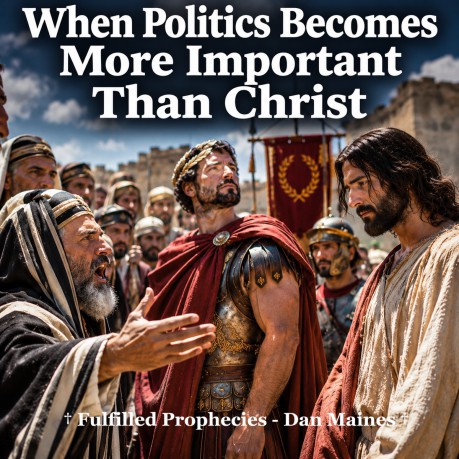
When Politics Becomes More
Important Than Christ Seeking God's Kingdom Must Come First Jesus Said His Kingdom Was Not Of This World Our Citizenship Is In Heaven Christians Must Not Place Their Trust In Political
Leaders Give Government What Belongs To Government And God What
Belongs To God We Should Pray For Leaders Instead Of Worshiping Them Christians Must Set Their Minds On Things Above Jesus Christ Has Already Received His Everlasting
Kingdom We Belong To A Kingdom That Cannot Be Shaken Historical References How It Applies To Us Today Q & A Appendix Q: Is it wrong for Christians to vote or
participate in politics? Q: Can a Christian support a political leader
without making that person an idol? Q: Should Christians defend politicians when they
do something wrong? Q: What if another Christian belongs to a
different political party? Q: Does the Kingdom of God depend on Christians
taking control of earthly governments? Q: Should we pray for political leaders we
disagree with? Q: What should Christians do when politics causes
anger and division? Q: Has Jesus already received His Kingdom, or are
we waiting for a political government to establish it? Q: What is the most important lesson Christians
should remember about politics? † This is the fulfilled perspective we proclaim at
Fulfilled Prophecies † Source Index
By Dan Maines
Introduction
†
There's nothing wrong with Christians being interested in politics,
voting in elections, or caring about the direction of their country.
The problem begins when political loyalty becomes more important than
loyalty to Jesus Christ. When believers spend more time defending
politicians than defending the gospel, something has gone wrong
(Matthew 6:33; Colossians 3:1-2).
† Today,
political disagreements can divide families, friendships, and even
churches. Some Christians become so devoted to a political party or
leader that anyone who disagrees with them becomes an enemy. But
Jesus never commanded His followers to build their lives around
political movements. He commanded them to seek His Kingdom first
(Matthew 6:33; John 18:36).
† No election can
accomplish what Jesus Christ has already accomplished. No president,
king, or government can provide salvation. No political party can
establish the everlasting Kingdom of God. Jesus Christ has already
received all authority, and His Kingdom cannot be shaken (Daniel
7:13-14; Matthew 28:18; Hebrews 12:28).
†
This study isn't about Republicans, Democrats, conservatives, or
liberals. It's about something far more important. Who has first
place in our hearts, Jesus Christ or the political leaders of this
world (Colossians 3:1-2)?
Matthew
6:33
But seek first His kingdom and His righteousness,
and all these things will be added to you.
†
Jesus didn't tell His disciples to seek political power first. He
told them to seek God's Kingdom and His righteousness. That
establishes the proper order of our priorities (Matthew 6:33).
†
When a Christian becomes more concerned about winning political
arguments than demonstrating Christ's righteousness, that priority
has been reversed. Our conduct should reflect the Kingdom we belong
to (Romans 14:17; Ephesians 4:1-3).
†
Political involvement isn't necessarily wrong. But when politics
begins controlling our attitudes, relationships, and behavior, we
need to examine whether we're still putting Christ first (Colossians
3:12-15).
† A political victory doesn't make
someone righteous, and a political defeat doesn't remove anyone from
Christ's Kingdom. Our standing before God depends on Christ, not
election results (Romans 5:1; Colossians 1:13).
John
18:36
Jesus answered, My kingdom is not of this world.
If My kingdom were of this world, then My servants would be fighting
so that I would not be handed over to the Jews; but as it is, My
kingdom is not of this realm.
† Jesus spoke
these words to Pontius Pilate, the Roman governor who represented the
political authority of that day. Jesus clearly distinguished His
Kingdom from earthly governments (John 18:33-37).
†
His Kingdom wasn't established through military conquest, political
campaigns, or human elections. Its authority came from heaven, not
from the political systems of the world (Daniel 7:13-14).
†
Notice that Jesus didn't say His Kingdom would eventually become an
earthly political government. He said His Kingdom wasn't of this
realm. Its origin and authority were heavenly (John 18:36; Luke
17:20-21).
† Christians shouldn't confuse
advancing the gospel with advancing a political party. The Kingdom of
Christ doesn't depend on controlling a government, passing
legislation, or winning elections (Romans 14:17; 2 Corinthians
10:3-5).
Philippians 3:20
For
our citizenship is in heaven, from which also we eagerly wait for a
Savior, the Lord Jesus Christ;
† Philippi was
a Roman colony, and Roman citizenship carried considerable
importance. Yet Paul reminded those believers that their greater
citizenship was in heaven (Acts 16:12; Philippians 3:20).
†
Paul wrote during the first century when believers were awaiting the
completion of the promised redemption. From the fulfilled
perspective, that covenantal expectation reached its fulfillment with
the passing of the Old Covenant age in AD 70 (Luke 21:22; Hebrews
9:28).
† Today, believers belong to Christ's
established Kingdom. Our earthly citizenship may identify the nation
where we live, but our spiritual citizenship identifies the King we
serve (Colossians 1:13; Hebrews 12:22-28).
†
We can love our country without making it our spiritual identity.
Nations have governments that change, but Christians belong to a
Kingdom whose King never loses His authority (Daniel 7:14; Hebrews
12:28).
Psalm 146:3
Do not trust in princes, In
mortal man, in whom there is no salvation.
†
This warning was written long before modern political parties
existed. Yet its message applies to every generation. Human leaders
are mortal, limited, and incapable of providing salvation (Psalm
146:3-5).
† Political leaders may accomplish
beneficial things, but none of them can forgive sins, reconcile
humanity to God, or provide eternal life. Only Jesus Christ can
accomplish those things (Acts 4:12; Romans 5:10-11).
†
When believers speak about a politician as though that individual
alone can save their country, they risk placing expectations on a
human being that belong to God alone (Psalm 118:8-9; Jeremiah
17:5-7).
† We shouldn't give any political
leader the devotion, trust, or unquestioning loyalty that belongs to
Christ. Every human leader must be measured against righteousness,
truth, and justice (Proverbs 21:3; Acts 5:29).
Matthew 22:21
They said to Him,
Caesar's. Then He said to them, Then render to Caesar the things that
are Caesar's; and to God the things that are God's.
†
Jesus was answering a question designed to trap Him politically. His
opponents wanted to force Him into a conflict over Roman taxation and
authority (Matthew 22:15-20).
† Jesus
acknowledged legitimate governmental responsibilities without
surrendering what belongs to God. Paying taxes and recognizing civil
authority didn't require anyone to make Caesar their spiritual master
(Matthew 22:21; Romans 13:6-7).
† Christians
can participate responsibly in government while remembering that
obedience to God comes first. When human commands conflict with God's
commands, the apostles established the proper priority (Acts 5:29).
†
Our responsibility isn't to worship government or reject every form
of government. It's to live responsibly while recognizing that Christ
holds the highest authority over our lives (Romans 13:1-7; Matthew
28:18).
1
Timothy 2:1-2
First of all, then, I urge that
entreaties and prayers, petitions and thanksgivings, be made on
behalf of all men,
for kings and all who are in authority, so
that we may lead a tranquil and quiet life in all godliness and
dignity.
† Paul instructed believers to pray
for those in authority. He didn't tell them to worship their rulers,
excuse their wrongdoing, or treat political leaders as spiritual
saviors (1 Timothy 2:1-2).
† When Paul wrote
these instructions, the Roman Empire governed much of the
Mediterranean world. Christians didn't have to approve of everything
Roman rulers did to pray for peaceful conditions (Romans 12:18; 1
Peter 2:17).
† We should be willing to pray
for leaders whether we voted for them or not. Prayer isn't an
endorsement of every political decision. It's an expression of our
desire for peace, righteousness, and godliness (1 Timothy 2:1-2).
†
If we can only pray for politicians we agree with, our political
loyalty may be influencing our spiritual responsibilities more than
we realize (Matthew 5:44; Romans 12:14).
Colossians
3:1-2
Therefore if you have been raised up with Christ,
keep seeking the things above, where Christ is, seated at the right
hand of God.
Set your mind on the things above, not on the
things that are on earth.
† Paul directed
believers toward Christ, who was already seated at God's right hand.
Their spiritual identity wasn't determined by the political
circumstances surrounding them (Colossians 3:1-3).
†
Setting our minds on things above doesn't mean ignoring earthly
responsibilities. It means allowing Christ's authority and
righteousness to govern how we fulfill those responsibilities
(Colossians 3:12-17).
† When politics fills
our thoughts with constant anger, bitterness, fear, and hostility, we
should examine whether we're allowing earthly controversies to
control our spiritual lives (Ephesians 4:31-32; Philippians 4:8).
†
Christians should be recognized for their love, kindness, patience,
forgiveness, and faithfulness to Christ, not merely for the political
positions they defend (John 13:34-35; Colossians 3:12-14).
Daniel 7:13-14
I kept looking in the night
visions, And behold, with the clouds of heaven One like a Son of Man
was coming, And He came up to the Ancient of Days And was presented
before Him.
And to Him was given dominion, Glory and a kingdom,
That all the peoples, nations and men of every language Might serve
Him. His dominion is an everlasting dominion Which will not pass
away; And His kingdom is one Which will not be destroyed.
†
Daniel saw the Son of Man coming to the Ancient of Days to receive
dominion, glory, and an everlasting Kingdom. This wasn't a
description of Jesus campaigning for earthly political office. It was
a heavenly presentation of divine authority (Daniel 7:13-14).
†
Jesus identified Himself with Daniel's Son of Man and declared that
all authority in heaven and on earth had been given to Him (Matthew
26:64; Matthew 28:18).
† From the fulfilled
perspective, the first-century transition from the Old Covenant order
to the fully established New Covenant Kingdom reached its completion
in AD 70. Christ's Kingdom wasn't waiting for a modern political
movement to establish it (Luke 21:31-32; Hebrews 12:28).
†
No election can remove Jesus from His throne. No political party can
overturn His authority. His Kingdom doesn't rise and fall with the
fortunes of earthly governments (Daniel 7:14; Revelation 11:15).
Hebrews
12:28
Therefore, since we receive a kingdom which
cannot be shaken, let us show gratitude, by which we may offer to God
an acceptable service with reverence and awe;
†
Hebrews was written during the first-century transition when the Old
Covenant order was becoming obsolete and ready to disappear. The
writer contrasted what could be shaken with the Kingdom that couldn't
be shaken (Hebrews 8:13; Hebrews 12:26-28).
†
From the fulfilled perspective, the removal of the Old Covenant
temple system in AD 70 completed that covenantal transition. The New
Covenant Kingdom remains established through Jesus Christ (Hebrews
9:8-10; Hebrews 12:28).
† Earthly governments
change. Political parties gain and lose influence. Presidents enter
and leave office. But none of those changes can shake the everlasting
Kingdom of Christ (Daniel 7:14; Hebrews 12:28).
†
That's why Christians don't need to live in constant fear over every
political development. We can take our earthly responsibilities
seriously while resting in the certainty that Christ remains King
(Colossians 3:15; Philippians 4:6-7).
†
Josephus, writing in the first century in Antiquities of the Jews and
The Jewish War, described the political tensions, Roman authority,
and conflicts that affected Jewish society before Jerusalem's
destruction in AD 70. His writings provide historical background for
understanding the political world in which Jesus and the apostles
lived.
† Tacitus, in his Annals, described
the Roman imperial government and the persecution of Christians under
Nero. His account reminds us that the early church existed under
rulers who didn't necessarily share Christian beliefs.
†
Pliny the Younger, writing to Emperor Trajan in the early second
century, described Christians gathering to honor Christ. His
correspondence provides evidence that Christian devotion continued
under Roman political authority.
† These
historical writers help establish the setting, but Scripture
establishes our spiritual responsibilities. The early Christians
belonged to Christ regardless of who governed the Roman Empire (John
18:36; Philippians 3:20).
†
Christians have the freedom to care about political issues, vote
according to their convictions, and participate in their communities.
But political participation should never become more important than
following Jesus Christ (Matthew 6:33; Colossians 3:1-2).
†
We shouldn't excuse dishonesty, cruelty, corruption, or injustice
simply because someone belongs to our preferred political party.
God's standards of righteousness don't change according to political
affiliation (Proverbs 21:3; Ephesians 4:25).
†
We shouldn't treat fellow Christians as enemies because they vote
differently. Our unity in Christ is greater than our disagreements
over earthly governments (Ephesians 4:1-6; Romans 14:19).
†
We should examine how much time we spend arguing about politics
compared with studying Scripture, helping others, encouraging
believers, and demonstrating Christ's love (2 Timothy 2:23-24;
Galatians 6:10).
† We can respect
governmental authority without surrendering our conscience. We can
disagree with political leaders without hatred. We can participate in
elections without treating the results as the foundation of our
spiritual hope (Romans 12:17-18; 1 Peter 2:17).
†
Ask yourself a simple question. If your preferred political party
lost every election, would Jesus Christ still be your King? Of course
He would. His authority doesn't depend on the approval of any earthly
government (Daniel 7:14; Matthew 28:18).
†
Another question is equally important. Are people seeing the
character of Jesus Christ in the way we discuss politics, or are they
seeing anger, insults, and division? Our words should reflect the
Lord we claim to follow (Colossians 4:6; Ephesians 4:29).
†
The church wasn't established to become the religious arm of a
political party. We belong to Jesus Christ, and our responsibility is
to proclaim His gospel, demonstrate His love, and live according to
His righteousness (Matthew 28:18-20; John 13:34-35).
†
Politics may influence the circumstances of our earthly lives, but it
cannot replace the salvation, peace, and eternal life we have in
Jesus Christ. Our hope rests in what He has accomplished, not in what
politicians promise to accomplish (Romans 5:1; Colossians 1:13-14).
A: No. Christians can
fulfill their civic responsibilities while keeping their devotion to
Christ first. Jesus recognized legitimate governmental
responsibilities in Matthew 22:21, and Paul discussed civil authority
in Romans 13:1-7.
A: Yes.
Supporting a leader's policies doesn't require unquestioning loyalty.
Scripture warns against placing our ultimate trust in human rulers
(Psalm 146:3; Psalm 118:8-9).
A: No. God's standards of
truth and righteousness apply regardless of political affiliation.
Christians shouldn't excuse wrongdoing simply because they support a
particular leader (Proverbs 21:3; Ephesians 4:25).
A: Political
disagreement doesn't automatically destroy our unity in Christ. We're
instructed to pursue peace, humility, patience, and love toward one
another (Ephesians 4:1-6; Romans 14:19).
A: No.
Jesus said His Kingdom wasn't of this realm in John 18:36. Daniel
7:13-14 describes His everlasting authority, and Hebrews 12:28
identifies the Kingdom that cannot be shaken.
A: Yes. Paul instructed
believers to pray for kings and all who are in authority. Prayer for
leaders doesn't mean approving of everything they do (1 Timothy
2:1-2).
A: We should examine our
priorities, pursue peace, speak truth with love, and remember that
our identity is in Christ rather than a political party (Colossians
3:12-15; Ephesians 4:29-32).
A:
Jesus has already received His authority and Kingdom. From the
fulfilled perspective, the first-century covenantal transition
reached completion in AD 70. His everlasting Kingdom doesn't depend
on any modern government (Daniel 7:13-14; Colossians 1:13; Hebrews
12:28).
A: No
politician is our savior. Jesus Christ is. We can care about our
country and participate in government, but our highest loyalty must
always belong to Him (Matthew 6:33; Acts 4:12; Philippians 3:20).
© Fulfilled Prophecies - Dan
Maines.
† Matthew
6:33; John 18:36; Philippians 3:20; Psalm 146:3; Matthew 22:21; 1
Timothy 2:1-2; Colossians 3:1-2; Daniel 7:13-14; Hebrews 12:28.
†
Flavius Josephus, Antiquities of the Jews and The Jewish War;
Tacitus, Annals; Pliny the Younger, Letters to Emperor Trajan.
Links