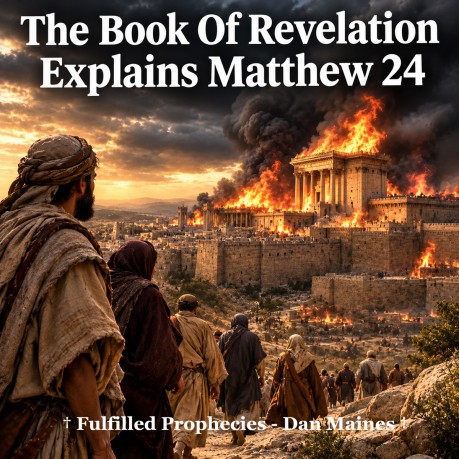
The Book Of Revelation
Explains Matthew 24 Introduction Matthew 24:1-3 Matthew 24:6-8 Revelation 6:3-6 Matthew 24:15-16 Luke 21:20-22 Matthew 24:21-22 Matthew 24:29-30 Revelation 6:12-14 Matthew 23:35-36 Revelation 11:8 Revelation 18:24 Matthew 24:34 Revelation 1:1-3 Revelation 22:6-7 Historical References How It Applies To Us Today Q & A Appendix Q: Why should Matthew 24 be used to interpret
Revelation? Q: Were the wars, famines, and earthquakes in
Matthew 24 the same kinds of judgments pictured in Revelation? Q: Was the great tribulation a worldwide event
still awaiting fulfillment? Q: Did the darkened sun and falling stars mean
the physical universe would be destroyed? Q: Why identify Babylon in Revelation with
Jerusalem? Q: What does this generation mean in Matthew
24:34? Q: Doesn't Revelation describe events that must
happen in our future? Q: What does Revelation mean for Christians today
if its prophecies were fulfilled? Conclusion † This is the fulfilled perspective we proclaim at
Fulfilled Prophecies † Source Index
By Dan Maines
† The Book
of Revelation isn't a separate prophecy about the end of the physical
world. It's the unveiling of the judgment Jesus had already described
to His disciples in Matthew 24. When we begin with the Olivet
Discourse, Revelation becomes much easier to understand.
†
Jesus spoke plainly about the destruction of Jerusalem, the coming
tribulation, the signs in heaven, His coming in judgment, and the end
of the age. John later received a vision describing these same events
through prophetic symbols. Both accounts concern the closing years of
the Old Covenant age and the judgment that culminated in AD 70.
†
The mistake many make is beginning with Revelation, interpreting its
symbols as future worldwide disasters, and then forcing Matthew 24 to
agree with those interpretations. We should do the opposite. Jesus'
explanation to His disciples establishes the historical setting, the
audience, and the timing. Revelation expands upon what Jesus had
already revealed.
† The most important
question isn't what these prophecies might mean to our generation.
It's what Jesus told His own generation would happen, and whether
Scripture places their fulfillment within the time He specified
(Matthew 23:36; Luke 21:32).
Jesus came out from the
temple and was going away when His disciples came up to point out the
temple buildings to Him. And He said to them, Do you not see all
these things? Truly I say to you, not one stone here will be left
upon another, which will not be torn down. As He was sitting on the
Mount of Olives, the disciples came to Him privately, saying, Tell
us, when will these things happen, and what will be the sign of Your
coming, and of the end of the age?
† The
entire discussion began with Jesus' announcement that the temple
would be destroyed. His disciples weren't asking about the
destruction of the planet. They wanted to know when the temple would
fall and how that event related to His coming and the end of the age
(Mark 13:1-4).
† The age in question was the
Old Covenant age, represented by the temple, priesthood, sacrifices,
and Mosaic system. Hebrews describes that covenant as becoming
obsolete and ready to disappear (Hebrews 8:13).
†
Revelation must be interpreted within this same covenantal setting.
Jesus had identified the coming destruction, and John would later
describe its judgment through visions of seals, trumpets, bowls, and
the fall of the great city (Revelation 6:1-17; 16:1-21; 18:1-24).
You will be hearing of wars
and rumors of wars. See that you are not frightened, for those things
must take place, but that is not yet the end. For nation will rise
against nation, and kingdom against kingdom, and in various places
there will be famines and earthquakes. But all these things are
merely the beginning of birth pains.
† Jesus
warned His disciples about disturbances that would precede
Jerusalem's destruction. These signs weren't instructions for
Christians thousands of years later to identify a future end of the
world (Luke 21:9-11).
† Revelation's opening
seals describe conquest, warfare, famine, and death. The imagery
parallels the conditions Jesus described as the beginning of birth
pains (Revelation 6:1-8).
† The Jewish revolt
beginning in AD 66, along with the violence and instability
surrounding the Roman Empire, provides the historical setting for
these judgments. The signs belong to the same first-century crisis,
not an endlessly repeating prophetic calendar (Matthew 24:34).
When He broke the second
seal, I heard the second living creature saying, Come. And another, a
red horse, went out; and to him who sat on it, it was granted to take
peace from the earth, and that people would kill one another; and a
large sword was given to him. When He broke the third seal, I heard
the third living creature saying, Come. I looked, and behold, a black
horse, and the one who sat on it had a pair of scales in his hand.
And I heard something like a voice in the center of the four living
creatures saying, A quart of wheat for a denarius, and three quarts
of barley for a denarius; and do not damage the oil and the wine.
†
The red horse represents warfare and the removal of peace. The black
horse represents scarcity and economic distress. These correspond to
the wars and famines Jesus said His disciples would witness (Matthew
24:6-7).
† John wasn't introducing a
different age of prophecy. He was presenting in symbolic form the
conditions Jesus had already described before Jerusalem's fall (Luke
21:10-11).
† Josephus describes terrible
famine, internal fighting, and desperate conditions during
Jerusalem's siege. His historical account demonstrates how closely
the events of AD 70 resemble the judgments portrayed in these
passages.
Therefore when you see the
ABOMINATION OF DESOLATION which was spoken of through Daniel the
prophet, standing in the holy place (let the reader understand), then
those who are in Judea must flee to the mountains.
†
Jesus gave His disciples a recognizable warning and a practical
instruction. When the threatened desolation approached, believers in
Judea were to flee. This wasn't a worldwide command to future
Christians (Daniel 9:26-27).
† The
instruction required a first-century setting. People in Judea could
escape to the mountains, while Christians living thousands of years
later in other nations couldn't obey this warning in its original
historical circumstances (Mark 13:14-18).
†
Luke's parallel account explains the approaching desolation by
identifying Jerusalem surrounded by armies. This connection is
essential when interpreting the judgments and warnings in Revelation
(Luke 21:20-22).
But when you see Jerusalem
surrounded by armies, then recognize that her desolation is near.
Then those who are in Judea must flee to the mountains, and those who
are in the midst of the city must leave, and those who are in the
country must not enter the city; because these are days of vengeance,
so that all things which are written will be fulfilled.
†
Luke removes any uncertainty about the geographical focus. Jesus was
speaking about Jerusalem and the approaching judgment upon the city
that had rejected Him (Luke 19:41-44).
† The
days of vengeance were the fulfillment of covenant judgments
previously announced in the Law and the Prophets. Jerusalem's
destruction wasn't an isolated military tragedy. It marked the public
and historical removal of the Old Covenant order (Deuteronomy
28:49-57; Hebrews 8:13).
† Revelation
describes the same covenantal judgment through the language of
plagues, blood, fire, and desolation. These images draw upon earlier
judgments against covenant unfaithfulness (Revelation 16:1-21).
†
The opportunity to flee also confirms that Jesus wasn't describing
the destruction of the entire physical universe. There would be
survivors, places of refuge, and life continuing after Jerusalem's
fall (Matthew 24:16-20).
For then there will be a
great tribulation, such as has not occurred since the beginning of
the world until now, nor ever will. And if those days had not been
cut short, no life would have been saved; but for the sake of the
elect those days will be cut short.
† The
great tribulation was connected directly to the desolation of
Jerusalem. Jesus didn't separate these events by thousands of years.
He described one approaching judgment within the lifetime of His
hearers (Matthew 24:15-16, 34).
† Daniel had
already connected an unparalleled time of distress with the
deliverance of God's people and the end of the appointed period.
Jesus applied this prophetic framework to the approaching crisis
(Daniel 12:1, 7).
† Revelation describes
intense persecution, suffering, and judgment against the persecuting
power. These visions expand upon the tribulation Jesus had already
announced (Revelation 7:14; 13:5-10).
† The
preservation of the elect demonstrates that God's purpose wasn't the
extinction of humanity. It was judgment upon the covenant order that
had reached its appointed end (Matthew 24:22).
But immediately after the
tribulation of those days THE SUN WILL BE DARKENED, AND THE MOON WILL
NOT GIVE ITS LIGHT, AND THE STARS WILL FALL from the sky, and the
powers of the heavens will be shaken. And then the sign of the Son of
Man will appear in the sky, and then all the tribes of the earth will
mourn, and they will see the SON OF MAN COMING ON THE CLOUDS OF THE
SKY with power and great glory.
† Jesus used
the prophetic language of heavenly disturbances to describe the
collapse of an established covenantal order. The Old Testament used
similar language when announcing judgment upon nations and kingdoms
(Isaiah 13:9-10; Ezekiel 32:7-8).
† The
coming on the clouds draws upon Daniel's vision of the Son of Man
receiving dominion and a kingdom. It expresses divine authority and
royal vindication, not necessarily a physical descent to the earth
(Daniel 7:13-14).
† Jesus connected these
events with the tribulation He had just described. The word
immediately doesn't permit a separation of thousands of years between
Jerusalem's destruction and the prophetic coming He announced
(Matthew 24:21, 29).
† Revelation uses the
same cosmic imagery because it describes the same covenantal upheaval
and the vindication of Jesus Christ (Revelation 1:7; 6:12-17).
I looked when He broke
the sixth seal, and there was a great earthquake; and the sun became
black as sackcloth made of hair, and the whole moon became like
blood; and the stars of the sky fell to the earth, as a fig tree
casts its unripe figs when shaken by a great wind. The sky was split
apart like a scroll when it is rolled up, and every mountain and
island were moved out of their places.
† John
repeats the heavenly imagery Jesus used in Matthew 24. The darkened
sun, altered moon, falling stars, and shaking heavens aren't
unrelated prophecies. They belong to the same biblical language of
judgment (Matthew 24:29).
† Isaiah used
comparable imagery to announce Babylon's downfall. The prophetic
meaning was the collapse of a ruling order under divine judgment, not
the literal disappearance of the physical universe (Isaiah
13:9-13).
† Revelation's sixth seal therefore
fits the judgment Jesus placed immediately after the tribulation. The
symbols communicate the magnitude of the covenantal transformation
taking place (Hebrews 12:26-28).
† If Matthew
24 provides the framework, we don't need to transform Revelation into
a prediction of astronomical destruction in our future.
so that upon you will fall
the guilt of all the righteous blood shed on earth, from the blood of
righteous Abel to the blood of Zechariah, the son of Berechiah, whom
you murdered between the temple and the altar. Truly I say to you,
all these things will come upon this generation.
†
Jesus identified the generation responsible for the accumulated guilt
of persecuting God's messengers. He placed the approaching judgment
upon His own contemporaries (Luke 11:49-51).
†
This statement is crucial for understanding Revelation's great city.
The judgment wasn't directed against an unidentified modern nation.
It concerned the city and covenantal leadership Jesus had already
condemned (Matthew 23:37-38).
† Revelation
identifies the guilty city through its responsibility for the blood
of God's servants and through the location where the Lord was
crucified (Revelation 11:8; 18:24).
And their dead bodies will
lie in the street of the great city which mystically is called Sodom
and Egypt, where also their Lord was crucified.
†
John identifies the great city by the place where Jesus was
crucified. That location was Jerusalem. The symbolic names Sodom and
Egypt describe its spiritual corruption and bondage (Luke 13:33;
Galatians 4:25).
† This identification
provides an important connection between Revelation and Matthew 24.
Jesus announced Jerusalem's judgment, and Revelation describes the
great city under judgment (Matthew 23:37-38; 24:2).
†
The symbolic identification also explains why Revelation can use the
language of Babylon for a city other than ancient Babylon. The name
represents covenantal corruption and opposition to God's people
(Revelation 17:5-6).
And in her was found the
blood of prophets and of saints and of all who have been slain on the
earth.
† The accusation against Babylon
corresponds to Jesus' accusation against Jerusalem. Both passages
describe responsibility for the blood of the prophets and God's
faithful servants (Matthew 23:35-37).
† Jesus
didn't leave the timing uncertain. He declared that the accumulated
judgment would fall upon His generation. Revelation describes that
same bloodguilt reaching its appointed judgment (Luke 11:50-51).
†
Identifying Babylon as covenant-breaking Jerusalem brings the
historical setting, prophetic accusations, and judgment imagery
together without requiring a future worldwide religious or political
system (Revelation 17:6; 18:20).
Truly I say to you, this
generation will not pass away until all these things take place.
†
This is the controlling time statement for the entire Olivet
Discourse. Jesus placed the fulfillment of all these things within
the generation then living (Matthew 23:36).
†
The phrase all these things includes the events He had just
described, the tribulation, heavenly signs, and His coming in
judgment. We can't remove the most dramatic events from His stated
time frame without changing the meaning of His declaration (Matthew
24:29-33).
† Revelation must agree with
Jesus' time statement. Its visions don't establish a new timetable
that contradicts the Lord's own words (Revelation 1:1-3).
†
The events culminating in Jerusalem's destruction in AD 70 fall
within the generation Jesus addressed. This is the historical
foundation of the fulfilled perspective.
The Revelation of Jesus
Christ, which God gave Him to show to His bond-servants, the things
which must soon take place; and He sent and communicated it by His
angel to His bond-servant John, who testified to the word of God and
to the testimony of Jesus Christ, everything that he saw. Blessed is
he who reads and those who hear the words of the prophecy, and heed
the things which are written in it; for the time is near.
†
Revelation begins with the same urgency found in Matthew 24. John was
told that the revealed events must soon take place and that the time
was near (Matthew 24:34).
† These statements
were meaningful to the original seven churches. They weren't told
that the fulfillment would begin thousands of years after their
deaths (Revelation 1:4, 11).
† The opening of
Revelation confirms that its message belongs to the approaching
first-century judgment. Jesus' prophecy and John's vision share the
same historical horizon (Luke 21:32).
And he said to me, These
words are faithful and true; and the Lord, the God of the spirits of
the prophets, sent His angel to show to His bond-servants the things
which must soon take place. And behold, I am coming quickly. Blessed
is he who heeds the words of the prophecy of this book.
†
Revelation closes by repeating the urgency announced in its opening
chapter. The events must soon take place, and Jesus declares that He
is coming quickly (Revelation 1:1-3).
† This
corresponds directly with the time limitation Jesus gave His
disciples. His coming in judgment belonged to their generation, not
an indefinite future generation (Matthew 24:34).
†
The consistency between the opening and closing of Revelation
confirms that its original audience was expected to understand the
prophecy as approaching fulfillment (Revelation 22:10).
†
When Matthew 24 establishes the setting and Revelation supplies the
prophetic imagery, both testify to the completion of the Old Covenant
age and the vindication of Jesus Christ (Hebrews 9:26; 12:28).
†
Flavius Josephus, writing in The Jewish War, Books 2, 5, and 6,
describes the Jewish revolt, internal conflict, famine, Roman siege,
and destruction of Jerusalem and its temple. His account provides
historical evidence for the conditions Jesus warned about.
†
Josephus records that Jerusalem suffered terrible violence from
within while Roman armies surrounded the city. His descriptions of
starvation and destruction closely resemble the conditions associated
with the great tribulation.
† Eusebius, in
Ecclesiastical History, Book 3, Chapter 5, preserves an early
Christian tradition that believers in Jerusalem were instructed to
leave and settle in Pella before the city's destruction. This
tradition corresponds to Jesus' warning to flee Judea (Matthew
24:16).
† Tacitus, in Histories, Book 5,
describes the Roman campaign against Jerusalem and the circumstances
surrounding the Jewish revolt. His account independently confirms the
historical reality of the conflict.
† These
writers don't establish the meaning of prophecy. Scripture does that.
Their testimony helps document the historical circumstances
surrounding the first-century fulfillment.
†
We don't need to live in fear of Revelation's seals, trumpets, bowls,
or the destruction of Babylon as events still waiting to happen. From
the fulfilled perspective, these judgments belonged to the closing
years of the Old Covenant age (Matthew 24:34; Revelation 1:1-3).
†
We aren't waiting for another great tribulation, another destruction
of Jerusalem's temple, or another covenantal Day of the Lord. Jesus
accomplished what He promised within the generation He addressed
(Luke 21:22, 32).
† We now belong to the
kingdom that cannot be shaken. Our relationship with God isn't
dependent upon an earthly temple, priesthood, or sacrificial system
(Hebrews 12:22-28; Ephesians 2:18-22).
†
Revelation remains valuable because it reveals Christ's victory, His
faithfulness to His promises, and the establishment of the New
Covenant order. Its fulfillment doesn't diminish its importance. It
confirms the reliability of God's Word (Revelation 21:1-5).
†
The church is now God's dwelling place through the Spirit. We're
citizens of the heavenly Jerusalem, and we proclaim the finished work
of Jesus Christ rather than waiting for the Old Covenant age to end
again (Galatians 4:26; Hebrews 12:22-23).
†
Our responsibility is to understand Scripture within its original
audience and historical setting, then apply its enduring truths to
our lives today (2 Timothy 2:15).
A: Because Jesus first explained
the approaching judgment, its signs, its geographical setting, and
its timing. Revelation expands upon these events through prophetic
visions (Matthew 24:1-34; Revelation 1:1-3).
A:
Yes. The seals portray conditions corresponding to those Jesus
described as preceding Jerusalem's destruction (Matthew 24:6-8;
Revelation 6:1-8).
A: No. Jesus
connected it with Jerusalem's approaching desolation and instructed
those in Judea to flee. Its fulfillment belongs to the first-century
judgment (Matthew 24:15-22; Luke 21:20-22).
A:
No. The prophets used cosmic imagery to describe the overthrow of
kingdoms and established orders. Jesus and John used that same
prophetic language (Isaiah 13:9-13; Matthew 24:29; Revelation
6:12-14).
A: Revelation identifies the great
city as the place where Jesus was crucified and condemns Babylon for
the blood of the prophets. These descriptions correspond to Jesus'
accusations against Jerusalem (Matthew 23:35-37; Revelation 11:8;
18:24).
A: It refers to the generation Jesus was
addressing. He declared that all the events He had described would
take place before that generation passed away (Matthew 23:36; 24:34).
A: Revelation repeatedly
states that its events must soon take place and that the time was
near. Those declarations were addressed to its original first-century
audience (Revelation 1:1-3; 22:6-10).
A: It
confirms Jesus' victory, the fulfillment of His promises, and our
present place in His unshakable kingdom. We live in the blessings of
the New Covenant rather than awaiting the destruction of the Old
Covenant order (Hebrews 12:22-28; Revelation 21:1-5).
† Matthew 24
provides the historical foundation, and Revelation reveals the
prophetic details. Jesus announced Jerusalem's coming destruction,
described the signs preceding it, warned His disciples to flee, and
declared that all these things would happen within their generation
(Matthew 24:1-34).
† John later described the
same approaching judgment through seals, trumpets, bowls, cosmic
disturbances, and the fall of the great city. The repeated language,
shared themes, and time statements connect these prophecies to the
same first-century fulfillment (Revelation 1:1-3; 6:12-14; 18:24).
†
The Book of Revelation doesn't move Matthew 24 into our future. It
confirms and expands upon the judgment Jesus had already announced.
†
The temple fell, the Old Covenant age ended, and Christ's kingdom was
vindicated. The prophecy was fulfilled, and God's promises proved
faithful. We aren't waiting for these events to begin. We're living
under the New Covenant that Jesus established (Hebrews 8:6-13;
12:22-28).
© Fulfilled Prophecies - Dan
Maines.
† Matthew
24:1-3, 6-8, 15-16, 21-22, 29-30, 34; Luke 21:20-22; Revelation
6:3-6, 12-14; Matthew 23:35-36; Revelation 11:8; 18:24; 1:1-3;
22:6-7.
† Flavius Josephus, The Jewish War,
Books 2, 5, 6; Eusebius, Ecclesiastical History, Book 3, Chapter 5;
Tacitus, Histories, Book 5.
Links