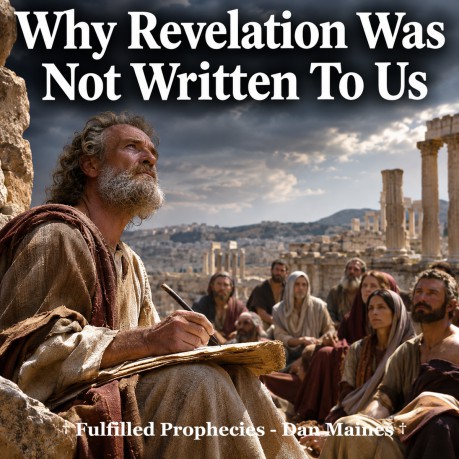
Why Revelation Was Not
Written To Us Introduction Revelation 1:1 Revelation 1:3 Revelation 1:4 Revelation 1:11 Revelation 2:10 Revelation 2:13 Revelation 3:10 Revelation 1:7 Revelation 11:8 Revelation 22:6 Revelation 22:10 Revelation 22:16 Revelation 22:20 Historical References How It Applies To Us Today Q & A Appendix Q: Was
Revelation written directly to Christians living today? Q: Doesn't
Revelation describe events that are still future? Q: Why
did Jesus name seven specific churches? Q: Doesn't
the Book of Revelation describe the end of the physical world? Q: Why
was Daniel told to seal his prophecy while John was told not to seal
Revelation? Q: Was
the destruction of Jerusalem in AD 70 the fulfillment of Jesus'
promised judgment? Q: Does
Revelation still have meaning for us if its prophecies were
fulfilled? Q: Should
Christians still expect another coming of Jesus to fulfill
Revelation? Q: What
is the most important rule when interpreting Revelation? † This is the fulfilled perspective we proclaim at
Fulfilled Prophecies † Source Index
By Dan Maines
† One of the
greatest mistakes in interpreting the Book of Revelation is assuming
that it was written directly to Christians living thousands of years
after the apostles. Revelation was preserved for us, but it wasn't
originally addressed to us. It was written to seven actual churches
in first-century Asia Minor, and its prophecies concerned events that
were approaching in their own generation (Revelation 1:1-4, 11).
†
When we read a letter written to someone else, we must first
understand what it meant to those who received it. We don't take
their warnings, their circumstances, and their promises and
automatically transfer them thousands of years into the future. Yet
that's exactly what much of modern Christianity has done with
Revelation (2 Timothy 2:15; 2 Peter 1:20).
†
Revelation wasn't written as a mysterious prediction of modern
governments, future world wars, electronic identification systems, or
the destruction of planet Earth. It revealed the approaching judgment
upon the Old Covenant order, the vindication of Christ's people, and
the establishment of the New Covenant kingdom in its completed form
(Matthew 24:34; Hebrews 8:13; Revelation 11:15).
†
The question isn't whether Revelation has meaning for Christians
today. Of course it does. The question is whether we have the
authority to change its original audience and its repeated
declarations concerning the nearness of fulfillment. Scripture gives
us no such authority (Revelation 1:3; 22:10, 18-19).
The Revelation of Jesus
Christ, which God gave Him to show to His bond-servants, the things
which must soon take place; and He sent and communicated it by His
angel to His bond-servant John,
† The opening
sentence establishes the timing of the entire prophecy. Jesus
revealed things that must soon take place. John wasn't instructed to
announce events thousands of years away. The revelation concerned
things approaching the people who originally received it (Revelation
1:3; 22:6).
† The word soon cannot reasonably
mean thousands of years when the same book repeatedly declares that
the time is near. The original readers had every reason to understand
these statements according to their ordinary meaning (Revelation 1:3;
22:10).
† If soon meant thousands of years to
the first-century churches, it would have communicated something
entirely different from what those words normally meant. Jesus wasn't
misleading His servants about the timing of His promised judgment
(Matthew 16:27-28; Hebrews 10:37).
Blessed is he who reads and
those who hear the words of the prophecy, and heed the things which
are written in it; for the time is near.
†
John specifically identifies people who would read, hear, and obey
this prophecy. In the first century, Scripture was commonly read
aloud to assembled believers. These churches were expected to
understand the message and respond to it (Colossians 4:16; 1
Thessalonians 5:27).
† The blessing was
connected to obedience because the time was near. These weren't
meaningless words added for dramatic effect. The approaching events
made faithfulness and perseverance especially important to those
believers (Revelation 2:10; James 5:8-9).
†
Notice that John didn't say the time would become near thousands of
years later. He declared that it was near when the prophecy was
delivered. We must allow the original audience to understand the
timing before applying its lessons to ourselves (1 Peter 4:7; 1 John
2:18).
John to the seven churches
that are in Asia: Grace to you and peace, from Him who is and who was
and who is to come, and from the seven Spirits who are before His
throne,
† Here is the original audience
plainly identified. John addressed seven churches in the Roman
province of Asia, located in what is now western Turkey. He didn't
address the United States, modern Israel, or a future generation of
Christians (Revelation 1:11).
† These
congregations had real members, real problems, real persecution, and
real responsibilities. Jesus addressed their spiritual condition
rather than offering predictions about modern political systems
(Revelation 2:2-5; 3:1-3).
† The fact that
Revelation was preserved for later Christians doesn't change its
original recipients. Paul's letters were preserved for us too, but
that doesn't mean we become the Corinthians, Galatians, or
Thessalonians to whom he originally wrote (1 Corinthians 1:2;
Galatians 1:2; 1 Thessalonians 1:1).
saying, "Write in a
book what you see, and send it to the seven churches: to Ephesus and
to Smyrna and to Pergamum and to Thyatira and to Sardis and to
Philadelphia and to Laodicea."
† Jesus
personally identified the seven congregations that were to receive
John's prophecy. These were actual first-century churches, not seven
imaginary congregations representing seven successive periods of
Christian history (Revelation 1:4; 2:1).
†
Each congregation received instructions addressing its circumstances.
Some were commended for faithfulness, others were rebuked for
compromise, and several were warned about approaching suffering or
judgment (Revelation 2:4-5, 9-10; 3:1-3).
†
If Jesus wanted these churches to understand that the prophecy
concerned events thousands of years beyond their lifetime, He could
have said so. Instead, He repeatedly emphasized the approaching
fulfillment of what John was commanded to write (Revelation 1:1, 3;
22:6).
Do not fear what you are
about to suffer. Behold, the devil is about to cast some of you into
prison, so that you will be tested, and you will have tribulation for
ten days. Be faithful until death, and I will give you the crown of
life.
† Jesus spoke directly to the church in
Smyrna about suffering that was approaching them. The warning
concerned some of those believers being imprisoned and tested. It
wasn't addressed to Christians living thousands of years later
(Revelation 1:11; 2:8).
† The words about to
suffer establish an immediate concern for that congregation. Jesus
wasn't describing a future worldwide persecution that the original
recipients would never experience (1 Peter 4:12-13).
†
The promise of the crown of life encouraged believers to remain
faithful even when facing death. That encouragement remains valuable
today, but its original historical setting must not be erased (James
1:12; Revelation 14:13).
I know where you dwell,
where Satan's throne is; and you hold fast My name, and did not deny
My faith even in the days of Antipas, My witness, My faithful one,
who was killed among you, where Satan dwells.
†
Jesus identified an actual believer named Antipas who had been killed
among the Christians in Pergamum. This wasn't a symbolic description
of a future Christian martyr. It was a historical circumstance known
to that congregation (Revelation 1:11; 2:12).
†
The reference to where they lived shows that Jesus was addressing the
circumstances of a particular first-century church. He knew their
location, their faithfulness, and the persecution they had
experienced (Revelation 2:9-10).
† We can't
turn every detail into a prediction about our generation while
ignoring the people Jesus was actually addressing. Their suffering
provides the historical setting for understanding the promises and
warnings that follow (Revelation 2:16-17).
Because you have kept the
word of My perseverance, I also will keep you from the hour of
testing, that hour which is about to come upon the whole world, to
test those who dwell on the earth.
† Jesus
promised the church in Philadelphia protection concerning an
approaching hour of testing. He addressed believers who had already
demonstrated perseverance, not a future generation unknown to the
original congregation (Revelation 3:7-9).
†
The expression about to come reinforces the urgency of the prophecy.
It belongs with the repeated declarations that the time was near and
that the revealed events must soon take place (Revelation 1:1, 3;
22:6).
† The reference to the whole world
must be understood within the first-century context. Scripture
sometimes uses broad geographical language concerning the inhabited
Roman world, as demonstrated by the census under Augustus (Luke 2:1;
Romans 10:18).
BEHOLD, HE IS COMING WITH THE
CLOUDS, and every eye will see Him, even those who pierced Him; and
all the tribes of the earth will mourn over Him. So it is to be.
Amen.
† The reference to those who pierced
Jesus identifies the generation responsible for His crucifixion.
Jesus had already warned the religious leaders of Jerusalem that they
would see the Son of Man coming on the clouds of heaven (Matthew
26:64; Zechariah 12:10).
† Coming with the
clouds is prophetic judgment language. God used similar language when
announcing judgment against Egypt, without describing a physical
descent to the ground (Isaiah 19:1; Daniel 7:13-14).
†
Jesus connected His coming in judgment with the generation then
living. He declared that the events He described would occur before
that generation passed away. The destruction of Jerusalem in AD 70
fulfilled that covenantal judgment (Matthew 24:30, 34; Luke
21:20-22).
And their dead bodies will
lie in the street of the great city which mystically is called Sodom
and Egypt, where also their Lord was crucified.
†
John identifies the great city by saying it was where their Lord was
crucified. Jesus was crucified outside Jerusalem, making Jerusalem
the unmistakable geographical reference in this passage (Luke 23:33;
Hebrews 13:12).
† Calling the city Sodom and
Egypt expresses its covenantal corruption and rebellion. Jerusalem
had rejected the Messiah and persecuted those sent to proclaim Him
(Matthew 23:34-37).
† This identification is
essential when understanding Revelation's judgment imagery. The city
responsible for shedding the blood of God's messengers was
approaching the judgment Jesus had already pronounced upon it
(Matthew 23:35-36; Luke 21:20-22).
And he said to me, "These
words are faithful and true"; and the Lord, the God of the
spirits of the prophets, sent His angel to show to His bond-servants
the things which must soon take place.
† Near
the conclusion of Revelation, the same timing statement appears
again. The prophecy begins with events that must soon take place and
concludes by repeating that declaration (Revelation 1:1).
†
This repetition matters because the closing chapters include the
judgment, the removal of the former covenantal order, and the
revelation of the New Jerusalem. The book doesn't suddenly change its
timeframe when it reaches its final visions (Revelation 21:1-2;
22:10).
† The New Jerusalem represents the
bride, the wife of the Lamb. Scripture identifies believers as
belonging to the heavenly Jerusalem and the New Covenant community
(Revelation 21:9-10; Hebrews 12:22-24; Galatians 4:26).
And he said to me, Do not
seal up the words of the prophecy of this book, for the time is
near.
† This is one of the strongest
statements establishing Revelation's first-century fulfillment. John
was specifically told not to seal the prophecy because its
fulfillment was near (Revelation 1:3).
†
Daniel received the opposite instruction concerning prophecies that
extended beyond his own lifetime. He was told to seal the book until
the time of the end. John was told not to seal his prophecy because
the appointed time had approached (Daniel 12:4, 9).
†
The contrast is unmistakable. Daniel's prophecy pointed forward to
the time when the power of the holy people would be shattered. Jesus
connected that approaching judgment with Jerusalem's destruction
(Daniel 12:7; Matthew 24:15-21; Luke 21:20-22).
†
If John's prophecy was intended primarily for events thousands of
years later, the command not to seal it because the time was near
would lose its ordinary meaning. The first-century audience was being
told that fulfillment was approaching (Revelation 22:6-7).
"I, Jesus, have sent
My angel to testify to you these things for the churches. I am the
root and the descendant of David, the bright morning star."
†
Even at the conclusion of Revelation, Jesus reminds John that the
testimony was intended for the churches. The original audience hasn't
changed between the first chapter and the last chapter (Revelation
1:4, 11).
† Jesus wasn't giving one message
to the seven churches and another unrelated message to people living
thousands of years later. The entire prophecy was delivered as a
unified revelation concerning things that were approaching
(Revelation 1:1; 22:6).
† We must distinguish
between the original recipients and those who later benefit from the
preserved message. Revelation continues to teach us about Christ's
victory, His kingdom, and His faithfulness without requiring another
future fulfillment (Colossians 1:13; Hebrews 12:28).
He who testifies to these
things says, "Yes, I am coming quickly." Amen. Come, Lord
Jesus.
† Jesus concluded the prophecy by
declaring that He was coming quickly. This agrees with the opening
announcement that the revealed events must soon take place
(Revelation 1:1, 3).
† The first-century
believers were waiting for the promised coming of Christ in judgment
and vindication. Jesus had already connected that coming with the
lifetime of some standing before Him and with the generation that
heard His Olivet Discourse (Matthew 16:27-28; 24:34).
†
We aren't waiting for another fulfillment of this promise. Christ
completed His covenantal judgment in AD 70, and His kingdom continues
without end (Daniel 7:13-14; Luke 21:22; Ephesians 3:21).
†
Flavius Josephus, a first-century Jewish historian who witnessed the
Jewish-Roman War, recorded the siege and destruction of Jerusalem in
AD 70. His account describes the terrible suffering, famine, internal
violence, and burning of the temple. These events provide historical
evidence for the catastrophe Jesus predicted (Josephus, The Jewish
War, Books 5-6; Luke 21:20-24).
† Josephus
also recorded the destruction of the temple and the removal of its
treasures by the Romans. This confirms that the Old Covenant
sacrificial center was physically destroyed within the generation
Jesus had addressed (Josephus, The Jewish War, 6.4.5; Matthew
24:1-2).
† Eusebius, writing in the fourth
century, reported that Christians in Jerusalem were instructed to
leave the city and settle in Pella before the war. His account
preserves an early Christian tradition consistent with Jesus' warning
to flee when Jerusalem was surrounded by armies (Eusebius,
Ecclesiastical History, 3.5.3; Luke 21:20-21).
†
Tacitus, a Roman historian, also recorded the Jewish revolt and the
Roman campaign against Jerusalem. His testimony independently
confirms the historical setting of the war that culminated in
Jerusalem's destruction (Tacitus, Histories, Book 5).
†
The precise date when Revelation was written remains debated among
historians. The fulfilled perspective understands it as a prophecy
written before AD 70, during the period when Jerusalem's judgment was
approaching. The repeated time statements and the historical
circumstances of the churches are central to that interpretation
(Revelation 1:1-4; 22:6, 10).
†
Revelation teaches us to respect the original audience of Scripture.
We shouldn't take promises and warnings addressed to first-century
Christians and automatically turn them into predictions about our own
generation (Revelation 1:4, 11; 22:16).
† We
can read Revelation with confidence rather than fear. We don't need
to search modern governments, technology, or international conflicts
for another fulfillment of prophecies that declared their fulfillment
was near (Revelation 1:3; 22:10).
† We live
under the completed New Covenant, not under the approaching judgment
of the Old Covenant world. The church is God's dwelling place, and
believers have access to the Father through Jesus Christ (Hebrews
8:13; Ephesians 2:18-22).
† We aren't waiting
for Christ to establish His kingdom. Believers have already been
transferred into the kingdom of God's beloved Son, and that kingdom
cannot be shaken (Colossians 1:13; Hebrews 12:28).
†
Revelation reminds us that Jesus kept His promises to His original
followers. He didn't fail to return within the generation He
identified, and He didn't postpone His judgment for thousands of
years (Matthew 24:34; Revelation 22:20).
†
The message of Revelation remains precious to Christians today
because it reveals the victory of Jesus Christ, the faithfulness of
God, and the blessings of the New Covenant. Its fulfillment doesn't
make the book irrelevant. Its fulfillment demonstrates that God's
word can be trusted (Revelation 21:3-4; 22:6).
†
We must stop reading Revelation as though John wrote it yesterday. We
should read it as a first-century prophecy that was fulfilled in its
appointed time and preserved so that every generation can understand
the completed work of Jesus Christ (Revelation 1:1-3; 22:10).
A:
No. It was addressed to seven actual first-century churches in Asia
Minor. It was preserved for our instruction, but we weren't its
original recipients (Revelation 1:4, 11; 22:16).
A:
From the fulfilled perspective, its prophetic judgments were
fulfilled in the first century, culminating in AD 70. John repeatedly
declared that the events must soon take place and that the time was
near (Revelation 1:1, 3; 22:6, 10).
A:
Because those congregations were the original recipients of the
prophecy. They faced actual circumstances requiring correction,
encouragement, perseverance, and faithfulness (Revelation 1:11; 2:10,
13; 3:10).
A:
No. The fulfilled perspective understands the passing of the former
heavens and earth as the passing of the Old Covenant order. The New
Jerusalem represents the bride of Christ, and the earth continues
according to God's established purposes (Revelation 21:1-10; Hebrews
8:13; Ecclesiastes 1:4).
A: Daniel was
looking forward to events beyond his lifetime, while John was
announcing events whose appointed time had approached. This contrast
supports the first-century timeframe of Revelation (Daniel 12:4, 9;
Revelation 22:10).
A: Yes.
Jesus connected Jerusalem's destruction with the days of vengeance
and declared that everything He described would occur within that
generation (Matthew 23:36; 24:34; Luke 21:20-22).
A: Absolutely. Its
fulfilled prophecies demonstrate Christ's faithfulness, the certainty
of God's promises, and the reality of His everlasting kingdom. We
benefit from the message without becoming its original audience
(Colossians 1:13; Hebrews 12:28; Revelation 21:3).
A: No. Jesus
declared that He was coming quickly, and His promised covenantal
coming was fulfilled in the judgment of AD 70. Believers now live in
His established kingdom (Matthew 16:27-28; 24:34; Revelation 22:20).
A:
Read it according to its original audience, historical setting,
prophetic language, and repeated time statements. Don't move its
fulfillment thousands of years beyond the generation to whom it was
given (Revelation 1:1-4; 22:6, 10, 16).
© Fulfilled Prophecies - Dan
Maines.
† Revelation
1:1, 3-4, 7, 11; 2:10, 13; 3:10; 11:8; 22:6, 10, 16, 20
†
Flavius Josephus, The Jewish War, Books 5-6; Eusebius, Ecclesiastical
History, 3.5.3; Tacitus, Histories, Book 5
Links