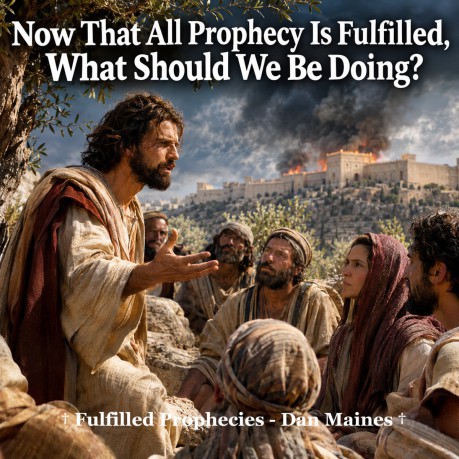
Now That All Prophecy Is
Fulfilled, What Should We Be Doing? Introduction The Kingdom Has Already Been Established Hebrews 12:28 Are We Living In The Greatest Time In History? John 17:3 Will The World Continue To Get Better? Ephesians 2:10 How Do We Bring Others To Christ? 1 Peter 3:15 What Should Our Relationship With Christ Be Like? Philippians 4:6-7 How Should Christians Treat One Another? Romans 12:18 The Invitation To Christ Still Matters Historical References How It Applies To Us Today Q & A Appendix † This is the fulfilled perspective we proclaim at
Fulfilled Prophecies † Source Index
By Dan Maines
† For nearly
two thousand years, Christians have been taught to look toward the
future for the fulfillment of God's promises. They've been told to
expect another coming of Christ, another resurrection, another
judgment, and the destruction of the physical world. But what happens
when we recognize that Jesus fulfilled everything He promised
concerning the end of the Old Covenant age in AD 70?
†
Does that mean our work is finished? Does it mean we have nothing
left to accomplish? Should we simply wait until we die and go to be
with the Lord? Absolutely not!
† The
fulfillment of prophecy wasn't the end of Christianity. It was the
completion of God's redemptive plan and the establishment of the
everlasting kingdom in which we now live (Daniel 7:14; Hebrews
12:28).
† We aren't waiting for Christ to
establish His kingdom. We're living in it. We aren't waiting for the
New Jerusalem to descend. We're citizens of that heavenly city. We
aren't waiting for the Old Covenant to disappear. We're living under
the completed New Covenant (Hebrews 8:13; 12:22-24).
†
But this raises some important questions. What should Christians be
doing now? Is the world going to become better? Are we living in the
greatest time in redemptive history? How do we bring others to
Christ? And perhaps most importantly, what should our personal
relationship with Jesus look like?
† These
aren't questions about predicting tomorrow. They're questions about
how we should live today.
Colossians
1:13
For He rescued us from the domain of darkness, and
transferred us to the kingdom of His beloved Son,
†
Paul didn't tell the Colossians they would someday enter Christ's
kingdom. He told them they had already been transferred into it.
Their citizenship wasn't a future possibility. It was an accomplished
reality (Colossians 1:12-14).
† The kingdom
was already present in the first century, and the judgment of AD 70
brought the Old Covenant age to its final conclusion. We aren't
waiting for another kingdom to arrive (Luke 21:20-22; Hebrews
8:13).
† Our responsibility is to live as
people who belong to Christ's kingdom. That means demonstrating His
righteousness, peace, love, and truth in our everyday lives (Romans
14:17).
Therefore, since we receive a
kingdom which cannot be shaken, let us show gratitude, by which we
may offer to God an acceptable service with reverence and awe;
†
The writer of Hebrews described a kingdom that couldn't be shaken.
The Old Covenant system was approaching its removal, but Christ's
kingdom would remain (Hebrews 12:26-27).
†
That kingdom hasn't disappeared, weakened, or been replaced. Jesus
continues to reign, and His people continue to serve Him (Ephesians
1:20-23).
† Our response to a completed
redemption should be gratitude, worship, and faithful service.
Fulfillment gives us a reason to live for Christ, not an excuse to
stop serving Him (Romans 12:1-2).
2
Corinthians 5:17
Therefore if anyone is in Christ, he
is a new creature; the old things passed away; behold, new things
have come.
† From the standpoint of covenant
redemption, we're living in the greatest age in human history. We
have the completed work of Christ, the established New Covenant, and
direct access to the Father through His Son (Hebrews 10:19-22).
†
Under the Old Covenant, the Law exposed sin and condemnation. Through
Christ, believers have forgiveness, reconciliation, and life. That's
a greater blessing than anything the former covenant could provide
(Romans 8:1-2; Hebrews 8:6).
† But living in
the greatest covenant age doesn't mean every human condition is
better than it has ever been. Wars, disease, poverty, suffering, and
human cruelty still exist. The fulfillment of prophecy didn't promise
the disappearance of every earthly hardship (Romans 12:15; Galatians
6:2).
This is eternal life, that they
may know You, the only true God, and Jesus Christ whom You have
sent.
† Jesus identified eternal life with
knowing the Father and His Son. Christianity isn't merely about
knowing when prophecy was fulfilled. It's about knowing the One who
fulfilled it (John 14:6).
† We can understand
Daniel, Matthew 24, and Revelation and still neglect our relationship
with Christ. Knowledge of fulfilled prophecy should deepen our love
for Jesus, not replace it (1 Corinthians 13:2).
†
The greatest blessing of our age isn't technology, prosperity, or
political freedom. It's the completed reconciliation that allows
believers to know God through Jesus Christ (2 Corinthians 5:18-19).
Matthew
5:14, 16
You are the light of the world. A city set on
a hill cannot be hidden;
Let your light shine before men in such
a way that they may see your good works, and glorify your Father who
is in heaven.
† Jesus didn't tell His
followers to hide from the world. He told them to shine in it. Their
lives were supposed to demonstrate God's goodness before others
(Philippians 2:15).
† Scripture doesn't give
us a timetable guaranteeing that every nation will become peaceful,
every government righteous, or every generation more moral than the
last. Those aren't promises we should invent (Ecclesiastes 7:10).
†
But neither should we assume that everything must continually become
worse. We have no reason to surrender the world to hopelessness when
Christ has called His people to practice righteousness and love
(Galatians 6:9-10).
† The world can become
better wherever people choose mercy over cruelty, truth over
deception, generosity over selfishness, and peace over hatred. We
shouldn't confuse the completion of prophecy with the completion of
human responsibility (Micah 6:8).
For we are His workmanship,
created in Christ Jesus for good works, which God prepared beforehand
so that we would walk in them.
† We weren't
created in Christ merely to understand biblical timelines. We were
created for good works. Our lives should demonstrate what it means to
belong to Him (Titus 3:8).
† We can't control
the entire world, but we can influence our homes, families, churches,
neighborhoods, and communities. Every act of kindness matters
(Galatians 6:10).
† We don't need another
prophetic event before we can begin doing good. We have everything
necessary to live faithfully in the kingdom Christ established (2
Peter 1:3).
2
Corinthians 5:18, 20
Now all these things are from God,
who reconciled us to Himself through Christ and gave us the ministry
of reconciliation,
Therefore, we are ambassadors for Christ, as
though God were making an appeal through us; we beg you on behalf of
Christ, be reconciled to God.
† Paul
described the ministry of reconciliation as bringing people to
understand what God accomplished through Jesus Christ. The foundation
of that message remains the same today (Romans 5:10-11).
†
We don't bring people to Christ by frightening them with predictions
of an approaching tribulation, a future Antichrist, or the
destruction of the planet. We introduce them to the Savior who gave
His life for sinners (John 3:16-17).
† Our
message should center on Jesus, His death, His resurrection, His
forgiveness, and the life available through Him. Fulfilled prophecy
helps explain His faithfulness, but Jesus Himself must remain the
center of our message (1 Corinthians 2:2).
but sanctify Christ as Lord in
your hearts, always being ready to make a defense to everyone who
asks you to give an account for the hope that is in you, yet with
gentleness and reverence;
† Peter instructed
believers to explain their hope with gentleness and reverence. That
principle remains essential when discussing the fulfilled perspective
with those who disagree (Colossians 4:6).
†
We don't win people to Christ by humiliating them, attacking their
intelligence, or treating every disagreement as a personal battle.
Truth doesn't require cruelty to make its point (2 Timothy
2:24-25).
† We should explain Scripture
clearly, answer questions patiently, and allow people time to examine
what they've been taught. Our responsibility is to present the truth
faithfully, not force someone to accept it (Acts 17:11).
†
Bringing someone to understand AD 70 isn't the same thing as bringing
that person into a relationship with Christ. Our goal must always be
greater than winning an argument about prophecy (John 20:31).
John
15:4-5
Abide in Me, and I in you. As the branch cannot
bear fruit of itself unless it abides in the vine, so neither can you
unless you abide in Me.
I am the vine, you are the branches; he
who abides in Me and I in him, he bears much fruit, for apart from Me
you can do nothing.
† Jesus described a
living relationship, not merely an intellectual agreement. A branch
depends upon the vine for life, nourishment, and fruitfulness. In the
same way, our spiritual lives depend upon Christ (Galatians 2:20).
†
Abiding in Christ means trusting Him, following His teachings,
remaining faithful to Him, and allowing His love to shape our
decisions. It's an ongoing relationship, not something we practice
only on Sunday (John 14:21).
† We should
begin our days remembering who we belong to. We should seek His
wisdom when making decisions, thank Him for His blessings, and turn
to Him during our difficulties (James 1:5).
Be anxious for nothing,
but in everything by prayer and supplication with thanksgiving let
your requests be made known to God.
And the peace of God, which
surpasses all comprehension, will guard your hearts and your minds in
Christ Jesus.
† Prayer isn't a ritual
performed to earn God's approval. It's an expression of our
relationship with our heavenly Father. We can bring Him our
gratitude, fears, needs, and concerns (Hebrews 4:16).
†
Having a relationship with Christ doesn't mean we'll never experience
pain, sickness, disappointment, or grief. It means we don't have to
face those experiences without the comfort and hope found in Him (2
Corinthians 1:3-4).
† Our relationship with
Jesus should grow through prayer, studying Scripture, obedience,
gratitude, and love. We shouldn't spend our lives studying His return
while neglecting His presence in our daily lives (John 14:23).
John
13:34-35
A new commandment I give to you, that you love
one another, even as I have loved you, that you also love one
another.
By this all men will know that you are My disciples, if
you have love for one another.
† Jesus didn't
say the world would recognize His disciples by their knowledge of
prophecy. He said people would recognize them by their love for one
another (1 John 4:7-8).
† We can have an
accurate understanding of fulfilled prophecy and still fail miserably
in the way we treat others. If our knowledge produces arrogance,
bitterness, and contempt, we've missed something essential (1
Corinthians 8:1).
† Christians should be
known for compassion, forgiveness, patience, generosity, and honesty.
We should care for those who are suffering, encourage those who are
discouraged, and help those who are struggling (Ephesians 4:32).
If possible, so far as it
depends on you, be at peace with all men.
†
Paul understood that peace isn't always possible because we can't
control how others behave. But we can control how we respond (Romans
12:17).
† We don't have to agree with
everyone to treat them respectfully. We can defend Scripture without
becoming hateful or insulting (Colossians 3:12-14).
†
If we want others to see the goodness of Christ, they should be able
to recognize something different in the way we live and speak
(Matthew 5:16).
Revelation
22:17
The Spirit and the bride say, Come. And let the
one who hears say, Come. And let the one who is thirsty come; let the
one who wishes take the water of life without cost.
†
Revelation originally addressed first-century believers concerning
events that were near. Its invitation to receive the water of life
reveals the gracious character of the completed redemption Christ
accomplished (Revelation 1:1-3).
† The New
Jerusalem represents God's redeemed people, and the water of life
represents the life available through Christ. The fulfillment of the
prophetic vision doesn't mean the blessings of Christ have stopped
being available (John 4:14).
† We aren't
inviting people to escape an approaching destruction of Jerusalem.
We're inviting them to know Jesus Christ and receive the life found
in Him (John 10:10).
† The church still has a
purpose because people still need forgiveness, hope, encouragement,
instruction, and love. The end of the Old Covenant age wasn't the end
of God's goodness toward humanity (Ephesians 2:8-10).
†
Josephus, in The Jewish War, Books 6-7, described the destruction of
Jerusalem and its temple in AD 70. His account provides historical
evidence of the catastrophe that brought the temple-centered Old
Covenant system to its physical end.
†
Tacitus, in Histories, Book 5, described the Roman conflict involving
Jerusalem and the Jewish people. His account independently confirms
the historical setting of the first-century war.
†
Eusebius, in Ecclesiastical History, Book 3, Chapter 5, recorded the
tradition that Christians departed Jerusalem and settled at Pella
before the city's destruction.
† These
historical accounts help us understand the first-century setting of
Jesus' warnings. They don't replace Scripture, and they don't
determine how we should live today. Our daily responsibilities come
from the teachings of Christ and His apostles (Matthew 24:34; John
13:34-35).
†
We should stop living as though Christianity is an unfinished story.
Christ accomplished the redemption promised in Scripture, and we now
live in the blessings of His established kingdom (Hebrews 12:28).
†
We should make our relationship with Jesus our highest priority.
Understanding prophecy is valuable, but knowing Christ and living
according to His teachings is far more important (John 17:3).
†
We should share the gospel without using fear. People need to hear
about the love of God, the sacrifice of Christ, the forgiveness of
sins, and the life available through Him (Romans 5:8).
†
We should work to make the world around us better. Feed the hungry,
help the struggling, encourage the discouraged, forgive those who
have hurt us, and show kindness wherever possible (Galatians 6:10).
†
We should stop measuring Christianity by the number of people who
agree with our eschatology. Our lives should be measured by
faithfulness, love, integrity, and the fruit we produce (John
15:8).
† We should enjoy the blessings of
life without feeling guilty for living in a world where suffering
still exists. We can celebrate God's goodness while helping those who
are hurting (Romans 12:15).
† We should
remember that our earthly lives are temporary, but our relationship
with Christ isn't. When believers leave this physical life, they have
the assurance of being with the Lord (2 Corinthians 5:8; Philippians
1:23).
† We should wake up each morning with
a purpose. There are people to love, lives to encourage, truths to
share, and opportunities to demonstrate the goodness of Jesus Christ
(Ephesians 2:10).
† We don't need another
coming, another judgment, another resurrection, or another prophetic
fulfillment to give our lives meaning. We already have a King, a
kingdom, a Savior, and a purpose.
† The
greatest question facing Christians today isn't when Jesus will
return. It's what we're doing with the life He's given us.
†
The prophecies have been fulfilled, but our opportunities to love,
serve, teach, encourage, and glorify Christ continue every day.
Q: If
all prophecy was fulfilled in AD 70, why are we still here?
A:
Because the fulfillment of prophecy wasn't the end of human
existence. It was the completion of God's covenant promises. We
continue living, serving Christ, and doing the good works for which
we were created (Ephesians 2:10; Hebrews 12:28).
Q:
Are we living in the greatest time in human history?
A:
We're living in the greatest age of covenant redemption because
Christ has completed His work and established the New Covenant. That
doesn't mean every earthly condition is better than in previous
generations (Hebrews 8:6; 10:19-22).
Q: Does
Scripture promise that the whole world will continually become
better?
A: No. Scripture calls us to do good
and demonstrate God's righteousness, but it doesn't guarantee
uninterrupted worldwide moral or political improvement (Matthew 5:16;
Galatians 6:9-10).
Q: Should Christians still
share the gospel?
A: Absolutely. The original
first-century mission reached its appointed fulfillment, but people
today still need to hear about Jesus Christ, His forgiveness, and the
life available through Him (Colossians 1:23; 2 Corinthians
5:18-20).
Q: How do we bring people to Christ
without frightening them about the end times?
A:
By teaching them about His love, sacrifice, resurrection,
forgiveness, and the blessings of knowing Him. We should explain our
hope with gentleness and reverence (John 3:16-17; 1 Peter 3:15).
Q:
Is understanding fulfilled prophecy necessary for salvation?
A:
No. Salvation is through Jesus Christ, not through mastering a
particular interpretation of prophecy. Our faith must rest in Him
(Ephesians 2:8-9; John 20:31).
Q: What should
our daily relationship with Christ look like?
A:
We should trust Him, pray regularly, study Scripture, obey His
teachings, love others, and allow His character to influence our
decisions (John 15:4-5; Philippians 4:6-7).
Q:
If Satan has been defeated, why do people still commit evil?
A:
Human beings remain capable of sinful choices. James explained that
temptation can arise from a person's own desires. Satan's defeat
doesn't eliminate human responsibility (James 1:14-15; Romans
6:12-13).
Q: Should Christians be involved in
helping their communities?
A: Yes. We were
created in Christ Jesus for good works. Helping others is one way we
demonstrate His love and glorify our Father (Ephesians 2:10; Matthew
5:16).
Q: What happens to believers when they
physically die?
A: Believers have the assurance
of being with the Lord. We aren't waiting for another future
resurrection event to make that possible (2 Corinthians 5:8;
Philippians 1:23).
Q: What is the most
important thing Christians should be doing now?
A:
Loving God, loving others, living faithfully, sharing Christ, and
demonstrating His goodness in everyday life. Fulfilled prophecy
should strengthen our relationship with Jesus, not distract us from
it (John 13:34-35; John 15:8).
Q: If the
redemptive work is complete, does that mean our Christian work is
complete?
A: No. Christ's completed redemption
is the foundation of our ongoing service. We don't work to finish
what Jesus accomplished. We serve because of what He has already done
(Ephesians 2:8-10; Hebrews 12:28).
© Fulfilled Prophecies - Dan
Maines.
† Colossians
1:13; Hebrews 12:28; 2 Corinthians 5:17-18, 20; John 17:3; Matthew
5:14, 16; Ephesians 2:10; 1 Peter 3:15; John 15:4-5; Philippians
4:6-7; John 13:34-35; Romans 12:18; Revelation 22:17.
†
Flavius Josephus, The Jewish War, Books 6-7; Tacitus, Histories, Book
5; Eusebius, Ecclesiastical History, Book 3, Chapter 5.
Links