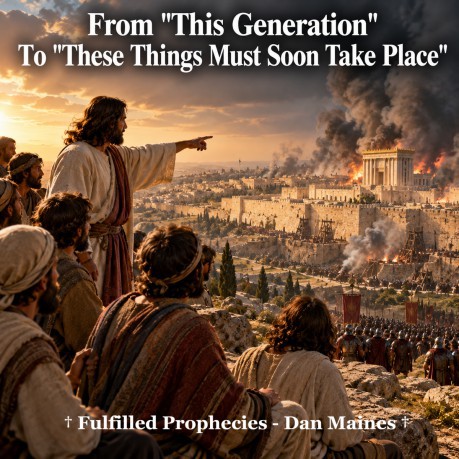
From "This Generation"
To "These Things Must Soon Take Place" Introduction Jesus Said Some Standing There Would See His
Coming The Disciples Wouldn't Finish Before He Came Jesus Identified The Generation Mark Confirmed The Same Time Limitation Luke Identified Jerusalem And The Days Of Vengeance Peter Declared The Last Days Had Arrived Paul Said The Day Was Near The Ends Of The Ages Had Already Come Paul Said The Lord Was Near Hebrews Declared The Consummation Of The Ages Hebrews Said He Wouldn't Delay James Said The Judge Was Standing At The Door Peter Said The End Of All Things Was Near John Said It Was The Last Hour Revelation Opened With Things That Must Soon Take
Place Revelation Closed With The Same Promise Historical References How It Applies To Us Today Q & A Appendix † This is the fulfilled perspective we proclaim at
Fulfilled Prophecies † Source Index
By Dan Maines
† From the
words of Jesus in the Gospels to the final chapter of Revelation, the
New Testament repeatedly declares that the fulfillment of prophecy
was near, approaching, and expected within the lifetime of the
first-century believers.
† Jesus said this
generation. Paul said the ends of the ages had come. James said the
Judge was standing at the door. Peter said the end of all things was
near. John said it was the last hour. Revelation declared that the
things written in the book must soon take place (Matthew 24:34; 1
Corinthians 10:11; James 5:9; 1 Peter 4:7; 1 John 2:18; Revelation
1:1).
† These statements weren't spoken to
people living thousands of years later. They were addressed to people
who were living, listening, reading, and preparing for the
approaching judgment upon Old Covenant Israel (Luke 21:20-22; Hebrews
8:13).
† The question isn't whether these
statements sound urgent to us today. The question is what they meant
to the people who originally received them (Matthew 24:34; Revelation
1:3).
† When we follow these statements in
their historical setting, we discover one consistent message. The Old
Covenant age was approaching its conclusion, and the promised kingdom
of Christ was being fully established through the events culminating
in AD 70 (Daniel 9:26-27; Hebrews 12:28).
†
The time statements weren't mistakes, exaggerations, or promises
postponed for thousands of years. They were declarations of an
approaching fulfillment that Jesus and His apostles expected within
their generation (Matthew 16:27-28; Revelation 22:10).
Matthew 16:27-28
For the Son of Man is
going to come in the glory of His Father with His angels, and WILL
THEN REPAY EVERY MAN ACCORDING TO HIS DEEDS.
Truly I say to you,
there are some of those who are standing here who will not taste
death until they see the Son of Man coming in His kingdom.
†
Jesus identified the people who would witness His coming. Some
standing before Him would still be alive when the Son of Man came in
His kingdom (Matthew 16:28).
† The statement
about rewarding each person according to his deeds connects this
coming with judgment, not merely an ordinary demonstration of His
power (Revelation 22:12).
† Jesus didn't say
that people living thousands of years later would witness this event.
He specifically identified some of His own listeners as those who
would remain alive (Mark 9:1).
† From the
fulfilled perspective, this coming was the covenantal manifestation
of Christ's royal authority and judgment, culminating in Jerusalem's
destruction in AD 70 (Daniel 7:13-14; Matthew 24:30).
Matthew
10:23
But whenever they persecute you in one city, flee
to the next; for truly I say to you, you will not finish going
through the cities of Israel until the Son of Man comes.
†
Jesus connected His coming with the mission and persecution of His
disciples among the cities of Israel (Matthew 10:16-23).
†
The disciples were told to flee from one city to another because
persecution would accompany their proclamation of the kingdom
(Matthew 10:17-23).
† Jesus placed His coming
within the historical setting of their mission, not within an
undefined generation thousands of years later (Matthew 10:23).
†
This agrees with His later declaration that His generation would
witness the fulfillment of everything He described concerning
Jerusalem's judgment (Luke 21:20-32).
Matthew 24:34
Truly
I say to you, this generation will not pass away until all these
things take place.
† Jesus gave His disciples
a definite time limitation. The generation then living wouldn't pass
away before the events He described took place (Matthew 24:1-34).
†
The expression this generation consistently identified the people
living during Jesus' earthly ministry when He condemned the unbelief
and wickedness of His contemporaries (Matthew 11:16; 12:41-42;
23:36).
† Jesus had already declared that
Jerusalem would be held accountable for the blood of the righteous
and that judgment would come upon that generation (Matthew
23:34-36).
† The destruction of Jerusalem and
its temple in AD 70 occurred approximately forty years after Jesus'
ministry, within the generation He addressed (Matthew 24:1-2, 34).
†
Moving this generation into our future changes the natural meaning of
Jesus' words and separates the prophecy from its original audience
(Matthew 23:36; 24:34).
Mark
13:30
Truly I say to you, this generation will not pass
away until all these things take place.
†
Mark recorded the same promise Jesus gave in Matthew. The events
would occur before that generation passed away (Mark 13:1-30).
†
The prophecy began with Jesus announcing the destruction of the
magnificent temple buildings standing before His disciples (Mark
13:1-2).
† Jesus described persecution, false
messiahs, wars, tribulation, and the approaching judgment before
declaring the generation in which these things would occur (Mark
13:5-30).
† Matthew and Mark weren't
describing two unrelated judgments separated by thousands of years.
They recorded the same teaching concerning the approaching end of
Jerusalem's covenantal age (Matthew 24:1-34; Mark 13:1-30).
Luke
21:20-22, 32
But when you see Jerusalem surrounded by
armies, then recognize that her desolation is near.
because
these are days of vengeance, so that all things which are written
will be fulfilled.
Truly I say to you, this generation will not
pass away until all things take place.
† Luke
identified the approaching judgment with Jerusalem surrounded by
armies. The disciples were given a recognizable historical warning
(Luke 21:20-21).
† Jesus instructed those in
Judea to flee to the mountains when the armies approached. This was a
warning to people who could physically escape the threatened city
(Luke 21:20-21).
† Jesus called these the
days of vengeance, connecting Jerusalem's destruction with the
fulfillment of the prophetic judgments written against covenant
unfaithfulness (Deuteronomy 28:49-68; Daniel 9:26-27).
†
Luke repeated the same generational limitation recorded by Matthew
and Mark. The fulfillment belonged to the generation Jesus addressed
(Matthew 24:34; Mark 13:30; Luke 21:32).
†
The Roman destruction of Jerusalem and its temple in AD 70
corresponds to the historical judgment Jesus described (Luke
19:41-44; 21:20-24).
† The prophecy concerned
the end of the Old Covenant order centered upon Jerusalem, not the
destruction of planet Earth (Hebrews 8:13; 12:26-28).
Acts
2:16-17
but this is what was spoken of through the
prophet Joel:
'AND IT SHALL BE IN THE LAST DAYS,' God says,
'THAT I WILL POUR FORTH OF MY SPIRIT ON ALL MANKIND; AND YOUR SONS
AND YOUR DAUGHTERS SHALL PROPHESY, AND YOUR YOUNG MEN SHALL SEE
VISIONS, AND YOUR OLD MEN SHALL DREAM DREAMS;
†
On Pentecost, Peter didn't announce that the last days would begin
thousands of years later. He declared that the events taking place
before his audience fulfilled Joel's prophecy (Acts 2:14-17).
†
The pouring out of the Holy Spirit demonstrated that the promised
last-days events were already unfolding among the first-century
believers (Joel 2:28-32; Acts 2:16-21).
†
Peter connected the outpouring of the Spirit with the approaching day
of the Lord and the promise of salvation to those who called upon His
name (Acts 2:17-21).
† The last days were the
closing period of the Old Covenant age, during which the promised
Messiah had appeared and the New Covenant was being established
(Hebrews 1:1-2; 9:26).
† The apostles weren't
waiting for the last days to begin. They were already living in them
(Acts 2:16-17; Hebrews 1:2).
Romans 13:11-12
Do
this, knowing the time, that it is already the hour for you to awaken
from sleep; for now salvation is nearer to us than when we
believed.
The night is almost gone, and the day is near.
Therefore let us lay aside the deeds of darkness and put on the armor
of light.
† Paul told the Roman believers
that the appointed hour had already arrived and that the approaching
day was near (Romans 13:11-12).
† His
language expressed an immediate expectation for those receiving his
letter, not an event that would remain unfulfilled for thousands of
years (Romans 13:11-12).
† The approaching
day fits the transition from the fading Old Covenant order into the
fully established New Covenant kingdom (Hebrews 8:13; 12:28).
†
Paul encouraged believers to live faithfully because they were
approaching the fulfillment of God's redemptive promises in Christ
(Romans 13:11-14).
1 Corinthians
10:11
Now these things happened to them as an example,
and they were written for our instruction, upon whom the ends of the
ages have come.
† Paul didn't say the ends of
the ages would arrive thousands of years after his readers died. He
declared that they had already come upon the believers receiving his
letter (1 Corinthians 10:11).
† Paul compared
Israel's wilderness experiences with the circumstances facing the
first-century church during the covenantal transition (1 Corinthians
10:1-11).
† The expression ends of the ages
points to the culmination of God's redemptive purposes in Christ, not
the termination of the physical universe (Hebrews 9:26).
†
The first-century believers were witnessing the conclusion of the age
governed by the Mosaic covenant and the establishment of the promised
New Covenant order (Hebrews 8:6-13).
† Paul's
words agree with Jesus' declaration that the generation then living
would witness the fulfillment of the approaching judgment (Matthew
24:34).
Philippians 4:5
Let
your gentle spirit be known to all men. The Lord is near.
†
Paul encouraged the Philippian believers to demonstrate gentleness
because the Lord was near (Philippians 4:4-5).
†
The statement carried immediate significance for the believers who
originally received the letter (Philippians 4:5).
†
Paul consistently presented the approaching fulfillment of God's
promises as a reason for faithfulness, perseverance, and godly
conduct (Romans 13:11-14; Philippians 4:4-9).
†
The nearness of Christ's judgment and kingdom vindication fits the
first-century expectation expressed throughout the apostolic writings
(Matthew 16:27-28; James 5:8-9).
Hebrews
9:26
Otherwise, He would have needed to suffer often
since the foundation of the world; but now once at the consummation
of the ages He has been manifested to put away sin by the sacrifice
of Himself.
† Hebrews identifies Christ's
sacrificial appearance with the consummation of the ages. The writer
located this fulfillment in the time of Christ's earthly ministry and
sacrifice (Hebrews 9:26).
† The end of the
ages wasn't the destruction of the physical heavens and earth. It
concerned the fulfillment of the sacrificial system through the
once-for-all offering of Jesus Christ (Hebrews 9:11-14, 26).
†
The Old Covenant priesthood, sacrifices, and temple ceremonies had
reached their intended fulfillment in Christ (Hebrews 7:11-28;
10:1-18).
† The covenant established through
Moses was becoming obsolete and was ready to disappear as the New
Covenant replaced its former administration (Hebrews 8:13).
†
The removal of Jerusalem's temple in AD 70 publicly demonstrated the
passing of the Old Covenant order whose sacrifices Christ had already
fulfilled (Matthew 24:1-2; Hebrews 10:11-18).
Hebrews 10:37
FOR
YET IN A VERY LITTLE WHILE, HE WHO IS COMING WILL COME, AND WILL NOT
DELAY.
† The writer encouraged suffering
believers with the promise that the coming One would arrive in a very
little while (Hebrews 10:32-39).
† The
statement specifically rejected the idea of an indefinite delay. The
promised coming was presented as approaching the original readers
(Hebrews 10:37).
† The believers were
instructed to endure because their promised deliverance and
vindication were drawing near (Hebrews 10:35-39).
†
From the fulfilled perspective, this coming belongs to the same
first-century judgment Jesus announced against Jerusalem (Matthew
24:30-34).
† The language of imminence must
be understood according to the historical circumstances of the people
who originally received the promise (Hebrews 10:32-39).
James
5:8-9
You too be patient; strengthen your hearts, for
the coming of the Lord is near.
Do not complain, brethren,
against one another, so that you yourselves may not be judged;
behold, the Judge is standing right at the door.
†
James told suffering believers that the coming of the Lord was near
and that the Judge was already standing at the door (James 5:7-9).
†
His words weren't describing a judgment that would remain thousands
of years away. They were intended to strengthen believers facing
persecution and injustice in their own time (James 5:1-9).
†
The expression standing at the door communicates the immediate
approach of judgment, not a distant event without a definite
historical setting (James 5:9).
† James'
declaration agrees with Jesus' warning that judgment would come upon
the generation responsible for rejecting God's messengers (Matthew
23:34-36).
† The approaching judgment would
vindicate the faithful and bring the Old Covenant persecuting order
to its appointed conclusion (Matthew 23:35-38; Hebrews 8:13).
1 Peter
4:7, 17
The end of all things is near; therefore, be of
sound judgment and sober spirit for the purpose of prayer.
For
it is time for judgment to begin with the household of God; and if it
begins with us first, what will be the outcome for those who do not
obey the gospel of God?
† Peter didn't say
the end of all things was thousands of years away. He told his
first-century readers that it was near (1 Peter 4:7).
†
The context concerns believers suffering persecution and being tested
as judgment approached (1 Peter 4:12-19).
†
Peter declared that the time for judgment had arrived, beginning with
God's household (1 Peter 4:17).
† From the
fulfilled perspective, the end concerned the passing of the Old
Covenant age and its temple-centered order, not the destruction of
the planet (Matthew 24:1-3; Hebrews 8:13).
†
Peter's warning agrees with the other apostolic declarations that the
final covenantal judgment was approaching their generation (James
5:8-9; Hebrews 10:37).
1 John 2:18
Children,
it is the last hour; and just as you heard that antichrist is coming,
even now many antichrists have appeared; from this we know that it is
the last hour.
† John didn't say the last
hour would begin thousands of years later. He declared that it was
already the last hour when he wrote to the believers (1 John 2:18).
†
John identified the appearance of many antichrists as evidence that
the last hour had arrived (1 John 2:18-19).
†
These opponents were already active during the apostolic period,
demonstrating that John's warning concerned circumstances his readers
were experiencing (1 John 2:18-22).
† The
last hour fits the closing period of the Old Covenant age, when
opposition to Christ intensified before Jerusalem's judgment (Matthew
24:9-13; 1 John 2:18).
† John's statement
agrees with Peter's declaration that the last days had arrived and
Paul's announcement that the ends of the ages had come (Acts 2:16-17;
1 Corinthians 10:11).
Revelation 1:1, 3
The Revelation of Jesus
Christ, which God gave Him to show to His bond-servants, the things
which must soon take place; and He sent and communicated it by His
angel to His bond-servant John,
Blessed is he who reads and
those who hear the words of the prophecy, and heed the things which
are written in it; for the time is near.
†
Revelation begins with two unmistakable time statements. The things
revealed must soon take place, and the time was near (Revelation
1:1-3).
† These statements establish the time
frame for the prophecy before the visions of judgment, Babylon, the
beast, and the New Jerusalem are introduced (Revelation 1:1-3).
†
The message was addressed to seven actual churches in Asia Minor,
whose members were expected to read, hear, and obey the prophecy
(Revelation 1:4, 11).
† The words soon and
near carried meaning for those first-century believers. They weren't
meaningless expressions that could be stretched across thousands of
years (Revelation 1:1-3).
† The early-date
interpretation of Revelation places its writing before AD 70 and
understands its judgments as describing the approaching destruction
of the Old Covenant order (Matthew 24:34; Revelation 11:1-2).
†
This interpretation preserves the connection between Jesus'
generational promise and Revelation's repeated declarations of
imminent fulfillment (Matthew 24:34; Revelation 1:1-3).
Revelation
22:6, 10, 12, 20
And he said to me, These words are
faithful and true; and the Lord, the God of the spirits of the
prophets, sent His angel to show to His bond-servants the things
which must soon take place.
And he said to me, Do not seal up
the words of the prophecy of this book, for the time is near.
Behold,
I am coming quickly, and My reward is with Me, to render to every man
according to what he has done.
He who testifies to these things
says, Yes, I am coming quickly. Amen. Come, Lord Jesus.
†
Revelation ends exactly as it begins, declaring that the things
revealed must soon take place (Revelation 1:1; 22:6).
†
John was specifically instructed not to seal the prophecy because the
time was near. The message was intended to be understood and acted
upon by its original readers (Revelation 22:10).
†
This contrasts with Daniel, who was instructed to seal his prophetic
words because their fulfillment belonged to a later appointed time
(Daniel 12:4, 9).
† Jesus repeated that He
was coming quickly, reinforcing the urgency already established in
the opening chapter (Revelation 1:1-3; 22:7, 12, 20).
†
The promise of reward according to each person's deeds connects
Revelation's closing declaration with Jesus' earlier promise that
some standing before Him would live to see His coming in His kingdom
(Matthew 16:27-28; Revelation 22:12).
† From
this fulfilled perspective, the judgment announced in Revelation
reached its covenantal fulfillment in AD 70, when Jerusalem and its
temple were destroyed (Matthew 24:1-34; Revelation 18:20-24).
†
The book's opening and closing time statements provide a consistent
framework for understanding the prophecy within its first-century
historical setting (Revelation 1:1-3; 22:6-20).
†
Flavius Josephus, a first-century Jewish historian who witnessed the
Jewish-Roman War, recorded the siege and destruction of Jerusalem in
The Jewish War, especially Books V and VI.
†
Josephus described the suffering, famine, internal violence, burning
of the temple, and devastation that accompanied Jerusalem's
destruction in AD 70.
† His account provides
historical evidence for the catastrophe Jesus described when He
warned that Jerusalem would be surrounded by armies (Luke
21:20-24).
† Tacitus, the Roman historian,
described the Roman campaign against Jerusalem during the reign of
Vespasian in Histories, Book V.
† Tacitus
provides an independent Roman historical perspective on the conflict
that culminated in Jerusalem's destruction.
†
Eusebius, writing in the fourth century, recorded a tradition that
believers in Jerusalem had been instructed to leave the city and
settle in Pella before the war, in Ecclesiastical History, Book III,
Chapter 5.
† This tradition is consistent
with Jesus' instruction that His followers should flee when they
recognized the approaching danger (Luke 21:20-21).
†
These historical writers confirm the reality of Jerusalem's
first-century destruction. Their accounts don't independently
establish every prophetic interpretation, but they provide important
historical context for the fulfillment perspective.
†
We must respect the original audience of Scripture. When Jesus
addressed this generation, we shouldn't automatically transfer His
words to a generation living thousands of years later (Matthew
24:34).
† When Paul said the ends of the ages
had come, we should recognize that he was speaking to believers
living during the first-century covenantal transition (1 Corinthians
10:11).
† When James said the Judge was
standing at the door, we should understand the urgency of his message
to the suffering believers who originally received it (James
5:8-9).
† When Peter said the end of all
things was near, we shouldn't assume he was predicting the
destruction of the physical universe in our future (1 Peter 4:7;
Hebrews 8:13).
† When John said it was the
last hour, we should recognize that he was identifying the
circumstances of his own generation (1 John 2:18).
†
When Revelation declared that its prophecies must soon take place, we
should honor the time frame given to the original churches
(Revelation 1:1-3; 22:6-10).
† We aren't
living in the last days of the Old Covenant. We live under the
accomplished New Covenant established through the blood of Jesus
Christ (Luke 22:20; Hebrews 9:15).
† We
aren't waiting for Christ to establish His kingdom. He has received
His kingdom, and believers have come to the heavenly Jerusalem, the
city of the living God (Daniel 7:13-14; Hebrews 12:22-28).
†
We aren't waiting for the Old Covenant temple to disappear. Christ
has fulfilled its sacrificial purpose and provided permanent access
to the Father (Hebrews 10:19-22; Ephesians 2:18).
†
We aren't waiting for the New Jerusalem to descend in a future
destruction of planet Earth. Through Christ, believers belong to the
Jerusalem above and enjoy the blessings of the New Covenant
(Galatians 4:26; Hebrews 12:22-23; Revelation 21:2-3).
†
The fulfillment of prophecy doesn't diminish our hope. It establishes
our confidence that Jesus kept His promises and that His kingdom
cannot be shaken (Matthew 24:34-35; Hebrews 12:28).
†
Our responsibility today is to proclaim the completed work of Christ,
live faithfully in His kingdom, and share the gospel with those who
need His salvation (Matthew 28:18-20; Ephesians 2:8-10).
†
Jesus didn't fail to keep His time statements. The fulfilled
perspective recognizes that His words were trustworthy, His promises
were accomplished, and His kingdom remains forever (Luke 21:32-33;
Hebrews 12:28).
Q: What
did Jesus mean by this generation?
A: He
identified the generation living during His earthly ministry as the
generation that would witness the events He described concerning
Jerusalem's judgment (Matthew 23:36; 24:34).
Q:
Did Jesus promise that some of His listeners would live to see His
coming?
A: Yes. Jesus declared that some
standing before Him wouldn't taste death before seeing the Son of Man
coming in His kingdom (Matthew 16:27-28).
Q:
Were the apostles already living in the last days?
A:
Yes. Peter identified Pentecost with Joel's last-days prophecy, and
John declared that it was already the last hour (Acts 2:16-17; 1 John
2:18).
Q: What did Paul mean when he said the
ends of the ages had come?
A: He was describing
the culmination of the former covenantal ages through Christ and the
transition into the New Covenant order (1 Corinthians 10:11; Hebrews
9:26).
Q: Did Peter predict the destruction of
planet Earth?
A: From the fulfilled
perspective, Peter's statement concerned the approaching end of the
Old Covenant order, consistent with the judgment Jesus announced
against Jerusalem (1 Peter 4:7, 17; Matthew 24:1-34).
Q:
Why did Revelation repeatedly say the time was near?
A:
Because its original readers were being warned about events
approaching their own historical generation (Revelation 1:1-3;
22:6-10).
Q: Why was John told not to seal
Revelation?
A: Because the time was near,
unlike Daniel's prophecy, which was sealed for a later appointed time
(Daniel 12:4, 9; Revelation 22:10).
Q: Did all
these time statements point toward AD 70?
A:
The fulfilled perspective understands them as a consistent witness to
the first-century culmination of the Old Covenant age, with
Jerusalem's destruction marking its decisive historical conclusion
(Matthew 24:34; Hebrews 8:13; Revelation 1:1-3).
Q:
Does fulfilled prophecy mean Jesus no longer reigns?
A:
No. Jesus reigns in His everlasting kingdom, and believers already
belong to the heavenly Jerusalem and the kingdom that cannot be
shaken (Daniel 7:13-14; Hebrews 12:22-28).
Q:
What should Christians do now that these prophecies have been
fulfilled?
A: We should live faithfully under
the New Covenant, proclaim salvation through Jesus Christ, and
rejoice that God's promises have been accomplished in Him (2
Corinthians 1:20; Hebrews 10:19-22).
© Fulfilled Prophecies - Dan
Maines.
† Matthew
16:27-28; Matthew 10:23; Matthew 24:34; Mark 13:30; Luke 21:20-22,
32; Acts 2:16-17; Romans 13:11-12; 1 Corinthians 10:11; Philippians
4:5; Hebrews 9:26; Hebrews 10:37; James 5:8-9; 1 Peter 4:7, 17; 1
John 2:18; Revelation 1:1, 3; Revelation 22:6, 10, 12, 20.
†
Flavius Josephus, The Jewish War, Books V-VI; Tacitus, Histories,
Book V; Eusebius, Ecclesiastical History, Book III, Chapter 5.
Links