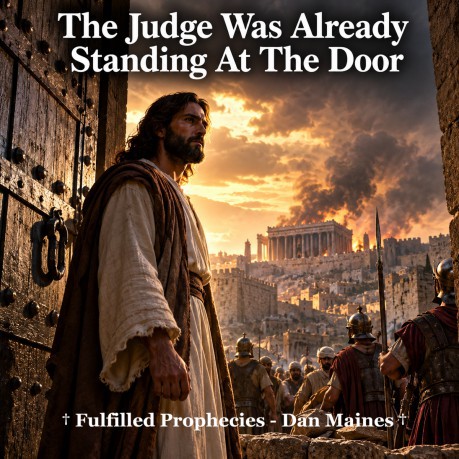
The Judge Was Already
Standing At The Door Introduction James Announced The Nearness Of Christ's Coming Jesus Had Already Said He Was Near The Door The Judgment Was Directed Toward Jerusalem Jesus Identified The Sign Of Jerusalem's Desolation The Coming Of The Son Of Man Was Within That
Generation Peter Confirmed That Judgment Was Near 1 Peter 4:17 Hebrews Said The Coming Would Not Be Delayed Revelation Announced The Same Approaching
Judgment Revelation Identified The Generation Connected With
Christ's Coming Revelation Identified The City Under Judgment Revelation Ended With The Same Time Statements Revelation 22:10-12 Historical References How It Applies To Us Today Q & A Appendix Q: What did James mean when he said the coming of
the Lord was near? Q: Was James describing a future destruction of
the physical earth? Q: How do we know Matthew 24 concerned the first
century? Q: Did Jesus physically return to stand upon the
earth in AD 70? Q: Why did Peter say judgment was already
beginning? Q: Does Revelation describe the same approaching
judgment? Q: What happened in AD 70? Q: Are Christians still waiting for another
fulfillment of these judgment prophecies? Q: What does the Judge standing at the door teach
us today? † This is the fulfilled perspective we proclaim at
Fulfilled Prophecies † Source Index
By Dan Maines
† When James
wrote that the Judge was standing right at the door, he wasn't
warning Christians about an event thousands of years in their future.
He was addressing believers living in the first century, telling them
that the coming of the Lord was near and that judgment was
approaching their generation (James 5:7-9).
†
Jesus had already warned that Jerusalem and its temple would face
destruction within the generation that heard Him speak. James, Peter,
and John repeated that same message of approaching judgment (Matthew
24:34; 1 Peter 4:7; Revelation 1:3).
† The
question isn't whether Christ would come in judgment. The question is
when Scripture said that judgment would happen. Jesus said it would
happen within His generation, and the apostles confirmed that the
appointed time was drawing near (Matthew 23:36; James 5:8).
†
When we compare James 5 with Matthew 24, Luke 21, and Revelation, we
discover one consistent message. The Judge was already standing at
the door, and the judgment of Old Covenant Jerusalem was approaching
(James 5:9; Luke 21:20-22).
James
5:7-9
Therefore be patient, brethren, until the coming
of the Lord. The farmer waits for the precious produce of the soil,
being patient about it, until it gets the early and late rains.
You
too be patient; strengthen your hearts, for the coming of the Lord is
near.
Do not complain, brethren, against one another, so that
you yourselves may not be judged; behold, the Judge is standing right
at the door.
† James wasn't speaking to
Christians living thousands of years later. He was addressing
believers who were experiencing suffering and needed patience because
the coming of the Lord was near (James 5:1-8).
†
Notice the urgency of his language. The coming was near, and the
Judge was already standing right at the door. These weren't
descriptions of an event separated from his readers by thousands of
years (Matthew 24:33-34).
† James compared
their waiting to a farmer expecting a harvest. The harvest
represented the approaching completion of the age, when judgment
would separate those who belonged to Christ from those who rejected
Him (Matthew 13:39-43).
† The believers were
instructed to strengthen their hearts because their suffering
wouldn't continue indefinitely. Christ's promised vindication was
approaching within their own generation (Luke 21:28; Hebrews
10:36-37).
Matthew
24:32-34
Now learn the parable from the fig tree: when
its branch has already become tender and puts forth its leaves, you
know that summer is near;
so, you too, when you see all these
things, recognize that He is near, right at the door.
Truly I
say to you, this generation will not pass away until all these things
take place.
† Jesus used the same picture
that James later used. Jesus said He would be right at the door when
the signs appeared, and James declared that the Judge was already
standing there (James 5:9).
† Jesus
identified the generation that would witness these events. He didn't
say a generation thousands of years later. He said this generation,
referring to the people living when He spoke (Matthew 23:36; Matthew
24:34).
† The fig tree illustration wasn't a
prophecy about the modern nation of Israel. Jesus was teaching His
disciples to recognize the approaching judgment when they saw the
signs He had described (Matthew 24:32-33).
†
James confirmed that the anticipated coming had drawn near. His words
fit the same first-century setting Jesus established in the Olivet
Discourse (James 5:8-9; Matthew 24:34).
Matthew
23:35-38
so that upon you may fall the guilt of all the
righteous blood shed on earth, from the blood of righteous Abel to
the blood of Zechariah, the son of Berechiah, whom you murdered
between the temple and the altar.
Truly I say to you, all these
things will come upon this generation.
Jerusalem, Jerusalem, who
kills the prophets and stones those who are sent to her! How often I
wanted to gather your children together, the way a hen gathers her
chicks under her wings, and you were unwilling.
Behold, your
house is being left to you desolate!
† Jesus
identified Jerusalem as the city responsible for rejecting God's
messengers and shedding the blood of the righteous. He declared that
the accumulated judgment would fall upon that generation (Luke
11:49-51).
† The judgment wasn't directed
toward the entire physical planet. It concerned the covenant nation
that had rejected its Messiah and persecuted His followers (Matthew
21:43; Matthew 23:37-38).
† Jesus announced
that their house would be left desolate. The temple represented the
center of Old Covenant worship, and its destruction would demonstrate
that the former covenant order had reached its appointed end (Matthew
24:1-2; Hebrews 8:13).
† James was writing
during the period when that judgment was approaching. The Judge
standing at the door was consistent with Jesus' warning that
Jerusalem's desolation would come upon His generation (James 5:9;
Matthew 23:36).
Luke
21:20-22
But when you see Jerusalem surrounded by
armies, then recognize that her desolation is near.
Then those
who are in Judea must flee to the mountains, and those who are in the
midst of the city must leave, and those who are in the country must
not enter the city;
because these are days of vengeance, so that
all things which are written will be fulfilled.
†
Jesus gave His disciples a recognizable sign. Jerusalem would be
surrounded by armies, and those living in Judea were instructed to
flee (Matthew 24:15-16).
† These instructions
were geographical and historical. They concerned Jerusalem, Judea,
and the approaching destruction of the city (Luke 21:20-24).
†
Jesus called these the days of vengeance, when the things written
concerning that judgment would be fulfilled. He wasn't describing the
destruction of the physical universe (Luke 21:22; Matthew 24:34).
†
The Roman destruction of Jerusalem in AD 70 provides the historical
fulfillment of this warning. The city and temple were destroyed,
bringing the Old Covenant temple system to its decisive end (Matthew
24:1-2; Hebrews 8:13).
† That's why James
could say the Judge was standing at the door. The generation Jesus
had warned was approaching its appointed judgment (James 5:9; Luke
21:32).
Matthew 24:29-30
But immediately after
the tribulation of those days THE SUN WILL BE DARKENED, AND THE MOON
WILL NOT GIVE ITS LIGHT, AND THE STARS WILL FALL from the sky, and
the powers of the heavens will be shaken.
And then the sign of
the Son of Man will appear in the sky, and then all the tribes of the
earth will mourn, and they will see the SON OF MAN COMING ON THE
CLOUDS OF THE SKY with power and great glory.
†
Jesus described His coming with the prophetic language of heavenly
signs and clouds. The Old Testament used similar language to describe
God's judgment against nations (Isaiah 13:9-13; Isaiah 19:1).
†
The coming on the clouds represented Christ's divine authority and
judgment. It didn't require Jesus to physically descend and stand
upon the earth (Daniel 7:13-14).
† The
shaking of the heavens described the removal of an established order.
In this context, it concerned the judgment of Jerusalem and the
passing of the Old Covenant system (Hebrews 12:26-28).
†
Jesus placed these events within the same generation that would
witness Jerusalem's destruction. We can't separate His coming from
the time statement He gave His disciples (Matthew 24:34).
†
James wasn't announcing another coming beyond the one Jesus had
promised. He was encouraging believers to remain faithful as that
appointed judgment approached (James 5:7-9).
1 Peter
4:7
The end of all things is near; therefore, be of
sound judgment and sober spirit for the purpose of prayer.
†
Peter didn't say the end was thousands of years away. He said it was
near, addressing believers who were already experiencing trials and
persecution (1 Peter 4:12-13).
† The end
concerned the approaching completion of the Old Covenant age, not the
destruction of the physical earth (Matthew 24:3, 34; Hebrews 8:13).
†
Peter's statement agrees with James. Both apostles taught that the
decisive events associated with Christ's coming were approaching
their generation (James 5:8-9).
For it is time for judgment to
begin with the household of God; and if it begins with us first, what
will be the outcome for those who do not obey the gospel of God?
†
Peter said it was time for judgment to begin. He didn't place that
judgment in a distant generation (1 Peter 4:7).
†
The first-century believers were being tested through suffering,
while those who rejected the gospel faced the approaching
consequences of their unbelief (1 Peter 4:12-19).
†
Peter's warning agrees with Jesus' announcement that Jerusalem would
be held accountable for rejecting God's messengers and His Son
(Matthew 23:34-36).
† James and Peter weren't
contradicting Jesus. They were confirming that His promised judgment
was drawing near (James 5:9; Matthew 24:34).
Hebrews
10:36-37
For you have need of endurance, so that when
you have done the will of God, you may receive what was promised.
FOR
YET IN A VERY LITTLE WHILE, HE WHO IS COMING WILL COME, AND WILL NOT
DELAY.
† The writer of Hebrews encouraged
suffering believers to endure because the promised coming was
approaching. The expression a very little while communicated urgency
to the original readers (Hebrews 10:32-39).
†
The writer wasn't promising an event thousands of years beyond their
lifetime. The passage connects their present endurance with the
approaching fulfillment of God's promise (Hebrews 10:36-39).
†
Hebrews also explained that the Old Covenant was becoming obsolete
and ready to disappear. The destruction of Jerusalem and its temple
marked the historical removal of that covenant system (Hebrews 8:13;
Matthew 24:1-2).
† James said the Judge was
at the door, and Hebrews said the One who was coming wouldn't delay.
Both statements belong to the same period of covenant transition
(James 5:9; Hebrews 10:37).
Revelation 1:1-3
The Revelation of Jesus
Christ, which God gave Him to show to His bond-servants, the things
which must soon take place; and He sent and communicated it by His
angel to His bond-servant John,
who testified to the word of God
and to the testimony of Jesus Christ, even to all that he
saw.
Blessed is he who reads and those who hear the words of the
prophecy, and heed the things which are written in it; for the time
is near.
† Revelation begins by identifying
the timing of its prophecy. The things revealed to John must soon
take place, and the time was near (Revelation 1:1-3).
†
These words were addressed to first-century believers who were
expected to read, understand, and obey the message (Revelation 1:4,
11).
† The timing agrees with James, Peter,
and Hebrews. All announced that the promised judgment and vindication
were approaching (James 5:8-9; 1 Peter 4:7; Hebrews 10:37).
†
Revelation's language of nearness shouldn't be stretched across
thousands of years. The book identifies its own historical urgency
from its opening verses (Revelation 1:1-3).
Revelation 1:7
BEHOLD, HE IS
COMING WITH THE CLOUDS, and every eye will see Him, even those who
pierced Him; and all the tribes of the earth will mourn over Him. So
it is to be. Amen.
† John used the same
prophetic imagery Jesus used in the Olivet Discourse. Both passages
describe the Son of Man coming with clouds and the mourning
associated with His judgment (Matthew 24:30).
†
Revelation specifically identifies those who pierced Christ. This
connects the prophecy with the generation responsible for His
crucifixion (Matthew 27:22-26; Acts 2:22-23).
†
Jesus had already declared that the judgment connected with His
rejection would come upon that generation (Matthew 23:35-36).
†
The cloud-coming language describes Christ's authority and judgment,
consistent with the prophetic imagery of Daniel and the Old Testament
prophets (Daniel 7:13-14; Isaiah 19:1).
†
James announced that the Judge was standing at the door because the
time for that covenant judgment was approaching (James 5:9).
Revelation
11:8
And their dead bodies will lie in the street of
the great city which mystically is called Sodom and Egypt, where also
their Lord was crucified.
† John identified
the great city by describing it as the place where the Lord was
crucified. That identifies Jerusalem (Luke 23:33; John 19:17-20).
†
The names Sodom and Egypt were symbolic descriptions of the city's
spiritual corruption and covenant unfaithfulness (Isaiah 1:9-10;
Ezekiel 16:46-49).
† This identification
connects Revelation's judgment imagery with Jesus' warnings against
Jerusalem (Matthew 23:37-38; Luke 21:20-22).
†
The city that rejected Christ and persecuted His messengers faced the
judgment Jesus had promised within that generation (Matthew
23:34-36).
Revelation
22:6-7
And he said to me, These words are faithful and
true; and the Lord, the God of the spirits of the prophets, sent His
angel to show to His bond-servants the things which must soon take
place.
And behold, I am coming quickly. Blessed is he who heeds
the words of the prophecy of this book.
†
Revelation ends with the same urgency found at its beginning. The
events must soon take place, and Christ announced that He was coming
quickly (Revelation 1:1-3).
† The
first-century churches were being encouraged to remain faithful
because their promised vindication was approaching (Revelation 2:10;
Revelation 3:11).
† John's words agree with
James. The Judge was near, and His coming wasn't being postponed for
thousands of years (James 5:8-9).
And he *said to me, Do
not seal up the words of the prophecy of this book, for the time is
near.
Let the one who does wrong, still do wrong; and the one
who is filthy, still be filthy; and let the one who is righteous,
still practice righteousness; and the one who is holy, still keep
himself holy.
Behold, I am coming quickly, and My reward is with
Me, to render to every man according to what he has done.
†
John was instructed not to seal the prophecy because its fulfillment
was near. This contrasts with Daniel, who was told to seal his
prophecy because its fulfillment concerned a later time (Daniel 12:4,
9).
† Revelation's original audience wasn't
told to wait thousands of years. They were told that Christ was
coming quickly and that His reward was with Him (Revelation 22:12).
†
The promised judgment included the vindication of the faithful and
the removal of the covenant order that had persecuted them
(Revelation 6:9-11; Revelation 18:20, 24).
†
James, Jesus, Peter, Hebrews, and Revelation all point toward the
same approaching first-century judgment (James 5:9; Matthew 24:34; 1
Peter 4:17).
† Flavius Josephus,
a first-century Jewish historian, recorded the Roman siege and
destruction of Jerusalem in AD 70 in The Jewish War, Books 5-6. His
account describes the famine, violence, burning of the temple, and
devastation of the city.
† Josephus described
the terrible suffering experienced during the siege, providing
historical confirmation of the destruction Jesus had warned would
come upon Jerusalem (Luke 21:20-24).
†
Tacitus, the Roman historian, also described the Jewish revolt and
Jerusalem's siege in Histories, Book 5. His account independently
confirms the historical setting of the Roman campaign.
†
Eusebius, writing in the fourth century, reported that Christians in
Jerusalem had been instructed to leave the city and settle in Pella
before the war. His account appears in Ecclesiastical History, Book
3, Chapter 5.
† These historical writers
document the destruction of Jerusalem and preserve traditions
concerning the early Christians. They don't independently establish
every prophetic interpretation, but their accounts agree with the
historical setting described in Jesus' warning (Matthew 24:15-16;
Luke 21:20-22).
† The destruction of
Jerusalem in AD 70 wasn't the end of the physical world. It was the
historical judgment that marked the decisive end of the Old Covenant
temple order (Hebrews 8:13; Matthew 24:1-2).
† We don't need
to wait for the Judge to approach the door again. The judgment Jesus
announced against Jerusalem belonged to the generation He addressed,
and that judgment was fulfilled in AD 70 (Matthew 24:34; Luke
21:32).
† Christ's kingdom isn't waiting to
begin. Jesus received His kingdom, and believers now belong to the
kingdom that cannot be shaken (Daniel 7:13-14; Hebrews 12:28).
†
We aren't living under the Old Covenant system of temple sacrifices
and Levitical priesthood. Christ fulfilled that covenant and
established the better covenant through His sacrifice (Hebrews
8:6-13; Hebrews 10:11-18).
† We don't need to
interpret every modern war, earthquake, or political event as a sign
that Matthew 24 is about to happen. Jesus identified the generation
that would witness those events (Matthew 24:34).
†
We can live with confidence because Christ reigns now. His kingdom
isn't dependent upon another earthly temple or a future national
restoration of Old Covenant Israel (Luke 17:20-21; Hebrews
12:22-28).
† The patience James encouraged
remains an important lesson for believers today. We should remain
faithful, treat one another with love, and trust God's promises, even
during difficult circumstances (James 5:7-11).
†
The fulfillment of prophecy strengthens our faith because Jesus kept
His word. What He promised His generation came to pass, and His
kingdom continues forever (Matthew 24:34-35; Luke 1:32-33).
Q: Who was the Judge
standing at the door?
A: Jesus Christ, whose
coming in judgment had been promised to His first-century disciples
(James 5:7-9; Matthew 24:33-34).
A: He was announcing that
Christ's promised judgment and the vindication of His suffering
followers were approaching within their generation (James 5:7-9;
Hebrews 10:36-37).
A: No. His warning fits the
first-century judgment Jesus announced against Jerusalem and the Old
Covenant order (Matthew 23:36-38; Luke 21:20-22).
A: Jesus explicitly declared that His
generation wouldn't pass away until all those things took place
(Matthew 24:34; Luke 21:32).
A: Scripture doesn't say He
physically stood upon the earth during that coming. The language
describes His coming in divine authority and judgment, using the
prophetic imagery of clouds (Daniel 7:13-14; Matthew 24:30).
A: Peter was addressing believers
experiencing trials during the approaching end of the Old Covenant
age (1 Peter 4:7, 12-17).
A: Yes. From its opening to its
conclusion, Revelation declares that its events must soon take place
and that Christ was coming quickly (Revelation 1:1-3; Revelation
22:6-12).
A:
Roman armies destroyed Jerusalem and its temple, fulfilling Jesus'
warning concerning the city's desolation and bringing the Old
Covenant temple system to its historical end (Matthew 24:1-2; Luke
21:20-24).
A:
No. From the fulfilled perspective, these prophecies reached their
appointed fulfillment in the first century. Christ reigns now in His
everlasting kingdom (Matthew 24:34; Hebrews 12:28).
A: It teaches us to trust the timing
of Scripture, recognize Christ's faithfulness, and live confidently
in His established kingdom (James 5:8-11; Hebrews 12:28).
© Fulfilled Prophecies - Dan
Maines.
† James
5:7-9; Matthew 24:32-34; Matthew 23:35-38; Luke 21:20-22; Matthew
24:29-30; 1 Peter 4:7; 1 Peter 4:17; Hebrews 10:36-37; Revelation
1:1-3; Revelation 1:7; Revelation 11:8; Revelation 22:6-7; Revelation
22:10-12.
† Flavius Josephus, The Jewish War,
Books 5-6; Tacitus, Histories, Book 5; Eusebius, Ecclesiastical
History, Book 3, Chapter 5.
Links