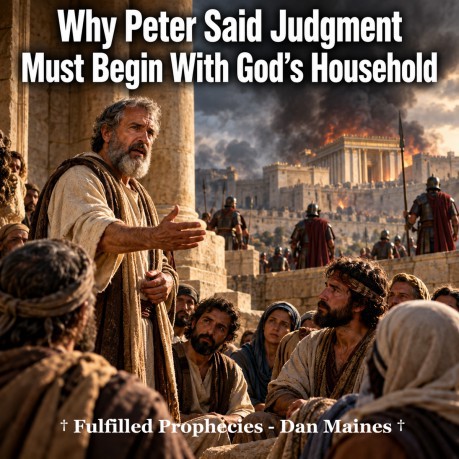
Why Peter Said Judgment Must
Begin With God's Household Introduction Peter Was Writing To First-Century Christians Peter Said God Was Ready To Judge The End Of All Things Was Near Judgment Must Begin With God's Household God's Judgment Had Previously Begun At His
Sanctuary The Fiery Trial Was Already Taking Place The Righteous And The Unbelieving Faced Different
Outcomes Jesus Identified The Generation Of Judgment Jerusalem's Desolation Was The Fulfillment Of
Prophecy James Also Declared That Judgment Was Near Christ's Sacrifice Came At The Consummation Of The
Ages The Spiritual Household Replaced The Temple System Historical References How It Applies To Us Today Q & A Appendix Q: Was Peter describing the destruction of the
physical earth? Q: Why did Peter say it was time for judgment? Q: Did judgment beginning with believers mean
Christians were condemned? Q: Why did Jesus identify Jerusalem as the place
of judgment? Q: Did the destruction of Jerusalem end God's
kingdom? Q: Is Peter's judgment still waiting to
happen? Q: Does Peter's teaching still apply to
Christians today? Q: Are we waiting for another Day of the Lord to
complete the Old Covenant judgment? † This is the fulfilled perspective we proclaim at
Fulfilled Prophecies † Source Index
By Dan Maines
† When Peter
wrote that judgment must begin with God's household, he wasn't
describing a judgment thousands of years in the future. He was
addressing Christians living during the final years of the Old
Covenant age, when Jerusalem and its temple were approaching their
appointed destruction (1 Peter 4:7, 17; Matthew 24:34).
†
Peter's warning belongs to the same first-century setting described
by Jesus, Paul, James, and the writer of Hebrews. They all spoke
about an approaching judgment, the suffering of God's people, and the
fulfillment of God's promises in Christ (Matthew 24:34; James 5:8-9;
Hebrews 9:26).
† The judgment Peter described
wasn't the destruction of planet Earth. It concerned the approaching
end of the Old Covenant order, the testing of God's people, and the
judgment of those who rejected the gospel (1 Peter 4:17; Hebrews
8:13).
† To understand Peter correctly, we
must examine whom he addressed, what judgment he expected, and why he
declared that the time had already arrived (1 Peter 1:1; 4:7, 17).
1 Peter
1:1
Peter, an apostle of Jesus Christ, To those who
reside as aliens, scattered throughout Pontus, Galatia, Cappadocia,
Asia, and Bithynia, who are chosen
† Peter
identified his original audience as believers scattered throughout
several Roman provinces in Asia Minor. His message was directed to
real Christians facing real circumstances during the first century (1
Peter 1:6-7).
† These believers were
experiencing persecution, rejection, and suffering because of their
faith in Jesus Christ. Peter encouraged them to remain faithful
because their trials weren't meaningless (1 Peter 4:12-13).
†
We can't remove Peter's warnings from their historical setting and
place their fulfillment thousands of years beyond the people who
originally received his letter (1 Peter 4:7, 17).
†
Peter wasn't writing to describe the end of the physical universe. He
was preparing his readers for the approaching judgment associated
with the conclusion of the Old Covenant age (Matthew 24:34; Hebrews
8:13).
1 Peter 4:5
but
they will give account to Him who is ready to judge the living and
the dead.
† Notice Peter's language. He
didn't say God would become ready thousands of years later. He said
God was already ready to judge (1 Peter 4:7).
†
The judgment was presented as an approaching reality for Peter's
generation, not an event postponed indefinitely into the future
(James 5:8-9).
† The living and the dead
describe the comprehensive authority of Jesus Christ as Judge. His
authority wasn't limited to those physically alive when Peter wrote
(Acts 10:42; Romans 14:9).
† Peter's
statement must be understood alongside the approaching judgment he
identified only two verses later. The immediate context establishes
the urgency of his warning (1 Peter 4:7, 17).
†
Christ had already received authority to judge, and the first-century
believers were living during the appointed period when the Old
Covenant age was reaching its conclusion (John 5:22; Hebrews 9:26).
1 Peter 4:7
The
end of all things is near; therefore, be of sound judgment and sober
spirit for the purpose of prayer.
† Peter's
words couldn't be clearer. The end was near when he wrote his letter.
He didn't tell his readers that the end would remain thousands of
years away (1 Peter 4:17).
† The expression
all things must be understood within the prophetic and covenantal
setting. The approaching end concerned the Old Covenant order, not
the destruction of the physical creation (Matthew 24:2, 34; Hebrews
8:13).
† Peter connected the approaching end
with immediate instructions to his readers. They were to exercise
sound judgment, remain sober in spirit, and devote themselves to
prayer because the appointed judgment was approaching (1 Peter
4:7).
† If Peter intended an event thousands
of years beyond his readers, his declaration that the end was near
would lose its natural meaning within the letter (James 5:8-9).
†
Jesus had already established the time limitation when He declared
that the generation listening to His prophetic warning wouldn't pass
away before everything He described took place (Matthew 24:34).
†
The end Peter anticipated was fulfilled in the first century,
culminating in the destruction of Jerusalem and its temple in AD 70
(Luke 21:20-22, 32).
1 Peter
4:17
For it is time for judgment to begin with the
household of God; and if it begins with us first, what will be the
outcome for those who do not obey the gospel of God?
†
Peter didn't say the time for judgment would arrive in some distant
generation. He declared that it was already time for judgment to
begin (1 Peter 4:7).
† Notice his words, with
us first. Peter included himself and the believers of his generation
in the approaching judgment and testing (1 Peter 4:12-13).
†
God's household included those who belonged to Christ. Peter had
already described believers as living stones being built into a
spiritual house (1 Peter 2:4-5).
† Judgment
beginning with God's household didn't mean faithful Christians were
condemned with unbelievers. It meant God's people were experiencing
testing and suffering before the judgment upon those who rejected the
gospel (1 Peter 4:12-19).
† The first-century
church was being tested through persecution, suffering, and
opposition as the Old Covenant age approached its conclusion (1 Peter
1:6-7; 4:12-13).
† Peter distinguished
between believers undergoing testing and those who refused to obey
the gospel. Their outcomes weren't the same (1 Peter 4:17-19).
†
The approaching judgment would vindicate Christ and His faithful
people while exposing the consequences of rejecting the gospel (2
Thessalonians 1:4-7).
† Peter's statement
fits the events leading to AD 70, when the Old Covenant temple system
was removed and the superiority of Christ's completed work was
historically demonstrated (Matthew 24:2; Hebrews 10:11-14).
Ezekiel 9:6
Utterly slay old men, young
men, maidens, little children, and women, but do not touch any man on
whom is the mark; and you shall start from My sanctuary. So they
started with the elders who were before the temple.
†
Ezekiel established an important Old Testament pattern. When God
judged Jerusalem for covenant unfaithfulness, judgment began at His
sanctuary (Ezekiel 9:1-7).
† Those who
possessed religious authority weren't automatically protected from
judgment. Their position increased their responsibility before God
(Ezekiel 8:6-18).
† Peter's warning reflects
this established principle. God's judgment begins with those who
claim to belong to Him, but the faithful and unfaithful don't receive
the same outcome (1 Peter 4:17-19).
†
Ezekiel's vision originally concerned judgment upon ancient
Jerusalem. Peter applied the principle of judgment beginning with
God's household to the circumstances facing the first-century church
(Ezekiel 9:6; 1 Peter 4:17).
† The connection
is significant because Jesus also announced judgment upon Jerusalem
and its temple during the generation that heard His warnings (Matthew
23:36-38; 24:2, 34).
1 Peter
4:12
Beloved, do not be surprised at the fiery ordeal
among you, which comes upon you for your testing, as though some
strange thing were happening to you;
† Peter
wasn't describing a trial that would begin thousands of years later.
He specifically identified the fiery ordeal as something already
occurring among his readers (1 Peter 4:13-16).
†
Their suffering was part of the testing that preceded the approaching
judgment. They were being persecuted because they belonged to Jesus
Christ (1 Peter 4:14-16).
† The fiery ordeal
wasn't necessarily literal fire. Peter used the language of testing
to describe the severe trials confronting believers (1 Peter
1:6-7).
† The purpose of this testing wasn't
to destroy faithful Christians but to demonstrate the genuineness of
their faith (1 Peter 1:7).
† The church's
suffering and Jerusalem's approaching judgment belonged to the same
first-century period, although Peter didn't identify every individual
trial with the Roman siege itself (Matthew 24:9-13; 1 Peter
4:12-17).
† Those who remained faithful to
Christ could trust God despite the persecution surrounding them (1
Peter 4:19).
1 Peter 4:18
AND IF IT IS WITH DIFFICULTY
THAT THE RIGHTEOUS IS SAVED, WHAT WILL BECOME OF THE GODLESS MAN AND
THE SINNER?
† Peter contrasted the difficult
circumstances experienced by righteous believers with the judgment
awaiting those who rejected God (1 Peter 4:17).
†
The difficulty didn't mean Christ's sacrifice was insufficient. It
described the suffering and testing believers experienced while
remaining faithful (1 Peter 1:6-9).
† Their
salvation rested upon Jesus Christ, not upon their ability to escape
every physical hardship (1 Peter 1:3-5).
†
Those who rejected the gospel faced a different outcome because they
refused the salvation offered through Christ (1 Peter 4:17; John
3:18).
† The distinction between the faithful
and unfaithful was especially important during the first-century
judgment upon Jerusalem (Luke 21:20-22).
†
Peter encouraged believers to remain faithful because their suffering
wasn't evidence that God had abandoned them (1 Peter 4:19).
Matthew
24:34
Truly I say to you, this generation will not pass
away until all these things take place.
†
Jesus established the time limitation for the judgment He described.
The generation hearing His words would witness the fulfillment of His
prophecy (Matthew 24:1-3).
† The disciples
had asked about the destruction of the temple, and Jesus explained
the events surrounding that approaching catastrophe (Matthew
24:2-3).
† The destruction of Jerusalem
wasn't an unrelated historical accident. Jesus had specifically
warned that the city and its temple would face judgment (Luke
19:41-44).
† Peter's announcement that the
end was near agrees with Jesus' declaration that these events would
occur within that generation (1 Peter 4:7; Matthew 24:34).
†
The first-century fulfillment doesn't require a second destruction of
Jerusalem or another future conclusion to the Old Covenant age
(Hebrews 8:13; 9:26).
† Jesus gave the
generation, Peter declared the nearness, and history records the
destruction of Jerusalem in AD 70 (Matthew 24:34; 1 Peter 4:7).
Luke 21:20-22
But when you see Jerusalem
surrounded by armies, then recognize that her desolation is
near.
Then those who are in Judea must flee to the mountains,
and those who are inside the city must leave, and those who are in
the country must not enter the city;
because these are days of
vengeance, so that all things which are written will be fulfilled.
†
Jesus identified Jerusalem as the city facing the approaching
judgment. He gave His disciples a recognizable sign, the city
surrounded by armies (Luke 21:20).
† The
warning was directed to people living in Judea who could recognize
the danger and flee. It wasn't an instruction for Christians living
thousands of years later (Luke 21:21).
†
Jesus called these events days of vengeance and connected them
directly with the fulfillment of what had been written (Luke
21:22).
† The Roman destruction of Jerusalem
in AD 70 fulfilled this historical warning and brought the
temple-centered Old Covenant order to its decisive end (Matthew 24:2;
Hebrews 8:13).
† Peter's declaration that
judgment had arrived belongs within this same first-century prophetic
setting (1 Peter 4:7, 17).
† The physical
earth didn't end when Jerusalem was destroyed. The judgment concerned
the covenantal order associated with the temple and the rejection of
Christ (Hebrews 9:26; 12:22-28).
James
5:8-9
You too be patient; strengthen your hearts, for
the coming of the Lord is near.
Do not complain, brethren,
against one another, so that you yourselves may not be judged;
behold, the Judge is standing right at the door.
†
James used the same language of nearness found in Peter's letter. The
coming of the Lord was near, and the Judge was already standing at
the door (1 Peter 4:7, 17).
† Both apostles
addressed believers experiencing difficult circumstances and
encouraged them to remain faithful because God's judgment was
approaching (James 5:7-11; 1 Peter 4:12-19).
†
James didn't describe a judgment thousands of years beyond his
readers. His words communicated urgency to the people receiving his
letter (James 5:8-9).
† The agreement between
James and Peter strengthens the first-century understanding of these
prophetic warnings (Matthew 24:34).
† Their
testimony belongs to the same period in which the Old Covenant order
was approaching its removal (Hebrews 8:13).
Hebrews 9:26
Otherwise, He would have needed
to suffer often since the foundation of the world; but now once at
the consummation of the ages He has been manifested to put away sin
by the sacrifice of Himself.
† The writer of
Hebrews placed Christ's sacrifice at the consummation of the ages.
This wasn't a reference to the physical destruction of the universe
(Hebrews 8:13).
† Jesus appeared during the
final period of the Old Covenant age to accomplish the redemption
promised through the Law and the Prophets (Matthew 5:17-18).
†
His sacrifice was complete before AD 70, but the temple and its
sacrificial system continued operating until Jerusalem's destruction
(Hebrews 10:11-14).
† The removal of the
temple demonstrated that the former covenantal system had reached its
appointed conclusion (Hebrews 8:13).
†
Peter's announcement of approaching judgment fits this transition
from the Old Covenant order to the fully established New Covenant
order (1 Peter 4:7, 17; Hebrews 12:22-28).
†
The end of the age wasn't the end of God's kingdom. It marked the
removal of the former covenantal order while Christ's kingdom
continued (Hebrews 12:28).
1
Peter 2:4-5
And coming to Him as to a living stone
which has been rejected by men, but is choice and precious in the
sight of God,
you also, as living stones, are being built up as
a spiritual house for a holy priesthood, to offer up spiritual
sacrifices acceptable to God through Jesus Christ.
†
Peter identified Christ as the living stone and believers as living
stones being built into a spiritual house (1 Peter 2:4-5).
†
God's dwelling place was no longer dependent upon the physical temple
in Jerusalem. Through Christ, believers were becoming God's spiritual
household (Ephesians 2:19-22).
† This
explains why the destruction of the Jerusalem temple didn't destroy
God's people or end His kingdom (Hebrews 12:22-28).
†
The Old Covenant priesthood and sacrifices had reached their
fulfillment in Jesus Christ, whose sacrifice was sufficient and final
(Hebrews 7:23-28; 10:11-14).
† The church
wasn't waiting for another physical temple to restore access to God.
Believers already possessed access to the Father through Jesus Christ
(Ephesians 2:18).
† God's spiritual household
continues because its foundation is Christ, not a building made with
human hands (1 Corinthians 3:11; Ephesians 2:20-22).
† Flavius Josephus,
a first-century Jewish historian, described the Jewish revolt, the
Roman siege of Jerusalem, the destruction of the temple, and the
terrible suffering experienced during AD 70 in The Jewish War, Books
5-6.
† Josephus recorded famine, internal
violence, and widespread destruction during the siege. His account
provides historical evidence for the catastrophe Jesus had announced
concerning Jerusalem (Luke 21:20-24).
†
Tacitus, the Roman historian, also described the Jewish revolt and
the siege of Jerusalem in Histories, Book 5. His account
independently confirms the Roman military setting of the conflict.
†
Eusebius, writing in the fourth century, reported that members of the
Jerusalem church had relocated to Pella before the city's
destruction. His account appears in Ecclesiastical History, Book 3,
Chapter 5.
† Eusebius' report is later
historical testimony rather than a contemporary eyewitness record,
but it supports the early Christian tradition that believers escaped
Jerusalem before its destruction (Luke 21:20-21).
†
These historical writers document the first-century catastrophe and
early Christian understanding of it. The identification of Peter's
judgment with the events culminating in AD 70 rests upon the
prophetic connections within Scripture (1 Peter 4:7, 17; Matthew
24:34).
† Peter's
warning had its original prophetic setting in the first century, but
its teaching about faithfulness, suffering, and obedience remains
valuable for Christians today (1 Peter 4:12-19).
†
We aren't waiting for the Old Covenant age to end. That covenantal
transition reached its conclusion in the first century, and we now
live under the completed work of Jesus Christ (Hebrews 8:13;
10:11-14).
† We don't need to fear another
prophetic destruction of Jerusalem or a future judgment that will
bring the Old Covenant system to an end again (Matthew 24:34; Luke
21:20-22).
† Christians can still experience
suffering, persecution, and difficult circumstances, but those
experiences don't mean Peter's first-century judgment remains
unfulfilled (1 Peter 4:12-19).
† God still
calls His people to holiness, obedience, prayer, and faithfulness.
These responsibilities remain important even though the specific
judgment Peter announced has passed (1 Peter 1:15-16; 4:7).
†
Our confidence rests in Christ's completed sacrifice and His
established kingdom, not in the expectation of another covenantal
age-ending event (Hebrews 9:26; 12:28).
† We
belong to God's spiritual household, and we have direct access to the
Father through Jesus Christ (Ephesians 2:18-22).
†
The kingdom isn't waiting to arrive. Christ reigns now, and believers
already belong to the heavenly Jerusalem (Hebrews 12:22-28).
†
That's why we proclaim fulfillment rather than postponement. God's
promises were fulfilled in Christ, and His kingdom continues without
end (Luke 21:22; Hebrews 12:28).
Q: What did Peter mean
when he said judgment must begin with God's household?
A:
He was describing the testing and suffering already confronting
first-century believers as the appointed judgment approached. God's
people experienced testing before judgment fell upon those who
rejected the gospel (1 Peter 4:12-19).
A: No. Within the fulfilled
perspective, Peter's warning concerned the approaching conclusion of
the Old Covenant age, culminating in Jerusalem's destruction in AD 70
(1 Peter 4:7, 17; Matthew 24:34; Hebrews 8:13).
A:
Because the appointed judgment was approaching during his generation.
He described God as ready to judge and declared that the end was near
(1 Peter 4:5, 7, 17).
A: No. Peter
distinguished the testing of faithful believers from the outcome
awaiting those who rejected the gospel (1 Peter 4:12-19).
A: Jerusalem had rejected God's
messengers and the Messiah. Jesus announced that the city and its
temple would face judgment within that generation (Matthew 23:34-38;
24:2, 34).
A: No. The Old Covenant temple system
ended, but Christ's kingdom is unshakable and continues forever
(Hebrews 8:13; 12:22-28).
A: No. The fulfilled perspective
understands Peter's approaching judgment as belonging to the
first-century events culminating in AD 70 (1 Peter 4:7, 17; Luke
21:20-22).
A: Yes. His instruction
concerning faithfulness, holiness, prayer, and trusting God during
suffering remains valuable, even though the specific prophetic
judgment has been fulfilled (1 Peter 1:15-16; 4:7, 19).
A: No.
Jesus placed the judgment upon Jerusalem within His own generation,
and the Old Covenant age reached its appointed conclusion in the
first century (Matthew 24:34; Luke 21:20-22; Hebrews 8:13).
© Fulfilled Prophecies - Dan
Maines.
† 1 Peter
1:1; 1 Peter 4:5, 7, 12, 17-18; Ezekiel 9:6; Matthew 24:34; Luke
21:20-22; James 5:8-9; Hebrews 9:26; 1 Peter 2:4-5
†
Flavius Josephus, The Jewish War, Books 5-6; Tacitus, Histories, Book
5; Eusebius, Ecclesiastical History, Book 3, Chapter 5
Links