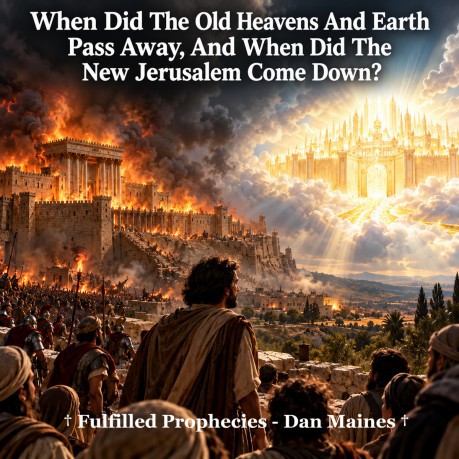
When Did The Old Heavens And
Earth Pass Away, And When Did The New Jerusalem Come Down? Introduction The Old Heavens And Earth Were A Covenant World Isaiah 51:16 The Old Covenant Was Already Disappearing Jesus Identified The Generation Of Fulfillment Revelation Was About Events That Were Near When Did The First Heaven And Earth Pass Away? The New Jerusalem Was Already A Heavenly Reality Hebrews 12:22 When Did The New Jerusalem Come Down? Who Is The Bride Of The Lamb? What Do The Streets Of Gold Represent? God Now Dwells Among His People Why Are Nations Still Present Outside The City? The Tree Of Life And The Healing Of The Nations The Prophecy Was Not Sealed For The Distant
Future Historical References How It Applies To Us Today Q & A Appendix † This is the fulfilled perspective we proclaim at
Fulfilled Prophecies † Source Index
By Dan Maines
† One of the
most misunderstood prophecies in Scripture concerns the passing away
of the old heavens and earth and the arrival of the New Jerusalem.
Many Christians believe these events will happen at the end of the
physical universe, when God destroys the planet and replaces it with
a literal golden city.
† But Revelation
wasn't describing the destruction of the physical universe. It was
describing the final removal of the Old Covenant order and the full
establishment of the New Covenant through Jesus Christ (Hebrews 8:13;
Revelation 21:1-3).
† The question is simple.
Exactly when did the old heavens and earth pass away? When did the
New Jerusalem descend from heaven? And if the city has streets of
gold, why aren't we walking on them today?
†
The fulfilled perspective identifies AD 70, when Jerusalem and its
temple were destroyed by the Romans, as the historical completion of
this covenantal transition. The physical earth didn't disappear, but
the religious world centered on the temple, sacrifices, and Levitical
priesthood came to its final end (Matthew 24:1-3; Hebrews 9:8-10).
†
The New Jerusalem isn't a future construction project. It's the
heavenly city of God's redeemed people, the bride of Christ, already
identified in Scripture before Jerusalem's destruction (Galatians
4:26; Hebrews 12:22-23).
Isaiah
65:17
For behold, I create new heavens and a new earth;
And the former things will not be remembered or come to mind.
†
Isaiah introduced the promise of a new heavens and earth centuries
before Revelation was written. His prophecy anticipated a new order
established through God's redemptive work (Isaiah 65:18-19; Isaiah
66:22).
† The expression heavens and earth
can describe an established order under God's authority. Isaiah's
prophecy must be understood alongside the covenant promises that
would be fulfilled through Christ (Isaiah 51:15-16; Jeremiah
31:31-34).
† The new creation promised by
Isaiah wasn't dependent upon the destruction of the physical planet.
It anticipated the establishment of righteousness and a restored
relationship between God and His people (Isaiah 65:17-25; 2 Peter
3:13).
I have put My words in your
mouth and have covered you with the shadow of My hand, to establish
the heavens, to found the earth, and to say to Zion, 'You are My
people.'
† Notice the connection between
establishing the heavens and earth and God's declaration that Zion
belonged to Him. The language is connected with His covenant
relationship with His people (Isaiah 51:15-16).
†
God wasn't describing another physical creation of the universe
during Isaiah's lifetime. He was describing His work of establishing
and preserving His covenant people (Isaiah 51:15-16; Exodus
19:5-6).
† This provides an important
biblical foundation for understanding how heavens and earth can carry
covenantal meaning in prophetic language (Isaiah 65:17; Hebrews
12:26-28).
Hebrews
8:13
When He said, A new covenant, He has made the
first obsolete. But whatever is becoming obsolete and growing old is
ready to disappear.
† Hebrews was written
while the Old Covenant system was approaching its historical
disappearance. The writer declared that the first covenant had
already become obsolete (Hebrews 8:6-13).
†
Notice the distinction. The Old Covenant had already been made
obsolete through Christ, but its visible institutions were still
approaching their final removal (Hebrews 9:8-10; Hebrews 10:9).
†
Jesus established the New Covenant through His death and
resurrection. The destruction of Jerusalem in AD 70 brought the
temple-centered system to its historical conclusion (Luke 22:20;
Hebrews 10:11-18).
† The passing away of the
old heavens and earth wasn't the disappearance of mountains, oceans,
and stars. It represented the end of the covenantal order that had
governed Israel under Moses (Hebrews 8:13; Hebrews 12:26-28).
Matthew
24:34
Truly I say to you, this generation will not pass
away until all these things take place.
†
Jesus wasn't speaking about a generation thousands of years in the
future. He was addressing His own disciples concerning the
destruction of the temple standing before them (Matthew 24:1-3).
†
The expression this generation identifies the generation living when
Jesus spoke. His prophecy included the approaching judgment upon
Jerusalem (Matthew 23:36-38; Luke 21:20-22).
†
The Roman destruction of Jerusalem in AD 70 occurred within that
first-century generation. This provides the historical setting for
understanding the fulfillment of the covenantal judgment Jesus
announced (Matthew 24:34; Luke 21:32).
† The
same generation that witnessed the ministry of Christ also witnessed
the final destruction of the Old Covenant temple system (Matthew
23:36; Matthew 24:2).
Revelation
1:1
The Revelation of Jesus Christ, which God gave Him
to show to His bond-servants, the things which must soon take place;
and He sent and communicated it by His angel to His bond-servant
John,
† Revelation begins with an explicit
statement concerning timing. The events described were to take place
soon, not thousands of years after John's original audience
(Revelation 1:3; Revelation 22:6).
† The
fulfilled perspective understands Revelation as a prophecy written
before AD 70, concerning the approaching judgment upon Jerusalem and
the completed establishment of Christ's kingdom (Matthew 24:34;
Revelation 11:1-2).
† This interpretation
connects Revelation's time statements with Jesus' earlier warnings
concerning Jerusalem's destruction (Luke 21:20-22; Revelation
22:10).
† Revelation's closing instructions
reinforce its opening announcement. John wasn't told to seal the
prophecy for a distant generation because its fulfillment was near
(Revelation 22:6-10).
Revelation
21:1
Then I saw a new heaven and a new earth; for the
first heaven and the first earth passed away, and there is no longer
any sea.
† John described the passing of the
first heavens and earth as part of his prophetic vision. The
fulfilled perspective understands this as the completed removal of
the Old Covenant order (Isaiah 65:17; Hebrews 8:13).
†
The decisive historical event was the destruction of Jerusalem and
its temple in AD 70. That judgment ended the temple sacrifices, the
functioning Levitical priesthood, and the physical center of the
Mosaic system (Matthew 24:1-2; Hebrews 9:8-10).
†
The expression no longer any sea belongs to the vision's symbolic
language. It doesn't require the literal disappearance of the world's
oceans (Isaiah 57:20; Revelation 17:15).
†
Scripture doesn't provide a particular day or hour in AD 70 when the
covenantal heavens and earth disappeared. It identifies the
first-century generation and the approaching destruction of Jerusalem
as the period of fulfillment (Matthew 24:34; Luke 21:20-24).
†
The destruction of the temple in AD 70 marked the historical
completion of that transition. The physical universe remained because
the prophecy concerned the passing of the former covenantal order
(Hebrews 8:13; Hebrews 12:26-28).
Galatians
4:26
But the Jerusalem above is free; she is our
mother.
† Paul didn't describe the Jerusalem
above as something that would begin existing thousands of years
later. He identified it as the mother of believers while the earthly
Jerusalem still stood (Galatians 4:21-31).
†
Paul contrasted two women, two covenants, and two Jerusalems. Hagar
represented the covenant associated with Mount Sinai and the
Jerusalem of Paul's day. Sarah represented freedom and the Jerusalem
above (Galatians 4:24-26).
† The New
Jerusalem wasn't waiting to be constructed. It already existed as the
heavenly reality associated with God's New Covenant people (Galatians
4:26; Hebrews 12:22-23).
† AD 70 didn't
create the heavenly Jerusalem. It completed the removal of the
earthly covenantal system that stood in contrast to it (Galatians
4:25-31; Hebrews 8:13).
But you have come to Mount
Zion and to the city of the living God, the heavenly Jerusalem, and
to myriads of angels,
† Notice the words you
have come. The writer didn't say believers would someday come to the
heavenly Jerusalem after the physical universe was destroyed (Hebrews
12:22-24).
† Christians were already
approaching God through the New Covenant established by Jesus Christ.
They had entered a spiritual relationship with the heavenly Jerusalem
(Hebrews 10:19-22; Hebrews 12:22-24).
† The
city was heavenly in origin and covenantal in identity. Its existence
wasn't dependent upon physical streets, buildings, or geographical
boundaries (Galatians 4:26; Hebrews 11:16).
†
This distinction is essential. The heavenly Jerusalem was already
accessible through Christ, while the historical judgment of AD 70
completed the removal of the former covenantal order (Hebrews 8:13;
Hebrews 12:26-28).
Revelation
21:2
And I saw the holy city, new Jerusalem, coming
down out of heaven from God, made ready as a bride adorned for her
husband.
† John saw the New Jerusalem
descending from heaven. The vision identifies its divine origin, not
the physical relocation of a gigantic city onto the earth (Galatians
4:26; Hebrews 12:22).
† The city was prepared
as a bride. This immediately connects the New Jerusalem with Christ's
redeemed people rather than a literal collection of buildings
(Ephesians 5:25-27; Revelation 21:9-10).
†
The fulfilled perspective places the consummation of this prophetic
vision in AD 70, when the Old Covenant order was finally removed and
the New Covenant stood without its former earthly rival (Hebrews
8:13; Revelation 21:1-2).
† The descent of
the city represents the public establishment and completed covenantal
reality of God's dwelling with His people. It doesn't mean a golden
city physically landed somewhere in Israel (John 14:23; Revelation
21:3).
Revelation 21:9
Then
one of the seven angels who had the seven bowls full of the seven
last plagues came and spoke with me, saying, Come here, I will show
you the bride, the wife of the Lamb.
† The
angel promised to show John the bride, the wife of the Lamb. What
John saw next was the holy city, Jerusalem, coming down from heaven
(Revelation 21:9-10).
† The identification is
direct. The bride and the New Jerusalem belong to the same prophetic
vision. The city represents the redeemed people joined to Christ
(Ephesians 5:25-32; Revelation 19:7-8).
† A
literal city made of precious metals cannot be married to Jesus
Christ. Scripture identifies His people as those united to Him in
covenant fellowship (2 Corinthians 11:2; Ephesians 5:31-32).
†
The New Jerusalem is therefore understood as the glorified covenantal
identity of God's people, not a future physical metropolis descending
through the atmosphere (Hebrews 12:22-23; Revelation 21:9-10).
Revelation
21:21
And the twelve gates were twelve pearls; each one
of the gates was a single pearl. And the street of the city was pure
gold, like transparent glass.
† John
described the city's street as pure gold resembling transparent
glass. The imagery communicates extraordinary purity, glory, and
holiness (Revelation 21:18-21).
† Ordinary
gold isn't transparent. John's description uses extraordinary imagery
to communicate the perfection of God's heavenly city rather than
ordinary construction materials (Revelation 21:11; Revelation
21:21).
† Gold was associated with holiness
and God's presence in the tabernacle and temple. The New Jerusalem
imagery communicates the glory of a people dwelling in fellowship
with God (Exodus 25:10-11; 1 Peter 2:5).
†
We're not supposed to search for literal golden pavement. The vision
communicates the spiritual beauty and purity of the New Covenant
relationship established through Christ (Ephesians 5:25-27;
Revelation 21:27).
† The streets of gold
don't prove that Christians are physically living in heaven. They
illustrate the glory of the heavenly Jerusalem to which believers
have already come through Christ (Hebrews 12:22-24).
Revelation 21:3
And
I heard a loud voice from the throne, saying, Behold, the tabernacle
of God is among men, and He will dwell among them, and they shall be
His people, and God Himself will be among them,
†
The central promise of the New Jerusalem is God's dwelling with His
people. This fulfills the covenant relationship promised throughout
Scripture (Leviticus 26:11-12; Ezekiel 37:26-27).
†
Under the Old Covenant, God's presence was associated with the
tabernacle and temple. Under the New Covenant, believers themselves
constitute His spiritual dwelling place (1 Corinthians 3:16;
Ephesians 2:19-22).
† God's presence isn't
restricted to a physical building in Jerusalem. Through Jesus Christ,
His people have direct access to the Father (John 4:21-24; Ephesians
2:18).
† The New Jerusalem represents the
fulfillment of God's covenant promise to dwell among His redeemed
people (Hebrews 8:10; Revelation 21:3).
Revelation
21:24
The nations will walk by its light, and the kings
of the earth will bring their glory into it.
†
John's vision continues to describe nations walking by the light of
the New Jerusalem. This language fits the ongoing proclamation of
Christ's kingdom among the nations (Isaiah 60:3; Matthew 28:18-20).
†
The city provides light because Christ is its source of glory. Those
who belong to Him participate in that light and bear witness to His
righteousness (John 8:12; Revelation 21:23).
†
The presence of nations shows that the vision isn't simply describing
the destruction of the physical world. It portrays God's kingdom and
its relationship to the nations (Isaiah 60:1-3; Revelation 22:2).
†
The New Covenant continues to welcome those who turn to Jesus Christ.
Its blessings aren't limited to one nation, geographical location, or
ethnic ancestry (Galatians 3:26-29; Revelation 22:17).
Revelation
22:2
in the middle of its street. On either side of the
river was the tree of life, bearing twelve kinds of fruit, yielding
its fruit every month; and the leaves of the tree were for the
healing of the nations.
† The tree of life
connects the New Jerusalem with the garden of Eden. What was once
guarded from fallen humanity is now presented as accessible within
God's redeemed community (Genesis 3:22-24; Revelation 22:14).
†
The healing of the nations represents the blessings of redemption
flowing through Christ. The New Covenant extends God's saving grace
beyond the boundaries of ancient Israel (Isaiah 49:6; Revelation
22:17).
† The continuing fruitfulness of the
tree communicates life, provision, and the enduring blessings of
God's kingdom (Ezekiel 47:12; John 15:4-5).
†
The vision doesn't require literal leaves possessing medicinal
properties. It communicates the restoration and life available
through Jesus Christ (John 10:10; Revelation 22:1-2).
Revelation 22:10
And he said to me, "Do
not seal up the words of the prophecy of this book, for the time is
near.
† John was specifically instructed not
to seal the prophecy because its appointed time was near. This
statement directly addresses the timing of Revelation's fulfillment
(Revelation 1:1-3; Revelation 22:6-7).
†
Daniel had previously been instructed to seal his prophetic vision
because its fulfillment concerned a later appointed time. John
received the opposite instruction (Daniel 12:4; Revelation 22:10).
†
The fulfilled perspective takes these time statements seriously. The
New Jerusalem prophecy belongs to the first-century completion of the
covenantal transition, not an event awaiting fulfillment thousands of
years later (Matthew 24:34; Revelation 22:10).
†
The prophecy's fulfillment in AD 70 doesn't mean God's kingdom ended.
It means the promised New Covenant order was fully established and
continues throughout succeeding generations (Daniel 7:14; Ephesians
3:21).
†
Flavius Josephus, a first-century Jewish historian, described the
Roman siege of Jerusalem, the burning of the temple, and the terrible
destruction that occurred in AD 70. His account in The Jewish War,
Books 5-6, provides historical evidence for the judgment Jesus
predicted (Matthew 24:1-2; Luke 21:20-24).
†
Josephus recorded that the temple was burned during the Roman siege.
The destruction permanently interrupted the temple sacrifices and
brought the functioning temple-centered religious system to an end
(Hebrews 8:13; Hebrews 10:11-18).
† Tacitus,
the Roman historian, described the Jewish revolt and Jerusalem's
destruction in Histories, Book 5. His account independently confirms
the historical setting of the Roman war against Jerusalem (Luke
21:20-24).
† Eusebius, writing in the fourth
century, connected the destruction of Jerusalem with Jesus' warnings
and preserved the tradition that Christians fled Jerusalem before its
destruction. His Ecclesiastical History, Book 3, chapters 5-7,
reflects the early Christian understanding of Jerusalem's judgment
(Matthew 24:15-16; Luke 21:20-22).
† These
historians confirm the destruction of Jerusalem and its temple. They
don't independently establish every symbolic interpretation of
Revelation, but they document the historical event that the fulfilled
perspective identifies as the completion of the Old Covenant age
(Matthew 24:34; Hebrews 8:13).
†
We're not waiting for the physical universe to disappear before we
can enjoy fellowship with God. Through Jesus Christ, believers
already have access to the Father and belong to His heavenly city
(Ephesians 2:18-22; Hebrews 12:22-24).
†
We're not waiting for a future golden city to descend from the sky.
The New Jerusalem represents the redeemed people of God living under
the completed New Covenant (Galatians 4:26; Revelation 21:9-10).
†
We don't need another physical temple, another Levitical priesthood,
or another system of animal sacrifices. Jesus Christ completed the
work necessary for our redemption (Hebrews 9:11-12; Hebrews
10:12-18).
† The passing of the old heavens
and earth doesn't mean the physical earth was destroyed. God's
covenantal order changed, and believers now live under the
righteousness and freedom established through Christ (Romans 8:1-2;
Galatians 5:1).
† The heavenly Jerusalem
isn't the same thing as claiming that every believer has already
entered the eternal spiritual realm after physical death. Christians
live on the physical earth while belonging to the heavenly city, and
when we depart this life, we're present with the Lord (2 Corinthians
5:6-8; Philippians 1:23).
† The completed New
Covenant gives us confidence that Christ's promises weren't delayed
or forgotten. His kingdom is established, His people are His dwelling
place, and His righteousness continues throughout all generations
(Hebrews 12:28; Ephesians 3:21).
Q:
Exactly when did the old heavens and earth pass away?
A:
The fulfilled perspective identifies AD 70, when the Romans destroyed
Jerusalem and its temple, as the historical completion of the Old
Covenant order. Scripture identifies the first-century generation but
doesn't specify an exact calendar day for the covenantal transition
(Matthew 24:34; Hebrews 8:13; Revelation 21:1).
Q:
Didn't the Old Covenant end when Jesus died on the cross?
A:
Jesus established the New Covenant through His death and
resurrection. The Old Covenant became obsolete through His completed
sacrifice, but its temple-centered institutions continued until
Jerusalem's destruction in AD 70 (Luke 22:20; Hebrews 8:13; Hebrews
10:9-18).
Q: When did the New Jerusalem come
down from heaven?
A: The heavenly Jerusalem
already existed when Paul and the writer of Hebrews addressed the
churches. The fulfilled perspective identifies AD 70 as the
consummation of Revelation's vision, when the Old Covenant system was
finally removed (Galatians 4:26; Hebrews 12:22; Revelation 21:2).
Q:
Does the Bible actually say the New Jerusalem is the bride of
Christ?
A: Yes. Revelation 21:9 identifies the
bride as the wife of the Lamb, and Revelation 21:10 shows John the
holy city, Jerusalem, descending from heaven. The vision identifies
the city with Christ's redeemed people (Ephesians 5:25-32).
Q:
If we're living in the New Jerusalem, where are the streets of
gold?
A: The streets of gold are part of the
city's symbolic description. They represent its purity, glory, and
holiness. The heavenly city isn't presented as an ordinary earthly
construction project (Revelation 21:18-21; Hebrews 12:22-24).
Q:
Does the New Jerusalem mean we're already living in eternal
heaven?
A: No. Believers belong to the heavenly
Jerusalem through Christ while continuing to live physically on
earth. After physical death, believers are present with the Lord in
the spiritual realm (Hebrews 12:22-23; 2 Corinthians 5:6-8;
Philippians 1:23).
Q: Why does Revelation say
there will be no more death if people still physically die?
A:
The fulfilled perspective understands Revelation 21:4 in connection
with Christ's victory over covenantal death and separation from God.
Physical death continues, but it no longer separates believers from
Christ or prevents their entrance into His presence (Romans 8:38-39;
1 Corinthians 15:54-57; Revelation 14:13).
Q:
Why does Revelation describe nations needing healing if the New
Jerusalem has already arrived?
A: The healing
of the nations represents the continuing blessings of redemption
through Jesus Christ. People from every nation can still receive the
life offered through the New Covenant (Revelation 22:2; Revelation
22:17; Galatians 3:28-29).
Q: Will God someday
destroy the physical earth and replace it with another planet?
A:
The fulfilled perspective doesn't interpret Revelation 21:1 as
predicting the destruction of the physical planet. Scripture
describes the earth as enduring through successive generations, while
the heavens and earth of the former covenantal order passed away
(Psalm 104:5; Ecclesiastes 1:4; Hebrews 8:13).
Q:
Was AD 70 the final fulfillment of biblical prophecy?
A:
Yes, according to the fulfilled perspective. Jesus placed the
judgment upon Jerusalem within His own generation, and Revelation
described its events as near. The completed kingdom continues, but no
additional prophetic fulfillment concerning Christ's return or the
end of the Old Covenant age remains outstanding (Matthew 24:34; Luke
21:22; Revelation 22:6-10).
Q: What is the most
important lesson of the New Jerusalem?
A: God's
people no longer approach Him through the Old Covenant temple and its
sacrifices. Through Jesus Christ, we've been brought into fellowship
with the Father, and we belong to His heavenly city now (Hebrews
10:19-22; Hebrews 12:22-24; Ephesians 2:18-22).
© Fulfilled Prophecies - Dan
Maines.
† Isaiah
65:17; Isaiah 51:16; Hebrews 8:13; Matthew 24:34; Revelation 1:1;
Revelation 21:1-3, 9, 21, 24; Revelation 22:2, 10; Galatians 4:26;
Hebrews 12:22
† Flavius Josephus, The Jewish
War, Books 5-6; Tacitus, Histories, Book 5; Eusebius, Ecclesiastical
History, Book 3, chapters 5-7
Links