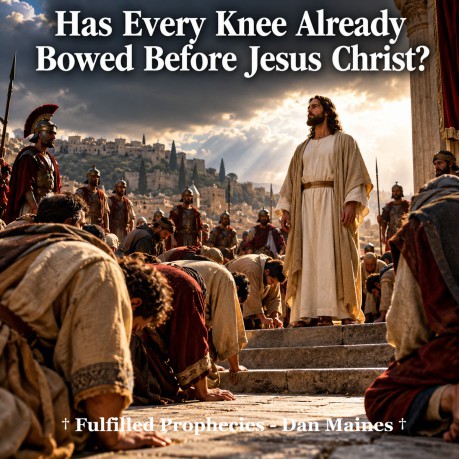
Has Every Knee Already Bowed
Before Jesus Christ? Introduction Philippians 2:8-11 Isaiah 45:22-23 Matthew 28:18 Acts 2:36 Ephesians 1:20-22 Hebrews 2:8 Colossians 1:13 1 Peter 3:22 Romans 14:11 Revelation 1:5 Historical References How It Applies To Us Today Q & A Appendix Q: If every knee has bowed, why do billions of
people still reject Jesus? Q: Does Philippians 2:10-11 predict a future
second coming? Q: Does every tongue confessing mean everyone
will eventually be saved? Q: What does under the earth mean? Q: Didn't Jesus receive His authority at His
resurrection rather than in AD 70? Q: Doesn't Romans 14:11 prove every person must
eventually bow before Christ? Q: If Jesus is already Lord, why does Scripture
speak of His enemies being placed under His feet? Q: Is Philippians 2:10-11 an eschatological
passage? Q: What is the greatest mistake people make when
interpreting these verses? Q: What should believers understand from
Philippians 2:10-11 today? † This is the fulfilled perspective we proclaim at
Fulfilled Prophecies † Source Index
By Dan Maines
†
Philippians 2:10-11 is frequently used to argue that Christ's victory
and the fulfillment of biblical prophecy must still be future. The
argument sounds convincing at first. If every knee must bow and every
tongue must confess that Jesus Christ is Lord, why do billions of
people still reject Him? Why do unbelievers continue to exist? Why
hasn't the entire world visibly acknowledged His authority?
†
Many Christians believe these verses describe a future event when
every human being who has ever lived will physically kneel before
Jesus and verbally confess His lordship. Some connect this event to a
future resurrection, final judgment, or second coming. They argue
that because everyone hasn't visibly bowed before Christ, the
prophecy cannot have been fulfilled.
†
However, this interpretation overlooks Paul's actual subject, the Old
Testament passage he's quoting, and the distinction between
possessing universal authority and receiving voluntary acknowledgment
from every individual.
† Paul wasn't
introducing a new prophecy about the end of the physical world. He
was explaining the exaltation of Jesus Christ following His
humiliation, obedience, and death. The central question isn't whether
every person has physically knelt before Jesus. The question is
whether God has already established Jesus as Lord over heaven, earth,
and everything beneath the earth.
† Scripture
answers that question repeatedly. Jesus received all authority
following His resurrection. The apostles proclaimed Him Lord. The
Father placed everything under His feet. His kingdom was already
established, and believers were already being transferred into it
(Matthew 28:18; Acts 2:36; Ephesians 1:20-22; Colossians 1:13).
†
To understand Philippians 2:10-11 correctly, we must begin with
Paul's context rather than assuming the passage describes an event
that must still happen in our future.
Being found in appearance
as a man, He humbled Himself by becoming obedient to the point of
death, even death on a cross.
For this reason also, God highly
exalted Him, and bestowed on Him the name which is above every
name,
so that at the name of Jesus EVERY KNEE WILL BOW, of those
who are in heaven and on earth and under the earth,
and that
every tongue will confess that Jesus Christ is Lord, to the glory of
God the Father.
† Notice Paul's explanation.
Because Jesus humbled Himself and became obedient to death, God
highly exalted Him. The exaltation was God's response to Christ's
completed sacrifice, not something postponed until the end of human
history (Hebrews 10:12; Acts 2:32-36).
† Paul
connects every knee bowing and every tongue confessing directly to
the authority God bestowed upon His Son. The language describes the
universal scope of Christ's lordship, not necessarily a future
gathering where every person physically kneels at the same moment
(Ephesians 1:20-22; Colossians 2:10).
† The
expression every knee will bow communicates universal submission to
divine authority. That authority doesn't depend upon whether every
individual willingly acknowledges it. A king doesn't stop being king
because some of his subjects refuse to recognize him (Psalm 2:1-6;
Daniel 7:13-14).
† The three realms, heaven,
earth, and under the earth, emphasize that no realm exists outside
Christ's supremacy. Paul wasn't describing three separate locations
where people must assemble for a future ceremony. He was declaring
the comprehensive reach of the authority given to Jesus (Ephesians
1:20-22; 1 Peter 3:22).
† The important
distinction is between the establishment of Christ's authority and
the acknowledgment of that authority. Scripture teaches that His
authority was already established, even while people continued to
resist Him (Matthew 28:18; Hebrews 2:8).
Turn to Me and be saved, all
the ends of the earth; For I am God, and there is no other.
I
have sworn by Myself, The word has gone forth from My mouth in
righteousness And will not turn back, That to Me every knee will bow,
every tongue will swear allegiance.
† Paul
wasn't inventing the language of every knee bowing. He was drawing
directly from Isaiah's declaration of God's universal sovereignty.
Isaiah wasn't describing the end of the physical universe. He was
declaring that the Lord alone is God and that His authority extends
over all nations (Isaiah 45:18-22).
† Notice
that Isaiah connects the declaration with salvation. God calls the
ends of the earth to turn to Him because He alone possesses divine
authority. The emphasis is upon God's supremacy over every competing
claim to worship and allegiance (Isaiah 45:20-25).
†
When Paul applies Isaiah's language to Jesus, he's identifying Christ
with the divine authority proclaimed in Isaiah. The authority
belonging to the Lord is now openly declared through the exalted Son
(John 5:22-23; Philippians 2:9-11).
†
Isaiah's words are not proof that every human being must become a
believer. The passage establishes that every creature stands under
God's authority, whether that authority is willingly acknowledged or
resisted (Psalm 2:10-12; Romans 14:11).
†
That's why the continued existence of unbelief doesn't prove that
Christ hasn't received universal authority. God's sovereignty was
real in Isaiah's day even though countless nations worshiped idols.
Christ's sovereignty is equally real despite continuing human
rebellion (Daniel 4:34-35; Matthew 28:18).
And Jesus came up and spoke to
them, saying, All authority has been given to Me in heaven and on
earth.
† Jesus didn't say that all authority
would eventually be given to Him thousands of years later. He
declared that it had already been given. His statement followed His
resurrection and preceded His ascension (Matthew 28:1-18; Acts
1:9).
† The word all leaves no authority
outside His rightful supremacy. Jesus didn't receive partial
authority while waiting for a future generation to complete His
enthronement (Ephesians 1:20-22; Colossians 2:10).
†
If every knee bowing in Philippians requires universal authority,
Jesus had already received the authority necessary for that
declaration to be true. The existence of unbelievers doesn't overturn
His own statement (John 17:2; 1 Peter 3:22).
†
This is a serious problem for the argument that Philippians 2 remains
unfulfilled simply because people still reject Jesus. That argument
confuses voluntary obedience with established lordship (Psalm
110:1-2; Hebrews 2:8).
Therefore let all the house of
Israel know for certain that God has made Him both Lord and
Christ--this Jesus whom you crucified.
†
Peter proclaimed this on Pentecost, decades before Jerusalem's
destruction in AD 70. He didn't tell Israel that Jesus would someday
become Lord. He announced that God had already made Him both Lord and
Christ (Acts 2:32-35).
† The same generation
that crucified Jesus was being confronted with the authority of the
One they had rejected. Their refusal to acknowledge Him didn't
prevent His exaltation (Acts 2:22-24; Acts 4:10-12).
†
Peter's proclamation establishes the historical foundation for Paul's
statement in Philippians. Jesus was already Lord, and the apostles
were announcing that reality throughout the first-century world
(Romans 10:9-13; 1 Corinthians 12:3).
†
Jerusalem's judgment in AD 70 publicly vindicated Christ's prophetic
warnings and demonstrated His authority over the covenant nation that
rejected Him. However, His exaltation didn't begin in AD 70. It had
already occurred following His resurrection and ascension (Matthew
24:30-34; Acts 2:32-36).
which He brought about in
Christ, when He raised Him from the dead and seated Him at His right
hand in the heavenly places,
far above all rule and authority
and power and dominion, and every name that is named, not only in
this age but also in the one to come.
And He put all things in
subjection under His feet, and gave Him as head over all things to
the church,
† Paul explicitly identifies when
Christ received His exalted position. God raised Him from the dead
and seated Him at His right hand. His authority wasn't awaiting the
end of the physical universe (Acts 2:32-35; Hebrews 1:3).
†
Notice the language. Christ was already seated far above every rule,
authority, power, and dominion. Paul didn't describe a throne that
Jesus would occupy only after every unbeliever physically bowed
before Him (Colossians 2:10; 1 Peter 3:22).
†
Paul also says God put all things under Christ's feet. This is the
same universal authority expressed in Philippians 2. The difference
is that Ephesians directly identifies the exaltation as an
accomplished reality (Philippians 2:9-11; Hebrews 2:8).
†
If all things were already placed under His feet, then universal
subjection cannot require every individual to demonstrate willing
obedience before Christ possesses that authority (Psalm 110:1-2; 1
Corinthians 15:25).
† Christ's reign was
established in the first century. The transition from the Old
Covenant order reached its completion in AD 70, but the authority of
the exalted Christ was already being proclaimed before that judgment
(Hebrews 8:13; Matthew 24:34).
YOU HAVE PUT ALL THINGS IN
SUBJECTION UNDER HIS FEET. For in subjecting all things to him, He
left nothing that is not subject to him. But now we do not yet see
all things subjected to him.
† This passage
is especially important because it addresses the exact objection
raised against Philippians 2. The writer says everything was placed
in subjection, yet acknowledges that this universal subjection wasn't
visibly apparent (Psalm 8:4-6; Hebrews 2:9).
†
Notice the distinction. God had subjected all things, but the
original audience didn't yet see that subjection fully manifested.
The absence of visible evidence didn't cancel the reality of Christ's
authority (Ephesians 1:20-22; Matthew 28:18).
†
That's precisely what many futurist interpretations overlook. They
insist that if Christ's authority cannot be observed through
universal human obedience, it hasn't been established. Hebrews
explicitly distinguishes established authority from its visible
manifestation (Hebrews 2:8-9).
† The
first-century believers were living during the final transition from
the Old Covenant age. They awaited the completion of the judgment
Christ had promised within their generation, not the establishment of
an authority He hadn't yet received (Hebrews 10:37; Matthew 24:34).
†
We must also recognize that Hebrews doesn't say every human being
must physically kneel before Christ at one future moment. That
requirement is being imposed upon the passage rather than drawn from
its actual wording (Philippians 2:9-11; Hebrews 2:8).
For He rescued us from the
domain of darkness, and transferred us to the kingdom of His beloved
Son,
† Paul didn't say believers would
eventually be transferred into Christ's kingdom after a future
worldwide confession. He said God had already transferred them into
the kingdom of His Son (Colossians 1:12-14).
†
A kingdom requires a king. Christ wasn't waiting for every unbeliever
to acknowledge Him before His kingdom could exist. His people were
already living under His authority (John 18:36; Romans 14:17).
†
The kingdom was spiritual in nature, not an earthly political
government awaiting universal public recognition. Jesus Himself
explained that His kingdom wasn't of this realm (John 18:36; Luke
17:20-21).
† That's why Philippians 2
shouldn't be transformed into a prediction of a future worldwide
political or religious event. Paul's emphasis was Christ's exalted
lordship, not the establishment of a future earthly empire (Ephesians
1:20-23; Colossians 2:10).
who is at the right hand of
God, having gone into heaven, after angels and authorities and powers
had been subjected to Him.
† Peter confirms
that heavenly authorities and powers had already been subjected to
Jesus. This directly supports Paul's reference to those in heaven
bowing before Christ (Philippians 2:10; Ephesians 1:20-21).
†
Peter wasn't waiting for some distant event before acknowledging
Christ's authority over the spiritual realm. He described that
authority as already established (Hebrews 1:3-4; Colossians 2:10).
†
If heavenly authorities were already subjected to Christ, then the
language of every knee bowing cannot automatically mean that the
entire declaration remains unfulfilled until every human being
physically kneels (Matthew 28:18; Hebrews 2:8).
†
The heavenly realm already recognized Christ's supremacy, while His
authority was being proclaimed throughout the earthly realm. The
apostles consistently taught one exalted Lord over all creation (Acts
10:36; Ephesians 1:20-22).
For it is written, AS I LIVE,
SAYS THE LORD, EVERY KNEE SHALL BOW TO ME, AND EVERY TONGUE SHALL
GIVE PRAISE TO GOD.
† Paul quotes Isaiah's
declaration again, this time while discussing accountability before
God. The context concerns believers judging one another and the
responsibility each person has before the Lord (Romans 14:10-12).
†
This passage reminds us that universal lordship also carries
universal accountability. Everyone is answerable to God, whether they
willingly acknowledge His authority during earthly life or not
(Romans 2:6-11; 2 Corinthians 5:10).
†
However, accountability doesn't establish the timing of a future
physical ceremony. Paul's purpose is to remind his readers that God
is the ultimate judge and that they must stop assuming His authority
over their fellow servants (Romans 14:4; Romans 14:10-12).
†
Romans 14 and Philippians 2 use Isaiah's language in different
contexts, but both affirm divine supremacy. Neither passage
explicitly teaches that Christ must return to earth thousands of
years later to receive an authority already given to Him (Matthew
28:18; Acts 2:36).
† The acknowledgment of
Christ's lordship can be willing or compelled by the reality of His
judgment. It doesn't follow that everyone receives salvation or that
everyone must participate in a single future worldwide gathering
(Matthew 7:21-23; Philippians 2:9-11).
and from Jesus Christ, the
faithful witness, the firstborn of the dead, and the ruler of the
kings of the earth. To Him who loves us and released us from our sins
by His blood--
† John identifies Jesus as the
ruler of the kings of the earth. He doesn't say Jesus will become
their ruler after every earthly king voluntarily acknowledges Him
(Psalm 2:6-12; Matthew 28:18).
† This
statement was written to first-century churches living under Roman
authority. The existence of Caesar and other earthly rulers didn't
mean Christ lacked sovereignty over them (Revelation 1:4-6;
Revelation 17:14).
† Revelation opens by
declaring Christ's existing authority and then announces events that
were near for its original audience. Those approaching judgments
would reveal the authority of the One already enthroned (Revelation
1:1-3; Revelation 22:6-10).
† The judgment
upon Jerusalem in AD 70 demonstrated that rejecting Christ couldn't
overturn His authority. The same Jesus whom Jerusalem rejected had
warned that its judgment would occur within that generation (Matthew
23:37-39; Matthew 24:30-34).
† Christ's
kingdom didn't depend upon Rome's approval, Jerusalem's acceptance,
or the voluntary submission of every human being. His authority came
from the Father (Daniel 7:13-14; John 17:2).
†
Isaiah wrote centuries before Christ that every knee would bow to the
Lord. This established the Old Testament foundation for Paul's
language. The declaration concerned God's exclusive sovereignty, and
Paul applied that divine authority to the exalted Jesus (Isaiah
45:22-23; Philippians 2:9-11).
† Clement of
Rome, writing near the end of the first century, emphasized Christ's
exalted position and the authority established through Him. His First
Epistle to the Corinthians, chapters 36 and 59, reflects the early
Christian conviction that Jesus was already exalted and honored.
†
Ignatius of Antioch, writing in the early second century, repeatedly
identified Jesus Christ as Lord and emphasized obedience to Him. His
Letter to the Ephesians, particularly chapters 7 and 18, demonstrates
that early Christians proclaimed Christ's existing divine dignity
rather than waiting for a future event to make Him Lord.
†
Polycarp of Smyrna, in his Letter to the Philippians, chapter 2,
described Jesus as the One whom God raised from the dead and to whom
everything in heaven and earth was subjected. His testimony closely
parallels the apostolic teaching concerning Christ's exaltation
(Philippians 2:9-11; Ephesians 1:20-22).
†
Josephus, in The Jewish War, Books 5-7, recorded Jerusalem's
destruction in AD 70. Although Josephus didn't interpret Philippians
2 as a fulfilled prophecy, his historical account documents the
judgment that Jesus had announced against Jerusalem's generation
(Matthew 23:36; Matthew 24:34).
† These
historical references help distinguish two related truths. Christ's
exaltation followed His resurrection, while Jerusalem's destruction
in AD 70 demonstrated the fulfillment of His first-century judgment
warnings. We shouldn't confuse the historical establishment of His
authority with the later manifestation of that authority in judgment
(Acts 2:36; Matthew 24:30-34).
†
We don't need to wait for every person on earth to kneel before Jesus
before acknowledging that He is Lord. God has already exalted Him,
and Scripture declares that all authority belongs to Him (Matthew
28:18; Philippians 2:9-11).
† The continued
existence of unbelief doesn't mean Christ's kingdom has failed.
People rejected God's authority throughout biblical history, yet
their rebellion never removed His sovereignty (Psalm 2:1-6; Daniel
4:34-35).
† We should distinguish between
Christ's established authority and humanity's response to that
authority. Believers willingly confess Jesus as Lord because they've
received Him through faith. Others may reject Him, but their
rejection doesn't change who He is (Romans 10:9-10; Colossians
2:10).
† Our responsibility isn't to predict
a future worldwide ceremony where every human being physically
kneels. It's to live faithfully under the authority of the King who
already reigns (Colossians 3:17; Ephesians 1:20-23).
†
We also shouldn't turn Philippians 2 into a teaching that everyone
will eventually be saved. Universal authority doesn't mean universal
salvation. Jesus distinguished between those who belong to Him and
those who reject Him (John 3:16-18; Matthew 7:21-23).
†
Paul's original purpose was practical. He instructed believers to
demonstrate humility, love, and concern for others, using Christ's
humiliation and exaltation as their supreme example (Philippians
2:3-8).
† That's why this passage should lead
us toward humility and obedience rather than speculation about events
that Scripture doesn't explicitly describe (Philippians 2:12-16).
†
Jesus Christ is Lord today. His kingdom is established, His authority
is complete, and His people belong to Him. We aren't waiting for Him
to become King. We're living under the authority of the King who
already reigns (Colossians 1:13; Hebrews 12:28).
Q:
Doesn't Philippians 2:10-11 clearly say every knee will bow and every
tongue will confess?
A: Yes, but the passage
doesn't explicitly say that every human being must physically kneel
at one future event. Paul uses Isaiah's declaration of universal
divine sovereignty to explain the authority bestowed upon Christ
through His exaltation (Isaiah 45:23; Philippians 2:9-11).
A: Because Christ's
authority doesn't depend upon universal voluntary obedience. Jesus
declared that all authority had already been given to Him, even while
people continued rejecting Him. Hebrews also distinguishes
established subjection from what was visibly apparent (Matthew 28:18;
Hebrews 2:8).
A: The passage doesn't mention a
second coming. Its immediate context concerns Christ's humility,
obedience, death, and exaltation. His coming in judgment must be
established from passages that actually discuss that event and its
timing (Philippians 2:5-11; Matthew 24:30-34).
A: No. Recognizing
Christ's authority isn't the same as receiving salvation through
faith. Scripture distinguishes those who believe from those who
reject the Son (John 3:16-18; Matthew 7:21-23).
A:
It's part of the threefold description of Christ's universal
supremacy. Heaven, earth, and under the earth express the
comprehensive reach of His authority. The phrase doesn't require a
future physical gathering of all the dead on earth (Philippians 2:10;
Ephesians 1:20-22).
A: Yes. His
exaltation followed His resurrection and ascension. AD 70 marked the
fulfillment of His judgment upon Jerusalem and the completion of the
Old Covenant age, not the beginning of His lordship (Acts 2:32-36;
Hebrews 8:13; Matthew 24:34).
A: Romans 14
emphasizes accountability before God. It doesn't specify that every
person must physically kneel at a single future event. Paul's purpose
was to remind believers that everyone is accountable to the Lord
(Romans 14:10-12).
A:
Christ's enthronement and the subjection of His enemies are related
but distinguishable. He was already reigning while His enemies were
being brought under His authority. The first-century covenant
judgment reached its fulfillment in AD 70 (Psalm 110:1-2; 1
Corinthians 15:25; Matthew 24:34).
A: It uses language associated with
divine sovereignty and universal acknowledgment, which can carry
judgment implications. However, its immediate purpose isn't to
establish the timing of a future end-time event. Paul is declaring
the exaltation and universal lordship of Jesus Christ (Isaiah 45:23;
Philippians 2:8-11).
A: They assume
Christ cannot possess universal authority until every individual
visibly acknowledges Him. Scripture teaches the opposite. Jesus
already received all authority, and God already placed everything
under His feet (Matthew 28:18; Ephesians 1:20-22).
A: Jesus doesn't
need another coronation, another kingdom, or another coming to become
Lord. God has already exalted Him above every name. Our
responsibility is to acknowledge His authority, follow His teaching,
and live faithfully in His established kingdom (Acts 2:36; Colossians
1:13; Philippians 2:12-16).
© Fulfilled Prophecies - Dan
Maines.
†
Philippians 2:8-11; Isaiah 45:22-23; Matthew 28:18; Acts 2:36;
Ephesians 1:20-22; Hebrews 2:8; Colossians 1:13; 1 Peter 3:22; Romans
14:11; Revelation 1:5.
† Isaiah, Book of
Isaiah, chapter 45; Clement of Rome, First Epistle to the
Corinthians, chapters 36 and 59; Ignatius of Antioch, Letter to the
Ephesians, chapters 7 and 18; Polycarp of Smyrna, Letter to the
Philippians, chapter 2; Flavius Josephus, The Jewish War, Books 5-7.
Links