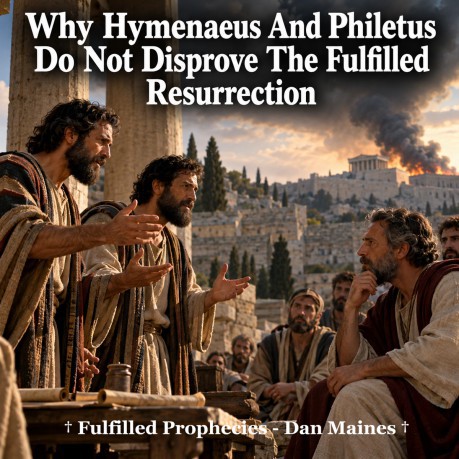
Why Hymenaeus And Philetus Do
Not Disprove The Fulfilled Resurrection Introduction The Error Of Hymenaeus And Philetus Paul Was Still Expecting The Resurrection The Resurrection And The Coming Of Christ Daniel Established The Timing Of The Resurrection Jesus Identified The Generation Of The Great
Tribulation Matthew 24:34 Jesus Said All Written Prophecy Would Be Fulfilled The Coming Of Christ Was Near John Was Told The Time Was Near The Resurrection Was Christ's Victory Over Death Paul Said God's Foundation Remained Secure The Kingdom Was Already Present Historical References How It Applies To Us Today Galatians 5:16 Q & A Appendix † This is the fulfilled perspective we proclaim at
Fulfilled Prophecies † Source Index
By Dan Maines
† One of the
most frequently used arguments against Full Preterism comes from
Paul's warning about Hymenaeus and Philetus in 2 Timothy 2:17-18.
These two men were teaching that the resurrection had already taken
place, and Paul condemned their teaching because it was upsetting the
faith of believers.
† Futurists and even some
Partial Preterists use this passage to argue that anyone who believes
the resurrection was fulfilled in AD 70 is repeating the same error.
However, this argument overlooks something extremely important. Paul
wrote his warning before AD 70, while the resurrection was still
future to his original audience (1 Corinthians 15:51-52; 1
Thessalonians 4:15).
† The question isn't
whether Hymenaeus and Philetus were wrong. Paul clearly said they
were. The question is why they were wrong, when they made their
claim, and whether their error can legitimately be applied to
believers who recognize the fulfillment of prophecy in AD 70 (2
Timothy 2:17-18; Matthew 24:34).
† We must
distinguish between declaring a prophecy fulfilled before its
appointed time and recognizing that fulfillment after the time Jesus
established had passed. Those are two completely different claims
(Daniel 12:1-2; Luke 21:22).
† Let's examine
the Scriptures in their historical setting and see why Paul's warning
doesn't overturn the fulfilled resurrection.
2 Timothy
2:16-18
But avoid worldly and empty chatter, for it
will lead to further ungodliness,
and their talk will spread
like gangrene. Among them are Hymenaeus and Philetus,
men who
have gone astray from the truth saying that the resurrection has
already taken place, and they upset the faith of some.
†
Notice exactly what Paul condemned. These men were claiming that the
resurrection had already taken place. Paul didn't say the
resurrection would never occur. He identified their declaration of
completed fulfillment as false at the time they were making it (1
Corinthians 15:51-52).
† Paul was writing
during the first-century transition between the Old Covenant and the
completed establishment of the New Covenant order. The resurrection
was still approaching, and the appointed time hadn't yet arrived
(Hebrews 10:37; Daniel 12:1-2).
† Their
teaching upset the faith of some because it contradicted what the
apostles were still expecting. Paul continued to describe the
resurrection as an approaching event involving the dead in Christ and
those who remained alive until the Lord's coming (1 Thessalonians
4:15-17).
† Scripture doesn't explain every
detail of what Hymenaeus and Philetus believed. It doesn't tell us
whether they denied any future resurrection altogether or
misunderstood its nature. What it explicitly identifies is their
false claim that the resurrection was already past (2 Timothy
2:18).
† Therefore, we shouldn't invent
additional doctrines for these men. We should examine the actual
accusation Paul made and the historical timing of that accusation (2
Timothy 2:16-18).
1
Corinthians 15:51-52
Behold, I tell you a mystery; we
will not all sleep, but we will all be changed,
in a moment, in
the twinkling of an eye, at the last trumpet; for the trumpet will
sound, and the dead will be raised imperishable, and we will be
changed.
† Paul included himself and his
original audience in the expectation of the resurrection. His words,
"we will not all sleep," show that he anticipated some
believers would remain alive when the promised change occurred (1
Thessalonians 4:15).
† This expectation
belongs to the first-century church, not to an audience thousands of
years removed from Paul's generation. The apostles were living during
the approaching conclusion of the Old Covenant age (Matthew 24:3, 34;
Hebrews 10:37).
† From the fulfilled
perspective, the resurrection concerned the completion of Christ's
victory over covenant death, the raising of those who had died in
faith, and the transformation of the living covenant community into
the completed New Covenant order (Daniel 12:2; 1 Corinthians
15:54-57).
† Hymenaeus and Philetus were
wrong because they announced that this promised event had already
occurred while Paul was still teaching that it remained ahead of them
(2 Timothy 2:18; 1 Corinthians 15:51-52).
1
Thessalonians 4:15
For this we say to you by the word
of the Lord, that we who are alive and remain until the coming of the
Lord, will not precede those who have fallen asleep.
†
Paul again included himself among those who might remain alive until
the coming of Christ. He wasn't describing an event necessarily
thousands of years away. He was addressing the expectations and
concerns of living first-century believers (1 Thessalonians
4:13-17).
† The Thessalonians were concerned
about believers who had already died. Paul reassured them that the
dead in Christ wouldn't be excluded from the promised resurrection
and gathering (1 Thessalonians 4:13-18).
†
The resurrection and the coming of Christ belonged together. They
weren't disconnected events separated by thousands of years. The
resurrection was associated with the Lord's coming and the completion
of His promised victory (1 Corinthians 15:23-26; 1 Thessalonians
4:15-17).
† That's why the timing matters.
Before the coming of Christ, claiming that the resurrection had
already happened contradicted apostolic teaching. After its
fulfillment, recognizing what Christ accomplished doesn't repeat that
premature announcement (2 Timothy 2:18; Matthew 24:34).
Daniel
12:1-2
Now at that time Michael, the great prince who
stands guard over the sons of your people, will arise. And there will
be a time of distress such as never occurred since there was a nation
until that time; and at that time your people, everyone who is found
written in the book, will be rescued.
Many of those who sleep in
the dust of the ground will awake, these to everlasting life, but the
others to disgrace and everlasting contempt.
†
Daniel connected the resurrection with a particular time of distress.
He didn't present the resurrection as an isolated event without
historical context (Daniel 12:1-2).
† The
time of distress, the deliverance of God's people, and the
resurrection are presented together. This connection is essential
because Jesus later identified the great tribulation with the
judgment approaching His own generation (Matthew 24:21, 34).
†
Daniel's resurrection prophecy concerned the people living under the
covenantal promises given to Israel. Its fulfillment marked the
vindication of the righteous and the judgment of the wicked at the
conclusion of that covenant age (Daniel 12:1-3; Matthew 24:30-34).
†
From the fulfilled perspective, the resurrection reached its
appointed fulfillment in AD 70, when the Old Covenant order came to
its final historical end and Christ's promised judgment was
manifested against Jerusalem (Luke 21:20-22; Hebrews 8:13).
†
Hymenaeus and Philetus were declaring the resurrection completed
before that appointed covenantal conclusion. Their error doesn't
establish that the resurrection must remain future forever (2 Timothy
2:18; Daniel 12:1-2).
Matthew 24:21
For then there will be a
great tribulation, such as has not occurred since the beginning of
the world until now, nor ever will.
† Jesus
used language corresponding to Daniel's description of an
unparalleled time of distress. This connects His warning about
Jerusalem with Daniel's prophetic setting (Daniel 12:1; Matthew
24:15-21).
† The tribulation wasn't an event
Jesus placed thousands of years beyond His disciples. He warned those
living in Judea to flee when the approaching danger became evident
(Matthew 24:15-20; Luke 21:20-21).
† The
destruction of Jerusalem and its temple in AD 70 provides the
historical setting for understanding the fulfillment of these
warnings. The same prophetic context includes the promised
deliverance and resurrection (Daniel 12:1-2; Luke 21:20-22).
Truly I say to you, this
generation will not pass away until all these things take place.
†
Jesus established the time limitation. He said that His own
generation wouldn't pass away until all these things took place. We
have no biblical authority to redefine that generation as people
living thousands of years later (Matthew 23:36; Matthew 24:34).
†
If Daniel connected the resurrection with the great tribulation, and
Jesus placed that tribulation within His generation, then the
resurrection must be understood within that same prophetic framework
(Daniel 12:1-2; Matthew 24:21, 34).
† This is
the central difference between the fulfilled perspective and
futurism. We accept the time statements Jesus gave rather than moving
their fulfillment into an indefinite future (Matthew 16:27-28; Luke
21:32).
Luke
21:22
because these are days of vengeance, so that all
things which are written will be fulfilled.
†
Jesus identified the approaching judgment against Jerusalem as the
days of vengeance. He connected those events with the fulfillment of
what had been written in the prophetic Scriptures (Luke 21:20-24).
†
Daniel's resurrection prophecy was part of those prophetic writings.
From the fulfilled perspective, we can't separate the resurrection
from the first-century fulfillment Jesus announced (Daniel 12:1-2;
Luke 21:22).
† The destruction of Jerusalem
in AD 70 marked the conclusion of the Old Covenant age. It wasn't the
destruction of the physical universe, but the judgment of the
covenant system that had rejected its Messiah (Matthew 23:37-38;
Hebrews 8:13).
† That's why recognizing the
resurrection as fulfilled in AD 70 doesn't contradict Paul. It
recognizes the completion of what Paul was still awaiting when he
wrote to Timothy (2 Timothy 2:18; 1 Corinthians 15:51-52).
Hebrews 10:37
FOR
YET IN A VERY LITTLE WHILE, HE WHO IS COMING WILL COME, AND WILL NOT
DELAY.
† The writer of Hebrews told his
original audience that Christ's coming would occur in a very little
while. Those words communicated genuine nearness to the believers
receiving the letter (Hebrews 10:36-39).
†
The passage doesn't describe a delay of thousands of years. It
encourages believers to persevere because the promised coming was
approaching (Hebrews 10:35-39).
† This
expectation agrees with Paul's anticipation of the resurrection and
Jesus' promise concerning His generation (1 Corinthians 15:51-52;
Matthew 24:34).
† Hymenaeus and Philetus were
wrong to announce fulfillment before the appointed time. But once the
promised coming occurred, the circumstances underlying their error no
longer remained the same (2 Timothy 2:18; Hebrews 10:37).
Revelation 22:10
And
he said to me, Do not seal up the words of the prophecy of this book,
for the time is near.
† John was specifically
instructed not to seal the prophecy because its fulfillment was near.
This contrasts with Daniel, who was told to seal his prophecy until
the time of the end (Daniel 12:4; Revelation 22:10).
†
The fulfilled perspective recognizes the first-century urgency of
Revelation. Its opening and closing statements repeatedly emphasize
that the events were approaching (Revelation 1:1-3; Revelation
22:6-10).
† We shouldn't accept the nearness
of these prophecies when discussing their original audience and then
abandon that nearness when discussing the resurrection (Daniel
12:1-2; Revelation 22:10).
† The timing of
fulfillment must remain consistent throughout Scripture. The
resurrection, judgment, and coming of Christ belonged to the
approaching completion of the Old Covenant age (Matthew 24:3, 34; 1
Corinthians 15:23-26).
1
Corinthians 15:54
But when this perishable will have
put on the imperishable, and this mortal will have put on
immortality, then will come about the saying that is written, DEATH
IS SWALLOWED UP in victory.
† Paul connected
the resurrection with the victory over death. From the fulfilled
perspective, the death being defeated was fundamentally the covenant
condemnation introduced through Adam and overcome through Christ
(Romans 5:12-21; 1 Corinthians 15:21-26).
†
Physical death continues today, but believers aren't separated from
Christ by covenant condemnation. Those who belong to Him possess
eternal life and have passed from death into life (John 5:24; Romans
8:1-2).
† The resurrection completed the
transition from the condemnation associated with Adam and the Old
Covenant order into the life established through Christ (1
Corinthians 15:21-22; Romans 8:1-4).
† This
doesn't mean Christians no longer experience biological death. It
means biological death doesn't prevent believers from being with the
Lord (2 Corinthians 5:6-8; Philippians 1:23).
†
Hymenaeus and Philetus were wrong about when the resurrection had
occurred. Their error doesn't determine the nature of the
resurrection or establish that Christ's victory must remain
unfinished today (2 Timothy 2:18; 1 Corinthians 15:54-57).
2 Timothy
2:19
Nevertheless, the firm foundation of God stands,
having this seal, The Lord knows those who are His, and, Everyone who
names the name of the Lord is to abstain from wickedness.
†
After warning about Hymenaeus and Philetus, Paul reassured Timothy
that God's foundation remained secure. False teaching couldn't
overturn God's knowledge of those who belonged to Him (2 Timothy
2:17-19).
† Paul's concern wasn't simply that
someone used the words "already taken place." His concern
was that a false declaration was leading believers away from the
truth and upsetting their faith (2 Timothy 2:18).
†
We must examine doctrine according to Scripture rather than assuming
that every statement about fulfilled prophecy is equivalent to the
error Paul condemned (Acts 17:11; 2 Timothy 2:15).
†
The fulfilled perspective doesn't teach that the resurrection
happened before Paul wrote his letters. It teaches that the
resurrection was fulfilled afterward, within the generation Jesus
identified (Daniel 12:1-2; Matthew 24:34).
Colossians 1:13
For
He rescued us from the domain of darkness, and transferred us to the
kingdom of His beloved Son,
† Paul didn't
tell believers that they would have to wait thousands of years to
enter Christ's kingdom. He said they had already been transferred
into it (Colossians 1:12-14).
† The kingdom
was already present during the apostolic age, even while the final
transition from the Old Covenant order was approaching completion
(Luke 17:20-21; Hebrews 12:28).
† The
resurrection's fulfillment didn't create a different Savior or
another gospel. It completed the promises associated with Christ's
covenantal victory (1 Corinthians 15:24-28; Hebrews 9:26-28).
†
We live today as members of Christ's established kingdom. We're not
waiting for another resurrection event to establish what Christ has
already accomplished (Colossians 1:13; Hebrews 12:22-28).
†
Flavius Josephus, in The Jewish War, Books VI and VII, described
Jerusalem's destruction, the burning of the temple, and the
devastation that followed the Roman siege in AD 70. His historical
record establishes the reality of the judgment Jesus had warned would
come upon Jerusalem (Luke 21:20-24).
†
Josephus wasn't writing a Christian explanation of the resurrection,
and he didn't identify AD 70 as its spiritual fulfillment. His
testimony supports the historical setting of Jerusalem's destruction,
not the theological interpretation by itself (Matthew 24:1-2; Luke
21:20-22).
† Eusebius, in Ecclesiastical
History, Book III, Chapter 5, recorded the tradition that Christians
in Jerusalem were instructed to leave the city and relocate to Pella
before its destruction. This tradition corresponds with Jesus'
warning that His followers should flee when Jerusalem's judgment
approached (Luke 21:20-21).
† Eusebius wrote
centuries after these events, so his account should be recognized as
a later historical tradition rather than an eyewitness report.
Nevertheless, it preserves an early Christian understanding of the
significance of Jerusalem's destruction (Matthew 24:15-21).
†
Neither Josephus nor Eusebius provides an eyewitness account of the
covenantal resurrection. Our understanding of its fulfillment must
come from the prophetic connections and timing established in
Scripture (Daniel 12:1-2; Matthew 24:34).
†
We shouldn't allow a warning about premature fulfillment to become an
argument against fulfillment itself. Hymenaeus and Philetus were
condemned for declaring the resurrection completed before its
appointed time, not for believing that God's promises would
eventually be fulfilled (2 Timothy 2:18; 1 Corinthians 15:51-52).
†
We must examine the audience, historical setting, and timing of every
passage. Removing Paul's warning from its first-century context
changes the issue he was addressing (2 Timothy 2:16-19; Matthew
24:34).
† We shouldn't build doctrine on
assumptions about what Hymenaeus and Philetus might have believed.
Scripture identifies their error, and we should remain within what
Scripture actually reveals (2 Timothy 2:17-18; 2 Timothy 2:15).
†
We can rejoice that Christ has fulfilled His promises. Our confidence
rests in His completed victory, not in an expectation that He must
return to finish something left undone (Colossians 2:13-15; Hebrews
10:37).
† The fulfilled perspective doesn't
remove our hope. It establishes our confidence in the faithfulness of
Christ, who accomplished what He promised within the generation He
identified (Matthew 24:34; Luke 21:22).
† We
now live in the blessings of the New Covenant, with direct access to
the Father through Jesus Christ. We don't need to return to the
shadows of the Old Covenant or wait for another covenantal age to
begin (Hebrews 10:19-22; Ephesians 2:18-22).
But I say, walk by the
Spirit, and you will not carry out the desire of the flesh.
†
Understanding fulfilled prophecy should strengthen our daily walk
with Christ. We aren't called to spend our lives fearing an
approaching prophetic catastrophe. We're called to walk by the Spirit
and live according to the righteousness Christ has established
(Romans 8:1-4; Galatians 5:16).
† The
fulfillment of prophecy doesn't eliminate our responsibility to live
faithfully. It gives us confidence that God's promises are
trustworthy and that His kingdom is already established (Colossians
1:13; Hebrews 12:28).
† That's why the
fulfilled perspective should produce gratitude, peace, love, and
faithful service. We're living in the reality of Christ's completed
covenantal work, not waiting for His victory to become effective
(Galatians 5:22-25; Colossians 2:13-15).
Q: Who
were Hymenaeus and Philetus?
A: They were men
identified by Paul as having departed from the truth by teaching that
the resurrection had already taken place. Their teaching was
upsetting the faith of some believers (2 Timothy 2:17-18).
Q:
Why did Paul condemn their teaching?
A: Because
they declared the resurrection completed while Paul was still
teaching that it remained future to his original audience. Their
announcement was premature (1 Corinthians 15:51-52; 1 Thessalonians
4:15-17).
Q: Does Paul explain exactly what
these men believed about the resurrection?
A:
No. Paul identifies their false claim about its timing, but he
doesn't provide a complete explanation of their understanding of its
nature. We shouldn't add details Scripture doesn't reveal (2 Timothy
2:17-18).
Q: Does 2 Timothy 2:18 prove Full
Preterism is heresy?
A: No. The passage
condemns a claim made before the resurrection's appointed
fulfillment. Full Preterism places that fulfillment afterward, in AD
70. The disagreement must be evaluated through the resurrection
prophecies and their timing, not merely through the fact that both
discussions concern a completed resurrection (Daniel 12:1-2; Matthew
24:34).
Q: How do we know the resurrection
belonged to the first-century fulfillment?
A:
Daniel connected the resurrection with an unparalleled time of
distress. Jesus connected that distress with the great tribulation
and placed its fulfillment within His generation (Daniel 12:1-2;
Matthew 24:21, 34).
Q: Was the resurrection
supposed to involve physical bodies coming out of graves?
A:
The fulfilled perspective understands the resurrection primarily as
the completion of Christ's victory over covenant death, including the
raising of the faithful dead and the transformation of the living
covenant community. This interpretation connects the resurrection
with the removal of condemnation and the completion of the Old
Covenant age (Romans 5:12-21; 1 Corinthians 15:21-26, 54-57).
Q:
If the resurrection was fulfilled in AD 70, what happens when
believers die today?
A: Believers are
immediately with the Lord. They don't enter Hades to await another
covenantal resurrection. Paul expressed his desire to depart and be
with Christ and described being absent from the body as being at home
with the Lord (2 Corinthians 5:6-8; Philippians 1:23).
Q:
Doesn't 2 Timothy 3 warn about people gathering teachers who tell
them what they want to hear?
A: The warning
about accumulating teachers according to personal desires appears in
2 Timothy 4:3-4. The proper response is to examine all teaching
through Scripture, including the audience and timing of prophecy.
Disagreement alone doesn't establish that someone has rejected sound
doctrine (Acts 17:11; 2 Timothy 2:15).
Q: Does
recognizing fulfilled prophecy mean Christians no longer need to walk
in obedience?
A: Absolutely not. Paul
instructed believers to walk by the Spirit, demonstrate the fruit of
the Spirit, and live according to their calling in Christ.
Fulfillment establishes our confidence in Christ, not permission to
live in disobedience (Galatians 5:16, 22-25; Ephesians 4:1).
Q:
What is the most important distinction between Hymenaeus and Philetus
and the fulfilled perspective?
A: Hymenaeus and
Philetus declared the resurrection completed before the appointed
fulfillment. The fulfilled perspective recognizes its completion in
AD 70, after Paul's letters and within the generation Jesus
identified. The issue is the timing of fulfillment, and that timing
must be established from Scripture (2 Timothy 2:18; Daniel 12:1-2;
Matthew 24:34).
© Fulfilled Prophecies - Dan
Maines.
† 2 Timothy
2:16-18, 2 Timothy 2:19, 1 Corinthians 15:51-52, 1 Corinthians 15:54,
1 Thessalonians 4:15, Daniel 12:1-2, Matthew 24:21, Matthew 24:34,
Luke 21:22, Hebrews 10:37, Revelation 22:10, Colossians 1:13,
Galatians 5:16
† Flavius Josephus, The Jewish
War, Books VI-VII; Eusebius, Ecclesiastical History, Book III,
Chapter 5
Links