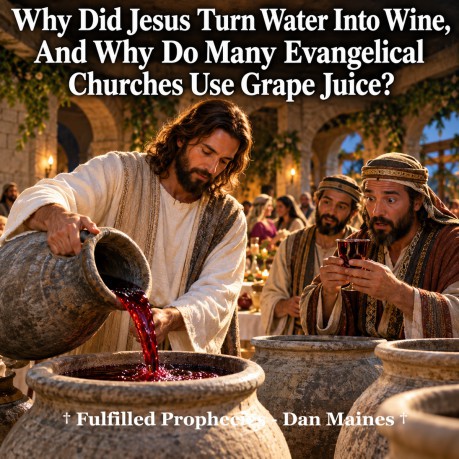
Why Did Jesus Turn Water Into
Wine, And Why Do Many Evangelical Churches Use Grape Juice? Introduction The First Miracle Revealed Christ's Glory John 2:1, 3, 6-11 The Waterpots Represented the Old Covenant Purification
System Hebrews 9:9-11, 15 The New Wine Pointed Toward the New Covenant Mark 2:19, 22 The Wedding Feast Was a Picture of Covenant Blessing Isaiah 25:6 Jesus Connected the Cup With His Covenant Blood Luke 22:20 Jesus Used the Fruit of the Vine Matthew 26:27-29 The Bible Condemns Drunkenness, Not Every Use of Wine Ephesians 5:18 Paul Even Recommended Wine for a Medical Purpose 1 Timothy 5:23 Christian Freedom Must Include Consideration for Others Romans 14:21 Why Many Evangelical Churches Use Grape Juice † The widespread use of grape juice in American
Protestant communion services developed largely during the
nineteenth-century temperance movement. Many Christians became
concerned about the destructive effects of alcohol abuse and began
advocating complete abstinence. Historical References † Josephus, writing in the first century,
described Jewish customs, religious celebrations, and the importance
of vineyards and agricultural produce in Jewish society. His writings
provide historical background for understanding wine within the
culture of Jesus' day. How It Applies To Us Today † The miracle at Cana teaches us to recognize
the glory of Jesus Christ. His first sign wasn't simply about meeting
a temporary need. It revealed His identity and pointed toward the
greater blessings He would bring (John 2:11; 1:14-17). Q & A Appendix Q: Why did Jesus choose to turn water into wine
instead of performing another miracle? † This is the fulfilled perspective we proclaim at
Fulfilled Prophecies † Source Index
By Dan Maines
† Jesus'
first recorded miracle wasn't healing the sick, raising the dead, or
casting out demons. It was turning water into wine at a wedding in
Cana of Galilee. John specifically called this the beginning of His
signs, revealing that the miracle carried a meaning far greater than
providing refreshments for wedding guests (John 2:1-11).
†
Why did Jesus choose wine? Why were six stone waterpots used for
Jewish purification? Why did He produce the best wine at the end of
the celebration? And why do many evangelical churches today insist
that Christians should drink grape juice instead of wine, even though
Jesus Himself provided wine? These questions deserve answers from
Scripture rather than denominational traditions (John 2:6-11; Mark
7:8).
† From the fulfilled perspective, this
miracle announced something extraordinary. Jesus had come to bring
the Old Covenant system to its appointed completion and establish the
New Covenant through His blood. The water associated with ceremonial
purification was transformed into wine, providing a beautiful picture
of the greater redemption Christ was bringing (Hebrews 8:13;
9:9-15).
† Scripture doesn't teach that
drinking wine is automatically sinful. It condemns drunkenness,
addiction, and the misuse of alcohol. Understanding that distinction
helps us appreciate both the miracle at Cana and the freedom
believers have under the New Covenant (Ephesians 5:18; Romans 14:21;
Galatians 5:1).
On the third day there was
a wedding in Cana of Galilee, and the mother of Jesus was there;
When
the wine ran out, the mother of Jesus said to Him, They have no
wine.
Now there were six stone waterpots set there for the
Jewish custom of purification, containing twenty or thirty gallons
each.
Jesus said to them, Fill the waterpots with water. So they
filled them up to the brim.
When the headwaiter tasted the water
which had become wine, and did not know where it came from (but the
servants who had drawn the water knew), the headwaiter called the
bridegroom,
and said to him, Every man serves the good wine
first, and when the people have drunk freely, then he serves the
poorer wine; but you have kept the good wine until now.
This
beginning of His signs Jesus did in Cana of Galilee, and manifested
His glory, and His disciples believed in Him.
†
John identified this miracle as the beginning of Jesus' signs. Its
primary purpose was to reveal His glory and strengthen the disciples'
faith in Him (John 20:30-31).
† The six stone
waterpots were specifically associated with Jewish purification.
Their presence connects the miracle to the ceremonial practices of
the Old Covenant, which pointed forward to the greater cleansing
Christ would provide (Hebrews 9:9-14).
† Each
waterpot held approximately twenty or thirty gallons. Together, the
six containers could hold approximately 120 to 180 gallons. Jesus
didn't produce a token amount of wine. The abundance demonstrated His
power and generosity (John 1:16; 10:10).
†
The headwaiter recognized that the wine Jesus provided was superior
to what had been served earlier. This distinction supports the
symbolism of something greater arriving through Christ (Hebrews
8:6).
† Notice that John didn't describe the
result as grape juice. He called it wine. The headwaiter's comments
about the usual practice of serving inferior wine after guests had
drunk freely fit the ordinary use of fermented wine at ancient
celebrations (John 2:9-10).
which is a symbol for the
present time. Accordingly both gifts and sacrifices are offered which
cannot make the worshiper perfect in conscience,
since they
relate only to food and drink and various washings, regulations for
the body imposed until a time of reformation.
But when Christ
appeared as a high priest of the good things to come, He entered
through the greater and more perfect tabernacle, not made with hands,
that is to say, not of this creation;
For this reason He is the
mediator of a new covenant, so that, since a death has taken place
for the redemption of the transgressions that were committed under
the first covenant, those who have been called may receive the
promise of the eternal inheritance.
† Hebrews
explains that the Old Covenant included various ceremonial washings
that couldn't perfect the worshiper's conscience. Those outward
regulations served their purpose until the appointed time of
reformation (Hebrews 9:9-10).
† The waterpots
at Cana belonged to that world of ceremonial purification. Their
transformation provides a meaningful picture of the transition from
outward cleansing to the greater spiritual cleansing accomplished
through Christ (John 2:6; Hebrews 9:13-14).
†
Jesus didn't come to improve the Old Covenant by adding another
ritual. He came to fulfill what the Law and Prophets anticipated and
establish the promised New Covenant (Matthew 5:17; Hebrews 8:6-13).
†
The miracle itself doesn't explicitly identify the waterpots as a
prophecy of AD 70. However, when read alongside Hebrews, the
symbolism is consistent with the covenantal transition completed when
the Old Covenant temple system passed away (Hebrews 8:13; 10:1-18).
†
The Old Covenant depended upon repeated sacrifices and ceremonial
regulations. The New Covenant rests upon the completed sacrifice of
Jesus Christ, who provides the cleansing those earlier ceremonies
could never accomplish (Hebrews 10:11-18).
And Jesus said to them, While
the bridegroom is with them, the attendants of the bridegroom cannot
fast, can they? So long as they have the bridegroom with them, they
cannot fast.
No one puts new wine into old wineskins; otherwise
the wine will burst the skins, and the wine is lost and the skins as
well; but one puts new wine into fresh wineskins.
†
Jesus described Himself as the bridegroom and used new wine to
illustrate the new reality His presence introduced. His ministry
couldn't simply be confined within the old religious structures
(Matthew 9:14-17).
† The old wineskins
represented the inability of existing religious practices to contain
what Christ was bringing. The New Covenant wasn't merely an extension
of the Old Covenant. It was the fulfillment of God's promises through
His Son (Jeremiah 31:31-34; Hebrews 8:6-13).
†
The wedding setting at Cana becomes especially meaningful because
Jesus later identified Himself as the bridegroom. His relationship
with His people would be described through the imagery of marriage
(John 3:29; Ephesians 5:25-32).
† From the
fulfilled perspective, the New Covenant was inaugurated through
Christ's death and reached its completed covenantal establishment
with the passing of the Old Covenant order in AD 70 (Luke 22:20;
Hebrews 8:13; 10:37).
† The church now
belongs to Christ as His bride. We're not waiting for another
covenant to replace the one established through His blood (Ephesians
5:25-27; Revelation 21:2, 9-10).
The LORD of hosts will prepare a
lavish banquet for all peoples on this mountain; A banquet of aged
wine, choice pieces with marrow, And refined, aged wine.
†
Isaiah described God's promised salvation through the imagery of a
magnificent banquet that included aged wine. The emphasis was
abundance, celebration, and the blessings of God's kingdom (Isaiah
25:6-9).
† The wedding at Cana reflects this
biblical imagery. Jesus brought abundance to a celebration,
demonstrating that His coming was good news rather than another
burden of religious regulations (Luke 4:18-21).
†
Isaiah connected the banquet with God's victory over death. Paul
later connected that same prophetic passage with the resurrection
victory accomplished through Christ (Isaiah 25:8; 1 Corinthians
15:54-57).
† The fulfilled perspective
recognizes this promised victory in the completed redemptive work of
Christ and the removal of the Old Covenant condemnation that
separated humanity from God (Romans 8:1-2; 1 Corinthians 15:54-57).
†
Wine itself wasn't the source of salvation. It served as an image of
the joy and abundance associated with the promised kingdom (Psalm
104:14-15; Matthew 26:29).
And in the same way He took the
cup after they had eaten, saying, This cup which is poured out for
you is the new covenant in My blood.
† Jesus
explicitly connected the cup with the New Covenant established
through His blood. The significance wasn't the chemical composition
of the beverage but the sacrifice it represented (Hebrews 9:15-22).
†
The miracle at Cana and the cup at the Last Supper belong to the same
redemptive story. At Cana, Jesus revealed His glory through wine. At
the Last Supper, He identified the cup with the covenant His death
would establish (John 2:11; Matthew 26:27-29).
†
Scripture doesn't say the wine at Cana literally became His blood.
The connection is symbolic, pointing toward the redemption
accomplished through His sacrifice (Hebrews 10:10-14).
†
The New Covenant was established through Christ's blood, not through
repeated animal sacrifices or ceremonial purification. His sacrifice
accomplished what the Old Covenant system couldn't accomplish
(Hebrews 9:11-15; 10:1-18).
And when He had taken a cup
and given thanks, He gave it to them, saying, Drink from it, all of
you;
for this is My blood of the covenant, which is poured out
for many for forgiveness of sins.
But I say to you, I will not
drink of this fruit of the vine from now on until that day when I
drink it new with you in My Father's kingdom.
†
Jesus called the contents of the cup the fruit of the vine. The
expression doesn't specifically identify whether the beverage was
fermented, although wine was the customary drink associated with
ancient Jewish festive meals (Luke 22:17-20).
†
Nothing in this passage commands Christians to replace wine with
grape juice. Neither does Jesus establish a rule requiring every
believer to consume alcohol (Romans 14:17, 21).
†
The purpose of the cup was to represent His blood poured out for the
forgiveness of sins. Making the beverage itself more important than
Christ's sacrifice misses the central meaning (Hebrews 9:22;
10:12-18).
† Jesus also connected the cup
with His Father's kingdom. From the fulfilled perspective, the
promised kingdom came in its completed covenantal reality through the
events surrounding AD 70 (Matthew 16:27-28; Luke 21:31-32).
†
We shouldn't turn a covenant symbol into another religious law. Our
righteousness comes through Christ, not through the choice between
wine and grape juice (Galatians 2:16; 5:1).
And do not get drunk with
wine, for that is dissipation, but be filled with the Spirit,
†
Paul directly condemned drunkenness. He didn't say that every person
who drinks wine commits sin. His warning concerned intoxication and
the loss of self-control (Galatians 5:19-23).
†
Scripture distinguishes between the ordinary use of wine and its
abuse. Noah's drunkenness brought shame, while other passages
describe wine as part of ordinary meals and celebrations (Genesis
9:20-21; Psalm 104:14-15).
† Jesus Himself
was accused of being a gluttonous man and a heavy drinker. That
accusation came from His opponents and doesn't establish that He was
guilty of either behavior (Matthew 11:18-19).
†
Christian freedom isn't permission for destructive behavior.
Believers are called to exercise wisdom, self-control, and
consideration for others (Romans 14:19-21; 1 Corinthians 6:12).
†
A person who chooses complete abstinence isn't disobeying Scripture.
However, declaring that every Christian must abstain goes beyond what
these passages command (Romans 14:3-4).
No longer drink water
exclusively, but use a little wine for the sake of your stomach and
your frequent ailments.
† Paul instructed
Timothy to use a little wine because of his stomach problems and
frequent ailments. This instruction would make little sense if every
use of wine were inherently sinful (1 Timothy 4:4-5).
†
Notice Paul's emphasis on a little wine. His instruction doesn't
encourage excessive drinking or establish wine as a universal medical
treatment (Ephesians 5:18).
† The passage
demonstrates that Scripture doesn't treat wine as automatically
immoral. Its use must be distinguished from drunkenness and
irresponsible behavior (Romans 14:21).
†
Modern medical decisions should be based on appropriate medical
guidance, not an assumption that Paul's advice to Timothy applies to
every illness today (Proverbs 11:14).
It is good not to eat meat or
to drink wine, or to do anything by which your brother stumbles.
†
Paul taught that believers should willingly limit their freedom when
exercising it would harm another person's conscience or spiritual
well-being (Romans 14:13-19).
† This
principle explains why choosing grape juice can be appropriate. A
congregation may wish to accommodate children, recovering alcoholics,
or people who abstain for personal reasons (1 Corinthians
10:23-24).
† However, voluntarily choosing
grape juice isn't the same as declaring wine sinful. Paul
distinguished personal convictions from requirements imposed upon
other believers (Romans 14:3-4).
† The New
Covenant calls us to love one another rather than judge spiritual
maturity by what someone drinks (Romans 14:17; Galatians 5:13-14).
† During that
period, temperance organizations and Protestant reformers
increasingly promoted the idea that Christians should avoid alcoholic
beverages altogether. Some churches began seeking an alternative to
fermented communion wine.
† Thomas Bramwell
Welch, a Methodist layman and dentist, developed a method of
preserving unfermented grape juice in 1869. His work helped make
grape juice a practical substitute for communion wine.
†
Welch's son, Charles Welch, later promoted the product more widely.
As commercial distribution expanded, grape juice became increasingly
common in American Protestant churches.
† The
change wasn't introduced by Jesus or commanded by the apostles. It
developed through later religious reform movements, practical
concerns, and changing cultural attitudes toward alcohol.
†
Not every evangelical church uses grape juice, and not every
denomination adopted the practice for identical reasons. Some
emphasize abstinence, while others use grape juice to accommodate
everyone participating in communion.
† The
historical distinction matters. Churches are free to adopt practices
that serve their congregations, but they shouldn't present a
nineteenth-century custom as though it were an explicit command from
Christ (Mark 7:8; Colossians 2:20-23).
† The Mishnah,
compiled around AD 200, preserves earlier Jewish traditions involving
wine, blessings, and Passover observances. Its discussion of cups of
wine at Passover demonstrates the importance of wine in Jewish
religious practice, although it was compiled after the New Testament
period.
† Clement of Alexandria, writing
during the late second and early third centuries, discussed the
proper use of wine and warned against excessive drinking. His
writings distinguish moderation from drunkenness.
†
John Chrysostom, writing in the fourth century, opposed drunkenness
while recognizing that wine itself wasn't inherently evil. His
teaching reflected the distinction between God's creation and its
misuse.
† Thomas Bramwell Welch, in 1869,
developed a preservation process for unfermented grape juice. His
contribution became influential in changing communion practices among
American Protestant churches.
† Charles Welch
helped expand the distribution and acceptance of unfermented grape
juice. His family's business contributed significantly to the
transition from wine to grape juice in many churches.
†
These historical sources show that the widespread preference for
grape juice developed long after the apostolic period. The New
Testament itself doesn't establish grape juice as a required
replacement for wine.
†
We should understand the difference between the Old Covenant
purification system and the New Covenant cleansing accomplished
through Christ. Our relationship with God isn't maintained through
ceremonial regulations but through His completed sacrifice (Hebrews
9:13-15; 10:14).
† We shouldn't condemn
Christians who responsibly choose to drink wine, and we shouldn't
criticize those who abstain. Scripture calls us to exercise freedom
with love and self-control (Romans 14:3, 21; Galatians 5:13).
†
Churches that use grape juice should understand that their practice
is a later tradition rather than an explicit biblical command.
Churches that use wine should also respect believers who cannot or
choose not to consume alcohol (Romans 14:19-21).
†
We must never confuse the symbol with the substance of our salvation.
Neither wine nor grape juice cleanses us from sin. Only the blood of
Jesus Christ accomplishes that redemption (Ephesians 1:7; Hebrews
9:14).
† The wedding at Cana reminds us that
Christ brought something greater than the Old Covenant could provide.
We now live under the completed New Covenant, enjoying the spiritual
blessings promised through Him (Ephesians 1:3; Hebrews 8:6).
†
That's why the real significance of turning water into wine isn't an
argument about alcohol. It's the revelation of Jesus Christ, the
fulfillment of God's promises, and the arrival of a better covenant
established through His blood (John 2:11; Hebrews 8:6-13).
A: John
explains that this was the beginning of His signs and that it
manifested His glory. The setting also provides meaningful covenant
symbolism through the purification waterpots and the wedding
celebration (John 2:6-11; Hebrews 9:9-15).
Q:
Did Jesus actually make alcoholic wine?
A: The
natural reading is that He produced ordinary wine, which in that
culture was generally fermented. The headwaiter's comparison with
wine served after guests had drunk freely supports that
understanding. John doesn't provide a laboratory description of its
alcohol content (John 2:9-10).
Q: Were the six
waterpots a prophecy of AD 70?
A: John doesn't
explicitly identify them as a prophecy of AD 70. However, their
connection with Jewish purification fits the broader New Testament
teaching concerning the passing of the Old Covenant system and the
establishment of the New Covenant (John 2:6; Hebrews 8:13;
9:9-10).
Q: Does the Bible command Christians
to drink wine?
A: No. Scripture permits its
responsible use but doesn't require Christians to consume alcohol.
Paul also taught that abstaining can be appropriate out of
consideration for others (Romans 14:21; 1 Timothy 5:23).
Q:
Is drinking wine automatically sinful?
A: No.
Scripture condemns drunkenness and the misuse of alcohol, not every
use of wine (Ephesians 5:18; 1 Timothy 5:23).
Q:
Why do many evangelical churches use grape juice?
A:
The practice became widespread through the nineteenth-century
temperance movement, particularly after Thomas Bramwell Welch
developed a method for preserving unfermented grape juice in 1869. It
wasn't established by a New Testament command (Romans 14:17, 21).
Q:
Is it wrong for a church to use grape juice for communion?
A:
The New Testament doesn't explicitly require unfermented grape juice
or specify an alcohol percentage for the cup. Churches should keep
their focus on Christ's sacrifice rather than making the beverage a
test of righteousness (Luke 22:20; 1 Corinthians 11:25-26).
Q:
What was the deeper meaning of Jesus providing the best wine last?
A:
The headwaiter recognized the superior quality of the wine. Within
the broader biblical story, this provides a fitting picture of the
greater blessings introduced through Christ and His New Covenant
(John 2:10-11; Hebrews 8:6).
Q: Are we still
waiting for the New Covenant to be established?
A:
No. Jesus established the New Covenant through His blood. From the
fulfilled perspective, the Old Covenant order reached its final
historical removal in AD 70, and believers now enjoy the completed
covenant blessings of Christ (Luke 22:20; Hebrews 8:13; 10:14-18).
Q:
What's the most important lesson from the miracle at Cana?
A:
Jesus revealed His glory and demonstrated that something greater had
arrived. The miracle directs our attention beyond ceremonial
purification and religious tradition to the redemption and spiritual
blessings accomplished through Him (John 2:11; Hebrews 9:11-15).
© Fulfilled Prophecies - Dan
Maines.
† John 2:1,
3, 6-11; Hebrews 9:9-11, 15; Mark 2:19, 22; Isaiah 25:6; Luke 22:20;
Matthew 26:27-29; Ephesians 5:18; 1 Timothy 5:23; Romans 14:21.
†
Flavius Josephus, Jewish Antiquities; Mishnah, Pesachim 10; Clement
of Alexandria, The Instructor, Book II; John Chrysostom, Homilies on
Ephesians; Thomas Bramwell Welch, historical records of unfermented
grape juice preservation, 1869; Charles Welch, historical records of
grape juice promotion and distribution.
Links