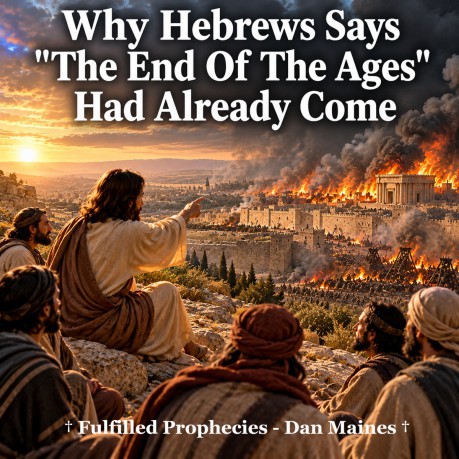
Why Hebrews Says "The
End Of The Ages" Had Already Come Introduction The End Of The Ages Had Already Arrived Hebrews 9:26 The Ends Of The Ages Had Come Upon Paul's Generation 1 Corinthians 10:11 God Had Spoken In These Last Days Hebrews 1:1-2 The First Covenant Was Ready To Disappear Hebrews 8:13 The Time Of Reformation Had Arrived Hebrews 9:8-10 Christ Appeared In The Last Times 1 Peter 1:20 Jesus Identified The End Of The Age Matthew 24:3 Matthew 24:34 The Coming Judgment Was Very Near Hebrews 10:37 The Shaking Of The Old Covenant Order Hebrews 12:26-28 The New Covenant Was The Promised Destination Hebrews 9:15 Historical References How It Applies To Us Today Q & A Appendix † This is the fulfilled perspective we proclaim at
Fulfilled Prophecies † Source Index
By Dan Maines
† Many
Christians have been taught that the end of the ages refers to the
destruction of the physical universe at some future time. However,
the New Testament places the end of the ages within the lifetime of
the apostles and the first-century believers. The inspired writers
didn't describe something thousands of years away. They declared that
the end of the ages had already come upon their generation (Hebrews
9:26; 1 Corinthians 10:11).
† Hebrews and 1
Corinthians provide two powerful witnesses to this truth. Both
identify the first century as the time when the ages were reaching
their appointed conclusion. The subject wasn't the destruction of
planet Earth but the fulfillment of God's redemptive purpose through
Jesus Christ and the passing away of the Old Covenant order (Hebrews
8:13; 9:26).
† Jesus came during the final
days of the Old Covenant age. His sacrifice established the New
Covenant, and the judgment upon Jerusalem in AD 70 brought the
remaining Old Covenant system to its historical conclusion. The
temple, priesthood, sacrifices, and covenant administration that had
governed Israel were removed, while Christ's everlasting kingdom
remained (Hebrews 9:15; 12:27-28).
† To
understand the end of the ages, we must allow the inspired writers to
identify their own time, their own audience, and the covenant that
was passing away (Hebrews 1:1-2; 8:13).
Otherwise, He would have needed
to suffer often since the foundation of the world; but now once at
the consummation of the ages He has been manifested to put away sin
by the sacrifice of Himself.
† Notice the
word now. The writer didn't say Christ would appear thousands of
years later at the consummation of the ages. He declared that Christ
had already appeared at that appointed time (Galatians 4:4; 1 Peter
1:20).
† The consummation of the ages was
connected directly to Christ's sacrifice. His death wasn't
preparation for another sacrifice at the end of human history. It was
the once-for-all sacrifice that accomplished what the Old Covenant
sacrifices could never accomplish (Hebrews 10:1-14).
†
The ages were reaching their fulfillment because the promises,
shadows, sacrifices, and priesthood of the Old Covenant were finding
their completion in Jesus Christ (Colossians 2:16-17; Hebrews
10:1).
† The writer used the past appearance
of Christ as evidence that the consummation had arrived. That's why
we can't move his statement into our future without ignoring the
historical setting of his words (Hebrews 1:2; 9:26).
Now these things
happened to them as an example, and they were written for our
instruction, upon whom the ends of the ages have come.
†
Paul identified the people upon whom the ends of the ages had come.
He said our instruction, referring to himself and the first-century
believers receiving his letter (1 Corinthians 1:2; 10:11).
†
Paul didn't say the ends of the ages would come upon Christians
living thousands of years later. He declared that they had already
come upon his own generation (Romans 13:11-12).
†
The historical examples of Israel were written to instruct those
living during the covenant transition. The same nation that had
received the Law was approaching the judgment Jesus had announced
(Matthew 23:35-38; Luke 21:20-22).
† Hebrews
9:26 and 1 Corinthians 10:11 agree. Christ appeared at the
consummation of the ages, and Paul declared that the ends of the ages
had come upon the believers of his day.
†
These statements weren't predictions of the end of the physical
universe. They identified the first-century fulfillment of God's
covenant purposes through Christ (Galatians 4:4; Hebrews 8:13).
God, after He spoke long ago
to the fathers in the prophets in many portions and in many ways, in
these last days has spoken to us in His Son, whom He appointed heir
of all things, through whom also He made the world.
†
The writer identified his own generation as living in these last
days. He didn't say the last days would begin thousands of years
after Christ's appearance (Acts 2:16-17).
†
The contrast is between God's former revelation through the prophets
and His final revelation through His Son. The Old Covenant prophets
anticipated the Messiah, and Jesus brought their promises to
fulfillment (Luke 24:44; Matthew 5:17).
†
These last days were the closing period of the Old Covenant age, not
the final days of planet Earth. The writer was addressing believers
living while the former covenant system was approaching its
disappearance (Hebrews 8:13).
† If the last
days had already arrived when Hebrews was written, we shouldn't
redefine them as a period that wouldn't begin until thousands of
years later (Hebrews 9:26; 1 Peter 1:20).
When He said, A new covenant,
He has made the first obsolete. But whatever is becoming obsolete and
growing old is ready to disappear.
† This
verse identifies what was coming to an end. It wasn't the physical
heavens and Earth. It was the first covenant, which had become
obsolete through the establishment of the New Covenant (Jeremiah
31:31-34; Hebrews 8:6).
† Notice the language
becoming obsolete, growing old, and ready to disappear. The writer
described a process already underway during his lifetime (Hebrews
9:8-10).
† Christ established the New
Covenant through His death, but the Old Covenant temple and
sacrificial system continued operating until Jerusalem's destruction
in AD 70 (Luke 22:20; Hebrews 10:9).
† The
destruction of Jerusalem didn't make Christ's sacrifice effective.
His sacrifice had already accomplished redemption. AD 70 publicly
demonstrated that the former covenant administration had reached its
appointed end (Hebrews 9:12-15; Matthew 24:1-2).
†
That's why the end of the ages must be understood in its covenant
setting. The former system was disappearing, while the kingdom
established through Christ would remain (Hebrews 12:27-28).
The Holy Spirit is signifying
this, that the way into the holy place has not yet been disclosed
while the outer tabernacle is still standing, which is a symbol for
the present time. Accordingly both gifts and sacrifices are offered
which cannot make the worshiper perfect in conscience, since they
relate only to food and drink and various washings, regulations for
the body imposed until a time of reformation.
†
The writer described the Old Covenant sanctuary as a symbol connected
to the present time of his readers. Its regulations were temporary
and awaited the appointed time of reformation (Hebrews 8:5; 10:1).
†
That reformation came through Jesus Christ, our great High Priest.
His sacrifice accomplished what the repeated animal sacrifices could
never accomplish (Hebrews 9:11-14; 10:11-14).
†
The Old Covenant sanctuary represented restricted access under the
former priesthood. Through Christ, believers received access to God
through a new and living way (Hebrews 10:19-22).
†
The continued existence of the earthly temple didn't mean Christ's
sacrifice was incomplete. It meant the old administration was still
visibly present during the transition that ended with Jerusalem's
destruction (Hebrews 8:13; Matthew 24:2).
†
The time of reformation wasn't postponed until the end of world
history. It arrived through Christ's completed work and the
establishment of His superior covenant (Hebrews 7:12; 9:15).
For He was foreknown before the
foundation of the world, but has appeared in these last times for the
sake of you
† Peter confirmed the same
historical setting described in Hebrews. Christ had appeared in these
last times for the benefit of the believers Peter was addressing (1
Peter 1:1-2).
† Peter didn't describe the
last times as a distant period beyond his generation. He connected
them to the historical appearance of Jesus Christ (Acts 2:16-21).
†
Christ's appearance fulfilled God's eternal redemptive purpose. The
promises made through the prophets were reaching their fulfillment
through His suffering, resurrection, and exaltation (1 Peter
1:10-12).
† Peter and the writer of Hebrews
weren't describing two different sets of last days. Both identified
the first-century appearance of Christ as belonging to the concluding
period of the former covenant age (Hebrews 1:2; 9:26).
As He was sitting on the Mount
of Olives, the disciples came to Him privately, saying, Tell us, when
will these things happen, and what will be the sign of Your coming,
and of the end of the age?
† The disciples
asked Jesus about the end of the age immediately after He predicted
the destruction of the temple. Their question arose from the judgment
He had just announced (Matthew 24:1-2).
†
Jesus didn't tell them the physical universe would be destroyed. He
described the coming judgment upon Jerusalem and the circumstances
surrounding that generation (Luke 21:20-24).
†
The end of the age concerned the conclusion of the Old Covenant order
centered upon Jerusalem and its temple. The kingdom of Christ wasn't
ending. It was being established as the enduring covenant reality
(Daniel 7:13-14; Hebrews 12:28).
† The
destruction of Jerusalem in AD 70 provides the historical fulfillment
of the temple judgment Jesus described (Luke 21:5-6, 20-22).
Truly I say to you, this
generation will not pass away until all these things take place.
†
Jesus identified the generation that would witness the fulfillment of
His prophecy. He didn't say a generation thousands of years later
would see these things (Matthew 23:36; Luke 21:32).
†
His words placed the judgment within the lifetime of those who heard
Him. The destruction of Jerusalem in AD 70 occurred within that
first-century generation (Luke 21:20-24).
†
This agrees with Hebrews and Paul. The end of the age wasn't an event
waiting for our generation. It belonged to the generation that
witnessed the final removal of the Old Covenant temple system
(Hebrews 8:13; 1 Corinthians 10:11).
† We
must honor the time statements Jesus gave rather than extending their
fulfillment beyond the generation He specifically identified (Matthew
16:27-28; 24:34).
FOR YET IN A VERY LITTLE
WHILE, HE WHO IS COMING WILL COME, AND WILL NOT DELAY.
†
The writer told his first-century readers that the coming of Christ
was very near. He didn't describe an event that would be delayed for
thousands of years (Hebrews 10:25).
† The
warning concerned believers who were facing persecution and needed
endurance as the former covenant age approached its conclusion
(Hebrews 10:32-36).
† Christ's coming in
judgment upon Jerusalem fulfilled His warnings concerning that
generation. The destruction of the city and temple demonstrated the
removal of the covenant order that had rejected Him (Matthew
23:37-38; 24:1-2).
† The expression very
little while must be understood from the perspective of the original
readers. It wasn't a promise intended to remain unfulfilled for
countless generations (James 5:8-9).
† The
same letter that declared the first covenant ready to disappear also
announced that Christ's coming was near. These statements belong
together in their first-century setting (Hebrews 8:13; 9:26).
And His voice shook the
earth then, but now He has promised, saying, YET ONCE MORE I WILL
SHAKE NOT ONLY THE EARTH, BUT ALSO THE HEAVEN.
This expression,
Yet once more, denotes the removing of those things which can be
shaken, as of created things, so that those things which cannot be
shaken may remain.
Therefore, since we receive a kingdom which
cannot be shaken, let us show gratitude, by which we may offer to God
an acceptable service with reverence and awe;
†
The writer contrasted what could be shaken and removed with the
kingdom that couldn't be shaken. The emphasis was upon the removal of
the temporary order and the permanence of Christ's kingdom (Hebrews
8:13).
† The Old Covenant system had served
its appointed purpose. Its priesthood, sacrifices, and earthly
sanctuary pointed forward to the greater realities established
through Jesus Christ (Hebrews 7:11-12; 10:1).
†
The shaking represented the removal of what was temporary so that
what was permanent would remain. In the fulfilled perspective,
Jerusalem's destruction in AD 70 marked the historical removal of the
former covenant administration (Matthew 24:1-2).
†
The believers weren't waiting to receive an earthly political
kingdom. They were receiving the kingdom of Christ, which couldn't be
shaken or destroyed (Luke 17:20-21; Daniel 7:14).
†
The end of the ages didn't mean the end of God's kingdom. It meant
the completion of the transition from the former covenant order into
the enduring New Covenant reality (Hebrews 8:6; 12:28).
For this reason He is the
mediator of a new covenant, so that, since a death has taken place
for the redemption of the transgressions that were committed under
the first covenant, those who have been called may receive the
promise of the eternal inheritance.
† Christ
didn't come merely to improve the Old Covenant system. He came to
establish the promised New Covenant through His own sacrifice
(Jeremiah 31:31-34; Luke 22:20).
† The first
covenant couldn't provide the final redemption accomplished by
Christ. His death secured the promised inheritance for those who
belong to Him (Hebrews 7:25; 10:14).
† The
consummation of the ages was therefore a redemptive fulfillment.
Everything anticipated by the former covenant found its appointed
completion in Jesus Christ (Galatians 3:16, 26-29).
†
The destruction of the temple didn't end God's relationship with His
people. Through Christ, believers became God's dwelling place, with
access to the Father through the Spirit (Ephesians 2:18-22).
†
The promised destination wasn't another earthly temple or a restored
system of animal sacrifices. It was the everlasting covenant
relationship established through Jesus Christ (Hebrews 10:19-22;
13:20).
†
Flavius Josephus, a first-century Jewish historian, recorded the
Jewish revolt against Rome and the destruction of Jerusalem and its
temple in AD 70. His account provides historical evidence for the
catastrophe Jesus had announced concerning Jerusalem (Matthew 24:1-2;
Luke 21:20-24).
† In The Jewish War, Books
5-6, Josephus described the Roman siege, the suffering within
Jerusalem, and the destruction of the temple. These events correspond
to the historical setting of Jesus' warnings concerning the city
(Luke 19:41-44; 21:20-22).
† Eusebius of
Caesarea, writing in the fourth century, connected Jerusalem's
destruction with divine judgment upon the generation that rejected
Christ. His Ecclesiastical History, Book 3, preserves early Christian
reflection on the fulfillment of Jesus' warnings (Matthew
23:37-38).
† Eusebius also recorded the
tradition that Christians in Jerusalem had received a warning and
departed to Pella before the war. This tradition illustrates how
early Christians understood the importance of escaping the
approaching judgment (Luke 21:20-21).
† John
Chrysostom, in his Homilies on Matthew, discussed Jesus' prediction
concerning Jerusalem and recognized the destruction of the temple as
a fulfillment of Christ's words (Matthew 24:1-2).
†
These historical writers weren't all Full Preterists, and their
theological conclusions differed. However, their accounts confirm
that Jerusalem's destruction was a real first-century event that
early Christians connected with Jesus' warnings.
†
We aren't living in the last days of the Old Covenant. Those days
belonged to the first-century generation that witnessed the
fulfillment of Christ's warnings and the removal of the former
covenant system (Hebrews 1:2; 8:13).
† We
don't need to wait for another temple, another priesthood, or another
system of sacrifices. Jesus Christ accomplished redemption through
His once-for-all sacrifice (Hebrews 9:26; 10:12-14).
†
We aren't waiting for the kingdom of God to begin. Through Christ,
believers belong to the kingdom that cannot be shaken (Colossians
1:13; Hebrews 12:28).
† We have access to the
Father through Jesus Christ. The separation represented by the former
sanctuary has been overcome through His completed work (Hebrews
10:19-22; Ephesians 2:18).
† We don't need to
fear that the physical universe must end for God's promises to be
fulfilled. The end of the ages described by Hebrews and Paul
concerned the fulfillment of the former covenant age, not the
destruction of planet Earth (Hebrews 8:13; Ecclesiastes 1:4).
†
We can live with confidence because Christ has established the
everlasting covenant. Our relationship with God doesn't depend upon
an earthly temple or a future prophetic timetable (Hebrews
13:20-21).
† The message of the end of the
ages is a message of fulfillment, not uncertainty. Jesus accomplished
what the prophets promised, and His kingdom continues without end
(Luke 1:32-33; Hebrews 12:28).
Q: What
does the consummation of the ages mean in Hebrews 9:26?
A:
It refers to the appointed fulfillment of God's redemptive purpose
through Christ. In the fulfilled perspective, it identifies the
closing period of the Old Covenant age, not the destruction of the
physical universe (Hebrews 8:13; 9:26).
Q: Did
Paul say the ends of the ages had already come?
A:
Yes. Paul declared that the ends of the ages had come upon himself
and the first-century believers receiving his instruction (1
Corinthians 10:11).
Q: Were the last days still
future when Hebrews was written?
A: No. Hebrews
identifies the time of Christ and the apostles as these last days
(Hebrews 1:1-2).
Q: What covenant was becoming
obsolete and ready to disappear?
A: The first
covenant. The writer specifically identified the Old Covenant as
obsolete and approaching its historical disappearance (Hebrews
8:13).
Q: Did the Old Covenant end when Jesus
died or when Jerusalem was destroyed?
A: Christ
established the New Covenant through His death. The former covenant
became obsolete through His completed work, while the temple system
remained until its historical removal in AD 70 (Luke 22:20; Hebrews
8:13; 9:15).
Q: Did Jesus identify the
generation that would witness the end of the age?
A:
Yes. Jesus declared that His own generation wouldn't pass away until
all the things He had announced took place (Matthew 24:3, 34).
Q:
Does the end of the ages mean the Earth must be destroyed?
A:
No. The covenant interpretation understands these passages as
describing the completion of the Old Covenant age and the
establishment of Christ's everlasting kingdom (Hebrews 8:13;
12:27-28).
Q: Are Christians today waiting for
another fulfillment of the end of the ages?
A:
No. From the fulfilled perspective, the prophetic conclusion of the
Old Covenant age occurred in the first century, culminating in
Jerusalem's destruction in AD 70 (Hebrews 9:26; 1 Corinthians 10:11;
Matthew 24:34).
Q: What remains after the end
of the Old Covenant age?
A: The everlasting New
Covenant, Christ's unshakable kingdom, and the believer's access to
the Father through Jesus Christ (Hebrews 9:15; 12:28; Ephesians
2:18).
© Fulfilled Prophecies - Dan
Maines.
† Hebrews
9:26; 1 Corinthians 10:11; Hebrews 1:1-2; Hebrews 8:13; Hebrews
9:8-10; 1 Peter 1:20; Matthew 24:3, 34; Hebrews 10:37; Hebrews
12:26-28; Hebrews 9:15
† Flavius Josephus,
The Jewish War, Books 5-6; Eusebius of Caesarea, Ecclesiastical
History, Book 3; John Chrysostom, Homilies on Matthew
Links