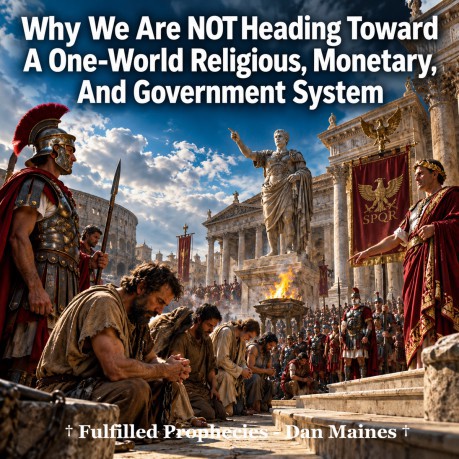
Why We Are NOT Heading Toward
A One-World Religious, Monetary, And Government System
By Dan Maines
Introduction
†
For generations, Christians have been warned that the world is moving
toward a single government, a single religion, and a single monetary
system controlled by the Antichrist. Every new development in
technology, banking, international politics, or religious cooperation
is presented as another sign that the end is approaching.
†
We're told that digital currency will become the mark of the beast,
international organizations will establish a one-world government,
and religious leaders will unite under a false prophet. But where
does Scripture actually teach that these events must happen in our
future?
† The answer begins by understanding
when Revelation was written, whom it addressed, and when its
prophecies were expected to be fulfilled. Jesus and His apostles
consistently placed the fulfillment of these events within the first
century, not thousands of years later (Matthew 24:34; Revelation
1:1-3).
† The fulfilled perspective doesn't
deny that governments can become oppressive, financial systems can
restrict freedom, or religious institutions can become corrupt. It
recognizes that these modern developments aren't the fulfillment of
prophecies that belonged to the first-century world.
†
We must allow Scripture to interpret Scripture rather than allowing
modern headlines to determine what prophecy means (Luke 21:20-22;
Revelation 22:6-10).
Revelation Was About Things That
Were Near
Revelation 1:1, 3
The Revelation of
Jesus Christ, which God gave Him to show to His bond-servants, the
things which must soon take place; and He sent and communicated it by
His angel to His bond-servant John,
Blessed is he who reads and
those who hear the words of the prophecy, and heed the things which
are written in it; for the time is near.
†
John didn't announce events that would begin thousands of years after
his readers died. He said the things revealed to him must soon take
place. The time was near for the seven churches receiving his message
(Revelation 1:4; 22:6).
† The words soon and
near established the time frame for the entire prophecy, including
the beast, false prophet, Babylon, and the judgment described
throughout Revelation (Revelation 1:1-3; 22:6-10).
†
If the mark of the beast, the religious deception, and the economic
restrictions belong to Revelation's prophecy, they must be understood
within the time frame John established (Revelation 13:16-18;
22:10).
† We can't move these events into the
twenty-first century simply because modern technology resembles
certain descriptions in Revelation (Revelation 1:1-3).
Jesus
Identified The Generation Of Fulfillment
Matthew 24:34
Truly
I say to you, this generation will not pass away until all these
things take place.
† Jesus placed the
fulfillment of His prophetic warnings within the generation standing
before Him. He wasn't describing a generation living thousands of
years after His disciples (Matthew 23:36; 24:1-3).
†
The destruction of Jerusalem and its temple in AD 70 fulfilled His
warnings concerning the end of the Old Covenant age. That judgment
didn't require the destruction of the physical planet (Matthew
24:1-3, 34; Hebrews 8:13).
† The same
first-century time frame must guide our understanding of Revelation.
Jesus didn't give one generation a warning and secretly reserve its
fulfillment for another generation thousands of years later (Luke
21:20-22, 32).
† That's why we shouldn't
interpret modern international developments as evidence that Jesus'
first-century warnings remain unfulfilled (Matthew 24:34; Luke
21:22).
The Beast Was A First-Century Imperial
Power
Revelation 13:1, 7
And the dragon stood on
the sand of the seashore. Then I saw a beast coming up out of the
sea, having ten horns and seven heads, and on his horns were ten
diadems, and on his heads were blasphemous names.
It was also
given to him to make war with the saints and to overcome them, and
authority over every tribe and people and tongue and nation was given
to him.
† The beast represented an imperial
power that opposed God and persecuted His people. From the fulfilled
perspective, the sea beast identifies Rome's imperial authority
during the first century (Daniel 7:7, 23; Revelation 13:1-7).
†
Rome controlled a vast empire containing many nations, languages, and
peoples. Its authority extended throughout the Mediterranean world,
where the early churches were established (Luke 2:1; Acts 11:28).
†
The language describing authority over every nation doesn't require a
future government controlling every person on the planet. Biblical
prophecy frequently uses universal language when describing the
dominant empires of the ancient world (Daniel 2:39-40; 7:23).
†
Rome's emperors claimed extraordinary authority, received divine
honors, and demanded loyalty. Christians who confessed Jesus as Lord
faced opposition because their allegiance belonged to Christ (Acts
17:6-7; Revelation 13:7).
† The beast wasn't
a prediction of a future United Nations, European Union, or
international political organization. It represented the imperial
opposition confronting the first-century church (Revelation 13:1-7;
17:9-10).
The Number Of The Beast Identified A
Man
Revelation 13:18
Here is wisdom. Let him who
has understanding calculate the number of the beast, for the number
is that of a man; and his number is six hundred and sixty-six.
†
John expected his original readers to exercise wisdom and calculate
the number. He didn't instruct them to wait thousands of years for
computers, digital identification, or electronic banking (Revelation
13:18).
† The number identifies a man within
the beast's historical setting. A well-known fulfilled interpretation
associates 666 with Nero Caesar through the numerical values of the
Hebrew letters in his name (Revelation 13:18; 17:10).
†
Nero ruled Rome from AD 54 to AD 68 and became associated with the
persecution of Christians. His reign fits the first-century setting
of the beast's opposition to the saints (Revelation 13:5-7).
†
The calculation concerns a person's name, not a computer chip, bank
account, credit card, or digital currency. None of those modern
technologies is identified in the verse (Revelation 13:17-18).
The
Mark Of The Beast Was About Allegiance And Worship
Revelation
13:16-17
And he causes all, the small and the great,
and the rich and the poor, and the free men and the slaves, to be
given a mark on their right hand or on their forehead,
and he
provides that no one will be able to buy or to sell, except the one
who has the mark, either the name of the beast or the number of his
name.
† The mark must be understood within
the conflict between worshiping the beast and remaining faithful to
God. Revelation connects the mark directly with the beast's name and
worship (Revelation 13:12-18; 14:9-12).
† The
forehead and hand recall the covenant language used when Israel was
commanded to keep God's words before their eyes and upon their hands.
These expressions represented identification, thought, and conduct
(Deuteronomy 6:6-8; 11:18).
† Revelation also
describes God's servants receiving His seal upon their foreheads.
That seal identifies those belonging to God, just as the beast's mark
identifies allegiance to the opposing power (Revelation 7:3; 14:1).
†
The buying and selling restrictions describe economic pressure
connected with allegiance to the beast. Participation in the ancient
imperial world could involve pressure to honor its religious and
political authority (Revelation 13:12-17).
†
The passage doesn't say that the mark is a microchip, barcode,
electronic payment system, or digital currency. Those ideas are added
through modern speculation rather than established by John's words
(Revelation 13:16-18).
† Modern governments
may introduce digital identification or electronic financial systems,
but that doesn't make them the fulfillment of the beast's mark
(Revelation 1:1-3; 13:16-18).
The False Prophet Was Part
Of The Same First-Century Conflict
Revelation 19:20
And
the beast was seized, and with him the false prophet who performed
the signs in his presence, by which he deceived those who had
received the mark of the beast and those who worshiped his image;
these two were thrown alive into the lake of fire which burns with
brimstone.
† The false prophet supported the
beast by promoting deception and directing worship toward its image.
His activity belonged to the same prophetic setting as the beast and
its mark (Revelation 13:11-15; 19:20).
† In
the fulfilled interpretation, the land beast and false prophet
represent the religious authority that supported the first-century
imperial system and encouraged allegiance to its power (Revelation
13:11-17).
† The false prophet wasn't
introduced as the future leader of a worldwide religious
organization. His identity and actions were tied to the beast already
operating within Revelation's historical setting (Revelation 13:12;
19:20).
† Revelation describes the beast and
false prophet as judged. We shouldn't rebuild their prophetic system
thousands of years after the time John declared was near (Revelation
19:20; 22:10).
Babylon Was Not A Future Worldwide
Religious Headquarters
Revelation 17:9, 18
Here is
the mind which has wisdom. The seven heads are seven mountains on
which the woman sits,
The woman whom you saw is the great city,
which reigns over the kings of the earth.
†
Revelation uses Babylon as a symbolic name for a city characterized
by covenant unfaithfulness, persecution, and opposition to God's
people (Revelation 17:1-6; 18:24).
† The
seven mountains and authority over kings point toward Rome's imperial
setting. Yet Revelation's accusations against the great city also
identify Jerusalem as the covenantal focus of judgment (Revelation
11:8; 17:9, 18).
† Jerusalem was the city
where Jesus was crucified, where the prophets were rejected, and
where the blood of God's messengers was charged against that
generation (Matthew 23:34-38; Revelation 11:8).
†
From this fulfilled perspective, Babylon represents apostate
Jerusalem in its alliance with the Roman world, while the beast
represents Rome's imperial power (Revelation 17:3-6; 18:24).
†
The distinction matters because Revelation describes both religious
corruption and political power without requiring a future worldwide
religious headquarters (Revelation 17:1-6, 18).
Babylon's
Commerce Doesn't Predict A Global Cashless Economy
Revelation
18:3, 11
For all the nations have drunk of the wine of
the passion of her immorality, and the kings of the earth have
committed acts of immorality with her, and the merchants of the earth
have become rich by the wealth of her sensuality.
And the
merchants of the earth weep and mourn over her, because no one buys
their cargoes any more--
† Revelation
describes commercial wealth, merchants, political alliances, and the
collapse of a powerful city. These were familiar realities within the
ancient Roman economy (Revelation 18:3, 11-19).
†
The merchants mourned because the city's destruction ended their
profitable relationship with her. The prophecy concerned judgment
upon an existing commercial and religious order (Revelation
18:9-19).
† Nothing in this passage requires
the creation of a future worldwide central bank, a single currency,
or a universal electronic payment system (Revelation 18:11-19).
†
International trade existed long before modern banking. Revelation's
references to merchants and nations must be interpreted within its
original historical setting (Revelation 18:3, 11-19).
†
The destruction of Old Covenant Jerusalem in AD 70 brought the
judgment Jesus had announced against that generation. From the
fulfilled perspective, Babylon's fall belongs to that completed
covenantal judgment (Matthew 23:35-38; Luke 21:20-22; Revelation
18:24).
The Fourth Kingdom Was Already Identified In
Daniel's Prophecy
Daniel 7:23
Thus he said: The
fourth beast will be a fourth kingdom on the earth, which will be
different from all the other kingdoms and will devour the whole earth
and tread it down and crush it.
† Daniel's
vision described successive kingdoms, culminating in the fourth
kingdom that would oppose God's people before the kingdom was given
to the saints (Daniel 7:17-27).
† In the
traditional fulfilled interpretation, these kingdoms were Babylon,
Medo-Persia, Greece, and Rome. The fourth kingdom was Rome, the
empire ruling during Jesus' earthly ministry (Daniel 2:37-44; Luke
2:1).
† Daniel didn't describe a
two-thousand-year interruption before the fourth kingdom would
suddenly reappear as a modern global government. The prophetic
sequence concerned kingdoms leading to the establishment of Christ's
kingdom (Daniel 2:44; 7:13-14).
† Christ
received His kingdom and authority, and the first-century saints
witnessed the transition from the Old Covenant order into the
established New Covenant kingdom (Matthew 28:18; Hebrews 12:28).
†
There's no biblical requirement for Rome to return as a future
political empire before Christ's kingdom can be established. Christ
already reigns (Colossians 1:13; Revelation 1:5-6).
The
Antichrist Was Already Present In John's Day
1 John
2:18
Children, it is the last hour; and just as you
heard that antichrist is coming, even now many antichrists have
appeared; from this we know that it is the last hour.
†
John didn't say the last hour would begin thousands of years later.
He declared that it was already the last hour because many
antichrists had appeared (1 John 2:18).
† The
antichrist teaching concerned those denying the Father and the Son,
particularly those rejecting Jesus as the Christ. John identified
this deception within his own generation (1 John 2:22; 4:2-3).
†
Scripture doesn't identify a future president, pope, political
leader, or international official as a final Antichrist who must
control the entire planet (1 John 2:18-22).
†
The first-century church was already confronting the deception John
described. His words shouldn't be transferred into a future political
system when he explicitly identified their fulfillment in his own
time (1 John 2:18; 4:3).
The Old Covenant Was Already
Near Its End
Hebrews 8:13
When He said, A new
covenant, He has made the first obsolete. But whatever is becoming
obsolete and growing old is ready to disappear.
†
Hebrews identified the Old Covenant as obsolete and ready to
disappear. That language describes the approaching removal of the
covenantal system centered upon Jerusalem and its temple (Hebrews
8:13; 9:8-10).
† Jesus established the New
Covenant through His death and resurrection. The temple's destruction
in AD 70 publicly demonstrated that the former covenantal
administration had reached its end (Luke 22:20; Hebrews 9:11-15).
†
Revelation's judgment belongs within this transition. Its central
concern wasn't the creation of a future worldwide banking system, but
the judgment of the old order and the vindication of Christ's people
(Matthew 24:1-3; Revelation 11:1-2).
† The
New Covenant isn't waiting for another prophetic crisis before it
becomes complete. Believers already belong to Christ's kingdom and
have access to the heavenly Jerusalem (Hebrews 12:22-28; Colossians
1:13).
Christ's Kingdom Isn't A World Government
John
18:36
Jesus answered, My kingdom is not of this world.
If My kingdom were of this world, then My servants would be fighting
so that I would not be handed over to the Jews; but as it is, My
kingdom is not of this realm.
† Jesus
distinguished His kingdom from the political kingdoms of the world.
His authority doesn't depend upon armies, international institutions,
national borders, or earthly governments (John 18:36; Matthew
28:18).
† Christ's kingdom was established
through His redemptive work, not through the creation of a
centralized political system. His people belong to a kingdom that
cannot be shaken (Colossians 1:13; Hebrews 12:28).
†
Governments will continue to rise, change, cooperate, and fall. None
of those developments means Christ has lost control or that His
kingdom remains unfinished (Daniel 7:13-14; Ephesians 1:20-22).
†
The church doesn't need to fear that a future world government will
fulfill an unfinished prophecy. Christ already possesses authority
over every ruler and power (Matthew 28:18; Ephesians
1:20-22).
Revelation Explicitly Declared Its Fulfillment
Was Near
Revelation 22:6, 10
And he said to me,
These words are faithful and true; and the Lord, the God of the
spirits of the prophets, sent His angel to show to His bond-servants
the things which must soon take place.
And he said to me, Do not
seal up the words of the prophecy of this book, for the time is
near.
† Revelation closes with the same time
limitation established in its opening chapter. The things revealed to
John must soon take place because the time was near (Revelation
1:1-3; 22:6-10).
† Daniel was instructed to
seal his prophecy because its fulfillment belonged to a later
appointed time. John received the opposite instruction because his
prophecy concerned events approaching his own generation (Daniel
12:4; Revelation 22:10).
† We can't
reasonably interpret soon and near as thousands of years without
removing their ordinary meaning for the original readers (Revelation
1:3; 22:6-10).
† That's why the beast, its
mark, the false prophet, Babylon, and the associated judgments belong
to the first-century fulfillment rather than an unfinished prophetic
program awaiting modern technology (Revelation 13:16-18; 19:20;
22:6-10).
Historical References
†
Tacitus, writing in the early second century, described Nero's
persecution of Christians in Rome. His account confirms that
Christians faced imperial hostility during the first century, the
historical environment reflected in Revelation's warnings (Tacitus,
Annals 15.44; Revelation 13:7).
† Suetonius
recorded the reign of Nero and the punishment of Christians during
his administration. His testimony supports the historical reality of
Roman opposition to Christianity (Suetonius, Nero 16; Revelation
13:7).
† Josephus described Jerusalem's
destruction in AD 70, including the Roman siege, famine, internal
violence, and destruction of the temple. His account provides
important historical background for Jesus' warnings concerning
Jerusalem (Josephus, The Jewish War, Books 5-6; Luke 21:20-24).
†
Eusebius preserved early Christian traditions concerning the
suffering of believers and the destruction of Jerusalem. His writings
demonstrate that early Christians understood the city's destruction
as an event of enormous religious significance (Eusebius,
Ecclesiastical History 2.25; 3.5).
† These
historians don't establish every detail of the fulfilled
interpretation. They confirm that the Roman persecution, imperial
authority, and destruction of Jerusalem were real first-century
events rather than imaginary future scenarios (Matthew 24:34;
Revelation 13:7).
How It Applies To Us Today
†
Christians don't need to live in fear of every new technology,
banking development, international agreement, or religious gathering.
None of these developments automatically fulfills a prophecy that
Scripture placed within the first century (Revelation 1:1-3;
22:6-10).
† Digital currencies and electronic
payment systems may raise legitimate questions about privacy,
financial freedom, and government authority. Those concerns should be
evaluated on their actual merits rather than identified as the mark
of the beast without biblical evidence (Revelation 13:16-18).
†
International organizations may seek greater political cooperation,
but cooperation between nations doesn't prove that a prophetic
one-world government is approaching (Daniel 7:23-27; Revelation
1:3).
† Religious organizations may pursue
unity, but that doesn't automatically identify them as the false
prophet or Babylon. We must distinguish actual religious error from
prophetic speculation (1 John 4:1-3; Revelation 19:20).
†
The Bible doesn't promise that modern governments will never become
oppressive or that economic systems will never become centralized. It
teaches us to exercise wisdom without assigning fulfilled prophecies
to unrelated modern events (Romans 13:1-7; Revelation 22:10).
†
Our responsibility isn't to search for a future Antichrist, fear a
coming mark, or prepare for an unfinished judgment. Our
responsibility is to remain faithful to Christ, proclaim His
completed redemption, and live according to His New Covenant
(Colossians 1:13-14; Hebrews 12:22-28).
†
Jesus is already reigning. His kingdom has already been established,
and believers already have access to the heavenly Jerusalem. We
aren't waiting for a future worldwide religious, monetary, and
government system to complete what Christ has already fulfilled
(Ephesians 1:20-22; Hebrews 12:22-28).
† The
fulfilled perspective doesn't require us to predict the political
future of the world. It requires us to recognize that the prophetic
events described in Revelation belonged to the first-century world
and reached their covenantal fulfillment by AD 70 (Matthew 24:34;
Revelation 22:6-10).
Q & A Appendix
Q:
Does Revelation predict a future one-world government?
A:
No. From the fulfilled perspective, Revelation's beast represented
first-century Roman imperial authority, not a future worldwide
political organization (Daniel 7:23; Revelation 13:1-7).
Q:
Is digital currency the mark of the beast?
A:
No. The mark concerned allegiance to the beast and participation in
its system of worship. Scripture doesn't identify electronic currency
or modern banking technology as the mark (Revelation 13:12-18;
14:9-12).
Q: Could governments eventually
control buying and selling?
A: Governments can
impose financial restrictions, but that possibility doesn't establish
that Revelation 13 remains unfulfilled. The prophecy belonged to the
time John described as near (Revelation 1:3; 13:16-17).
Q:
Is the Antichrist a future world leader?
A:
John identified many antichrists already present during the last hour
of the first-century covenantal age. He defined their deception by
their denial of Christ, not by control of a future global government
(1 John 2:18-22).
Q: Will all religions
eventually unite under the false prophet?
A:
Scripture doesn't require a future worldwide religious organization
to fulfill Revelation. The false prophet belonged to the beast's
prophetic setting and was included in its judgment (Revelation
13:11-17; 19:20).
Q: Does Babylon represent a
future worldwide economic system?
A: No. In
this fulfilled interpretation, Babylon represented apostate Jerusalem
and its covenantal judgment, while the surrounding imperial and
commercial imagery reflected the first-century Roman world
(Revelation 11:8; 17:9, 18; 18:11-19, 24).
Q:
Does this mean international governments and financial institutions
can't become dangerous?
A: No. Political and
financial systems can become oppressive, but modern dangers don't
establish the future fulfillment of Revelation's first-century
prophecies (Romans 13:1-7; Revelation 22:6-10).
Q:
What should Christians be watching for today?
A:
We should remain faithful to Christ, exercise discernment, love one
another, and proclaim the gospel. We aren't waiting for another
prophetic fulfillment beyond AD 70 because Christ's kingdom has
already been established (Colossians 1:13-14; Hebrews 12:22-28).
†
This is the fulfilled perspective we proclaim at Fulfilled Prophecies
†
© Fulfilled Prophecies - Dan Maines.
Source
Index
† Revelation 1:1, 3; Matthew
24:34; Revelation 13:1, 7, 16-18; Revelation 19:20; Revelation 17:9,
18; Revelation 18:3, 11; Daniel 7:23; 1 John 2:18; Hebrews 8:13; John
18:36; Revelation 22:6, 10
† Tacitus, Annals
15.44; Suetonius, Nero 16; Flavius Josephus, The Jewish War, Books
5-6; Eusebius, Ecclesiastical History 2.25 and 3.5
Links